You Wouldn't Want to Live in an Ancient City
Modern romanticization of ancient Rome overlooks the grim reality: cramped fire-prone apartments, streets reeking of sewage, shared toilet sponges, chronic malnutrition, and zero worker protections made life miserable for ordinary citizens.
I have repeatedly noticed in online comments how people, upon seeing similarities between the past and the present, project their modern experience onto antiquity. With ancient Rome, this is especially easy because the height of the Roman Empire has been turned into a glossy media stereotype: bright and beautiful, but bearing little resemblance to reality.
The problem is largely that over the past 100 years, thanks to technological progress, our way of life (at least in first- and second-world countries) has changed so dramatically that most of my contemporaries simply have no relevant experience of living in conditions remotely like those of antiquity — or even of 100 years ago. Electricity alone radically transforms every aspect of daily life, and there are many such transformative technologies today. Urban life in our time bears almost no resemblance to life in Rome. Today, the standard of living of an ordinary citizen exceeds that of the ancient elite in most measurable parameters. Between our time and antiquity lies a true chasm in quality of life and comfort. So let us take a closer look at how people lived in "the greatest city on Earth" — Rome — and why you would not want to live there.
Naturally, we will be discussing ordinary people, not the elites — though we will touch on elite life briefly. After all, if we are going to make comparisons, we should compare with the average, not the best. And the average Roman lived in the "wonder of antiquity" — the insula.
The Insulae: Ancient Rome's Apartment Blocks
I have seen people express admiration more than once that Romans could build residential buildings of 5 to 9 stories. Indeed, from an engineering standpoint this was no trivial feat — but it was not exceptional either. The insula was a phenomenon born of the same root as modern high-density housing: the attempt to extract maximum profit from minimum territory. People flooded into cities for work. Public transportation had not been invented, the city was bounded by walls and by the practical limit of how far a resident could walk to work. So endless horizontal expansion was impossible, but vertical growth was not.
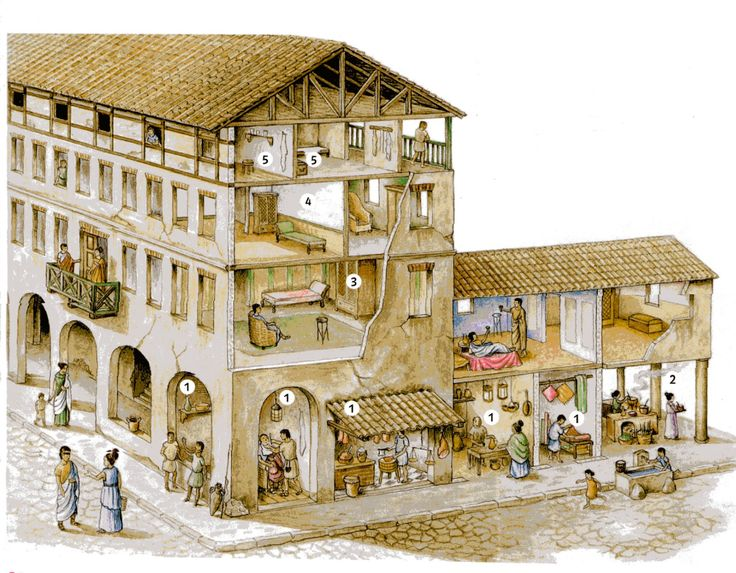
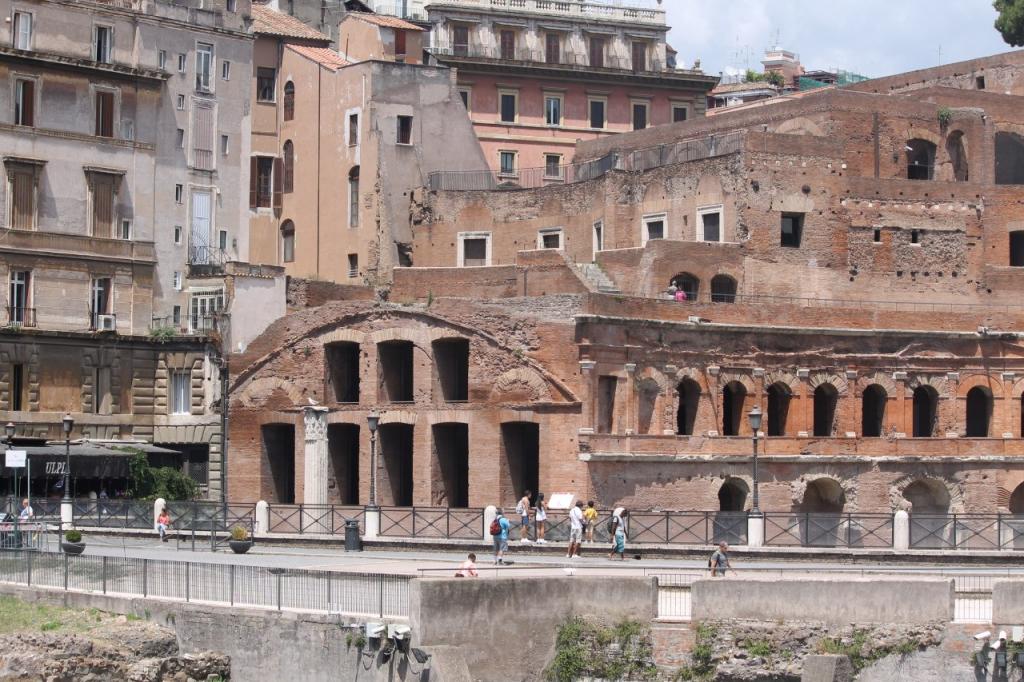
Insulae were Rome's answer to the question: "How do you house masses of people on minimal land?" These ancient tenements were purely commercial buildings, so they were constructed as quickly and cheaply as possible. Much of their structure was wood, which had an unfortunate tendency to rot, warp, and burn. Insulae were typically demolished every few decades, often after fires or collapses, and rebuilt from scratch.
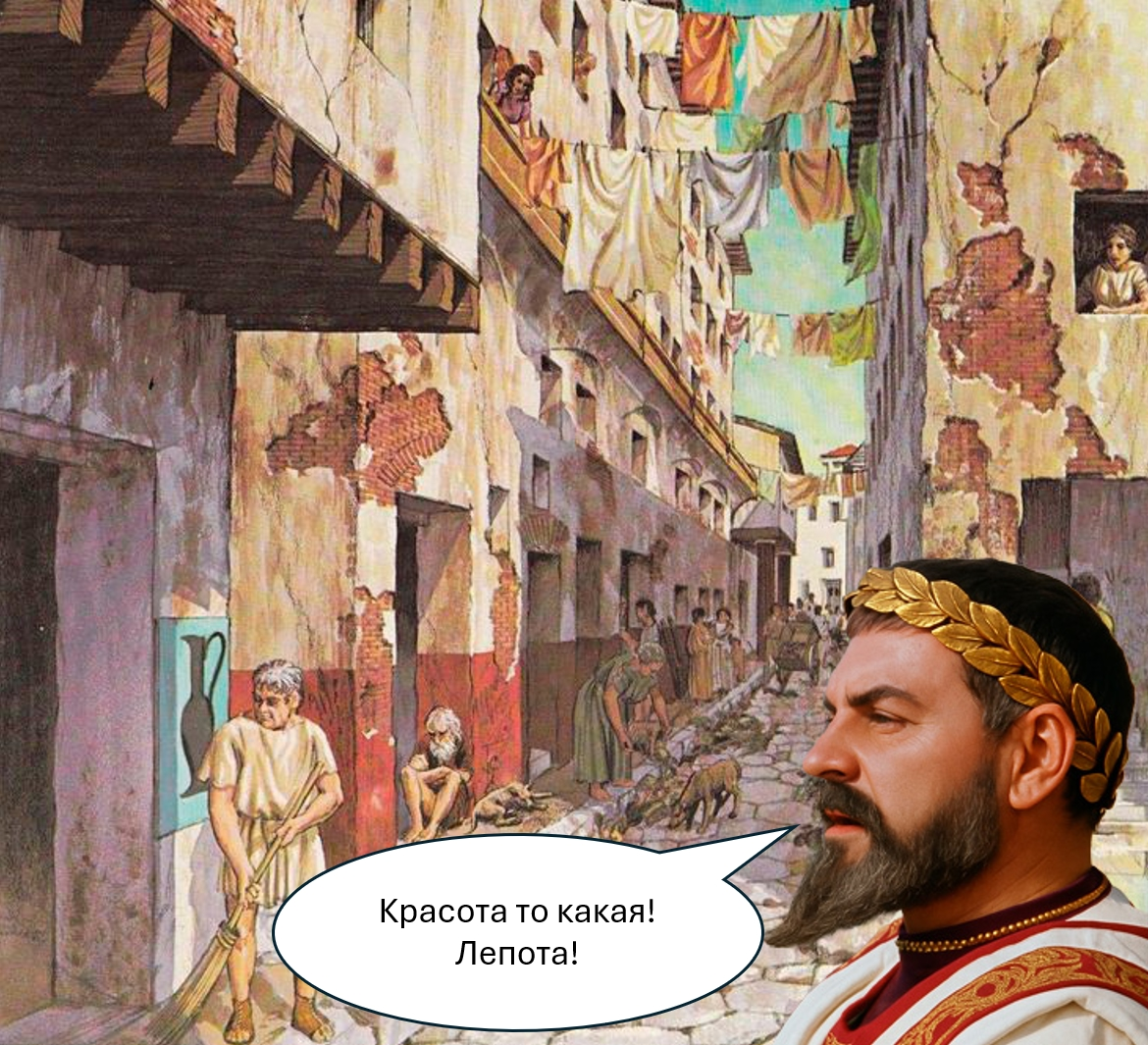
The ground floor was usually given over to shops and traders. The second floor was the most prestigious — elevators had not been invented, so it was the easiest to reach, and in case of fire (a very common occurrence), the quickest to escape from. Moreover, second-floor apartments could — though not always — boast running water, since water flowed by gravity and could only rise to a limited height. Average apartment size was 50 to 100 square meters. Naturally, such spacious quarters were extremely expensive and could only be afforded by the middle class or building managers.
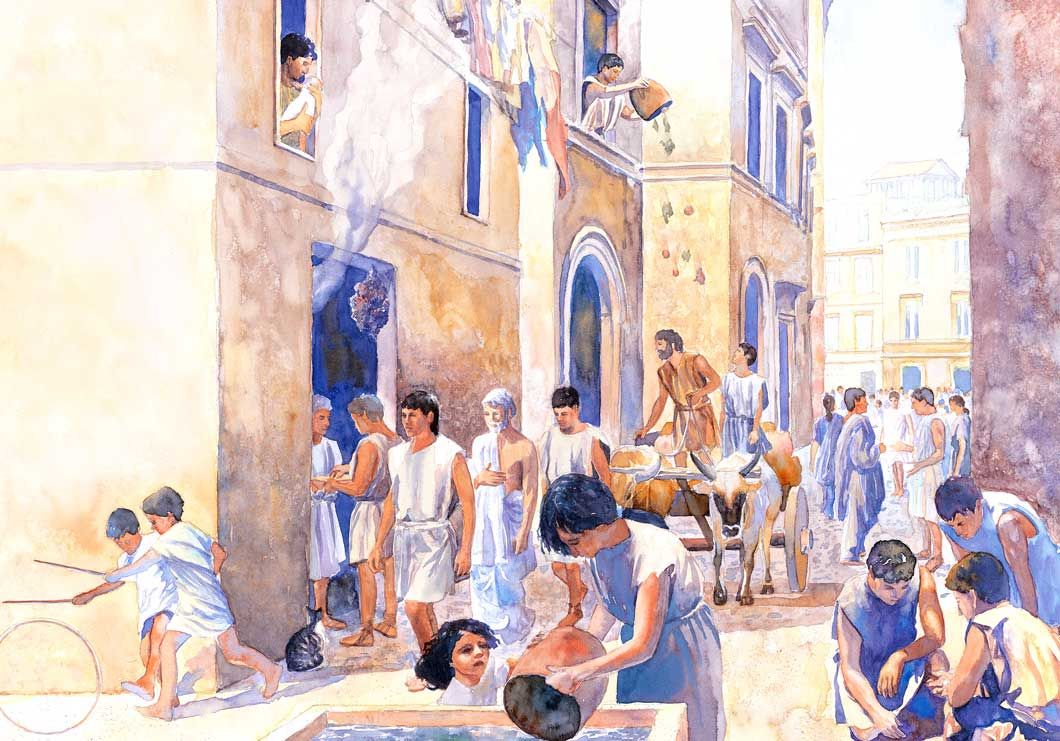
Even these relatively good apartments did not dazzle with luxury: decoration consisted of simple black-and-white floor mosaics and whatever personal possessions the owner chose to display. The higher the floor, the less prestigious and smaller the apartment. Upper floors were essentially communal apartments, with rooms divided by partitions and mats into individual cubicles. The higher you went, the more people were crammed in. Since there was no running water up there, apartments were rarely washed — water had to be carried up from the nearest public fountain.
Light, Heat, and Smoke
Lighting in insulae was primarily natural. Good artificial lighting was a privilege of the wealthy. The main sources of artificial light were oil lamps and candles, which were relatively cheap only in oil-producing regions like North Africa. As Saint Augustine noted, while even poor homes in Roman Carthage showed light at night, Rome itself greeted the darkness with unlit windows.
To let sunlight into rooms, all living spaces were arranged along exterior walls. Wealthier tenants on the second floor could afford glass; the poor made do with shuttered windows covered by netting or heavy curtains. Insulae were usually built close together, so rooms along the side walls had windows facing narrow alleys where sunlight was visible for only a few minutes a day.
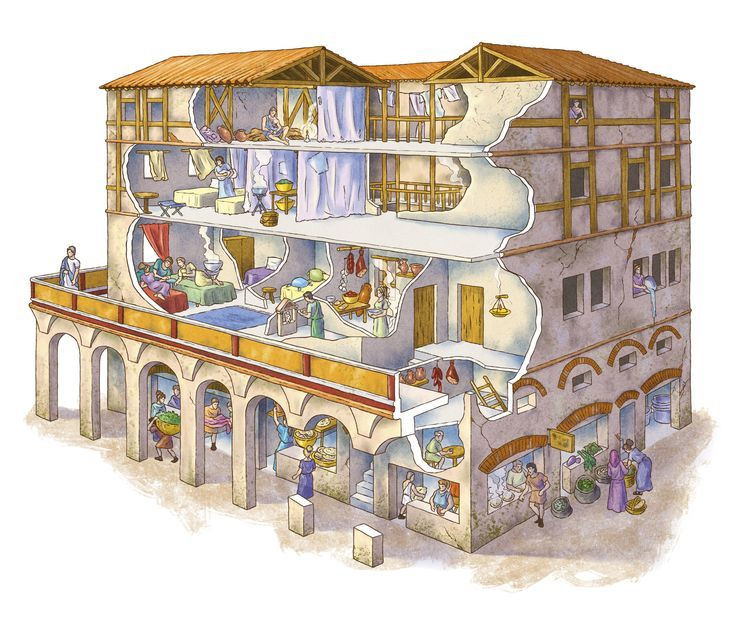
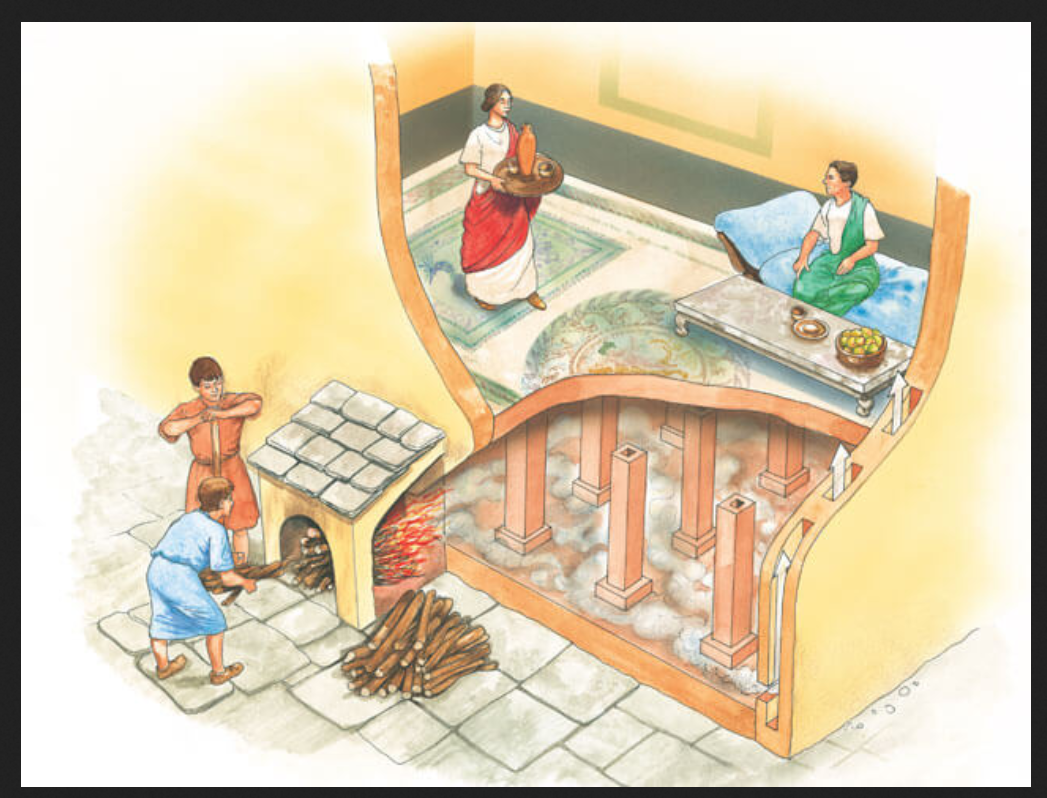
Since central heating had not been invented either, rooms were heated with braziers. The famous "heated floor" — the hypocaust — was an extremely expensive luxury available only to the rich, and it could only effectively heat the ground floor. Even in wealthy homes, braziers were still heavily used for comfort. Now imagine the dilemma of the poor in winter: to have light, you had to open the shutters, but then it was cold; close them, and it was dark. Food, when it was cooked at all, was prepared right there on the same brazier. Walls and ceilings quickly became coated in soot, making the rooms dark and unpleasant. And braziers were a common cause of fires in insulae.
Compared to the average dwelling of a not-wealthy Roman, a modern studio apartment in a high-rise looks like nothing less than a palace — it is clean, bright, spacious, with hot water, sewage, and electric lighting that provides as much light as daytime. By modern standards, the upper floors of insulae would look like a typical derelict squat: dirty, dark, smelling of something unpleasant. Yet insulae apartments and modern studio apartments are housing of roughly the same price category, adjusted for their era. The difference is colossal. Today we spend a huge portion of our time at home because it is comfortable. Ordinary Romans spent most of their day anywhere but home.
The Smell
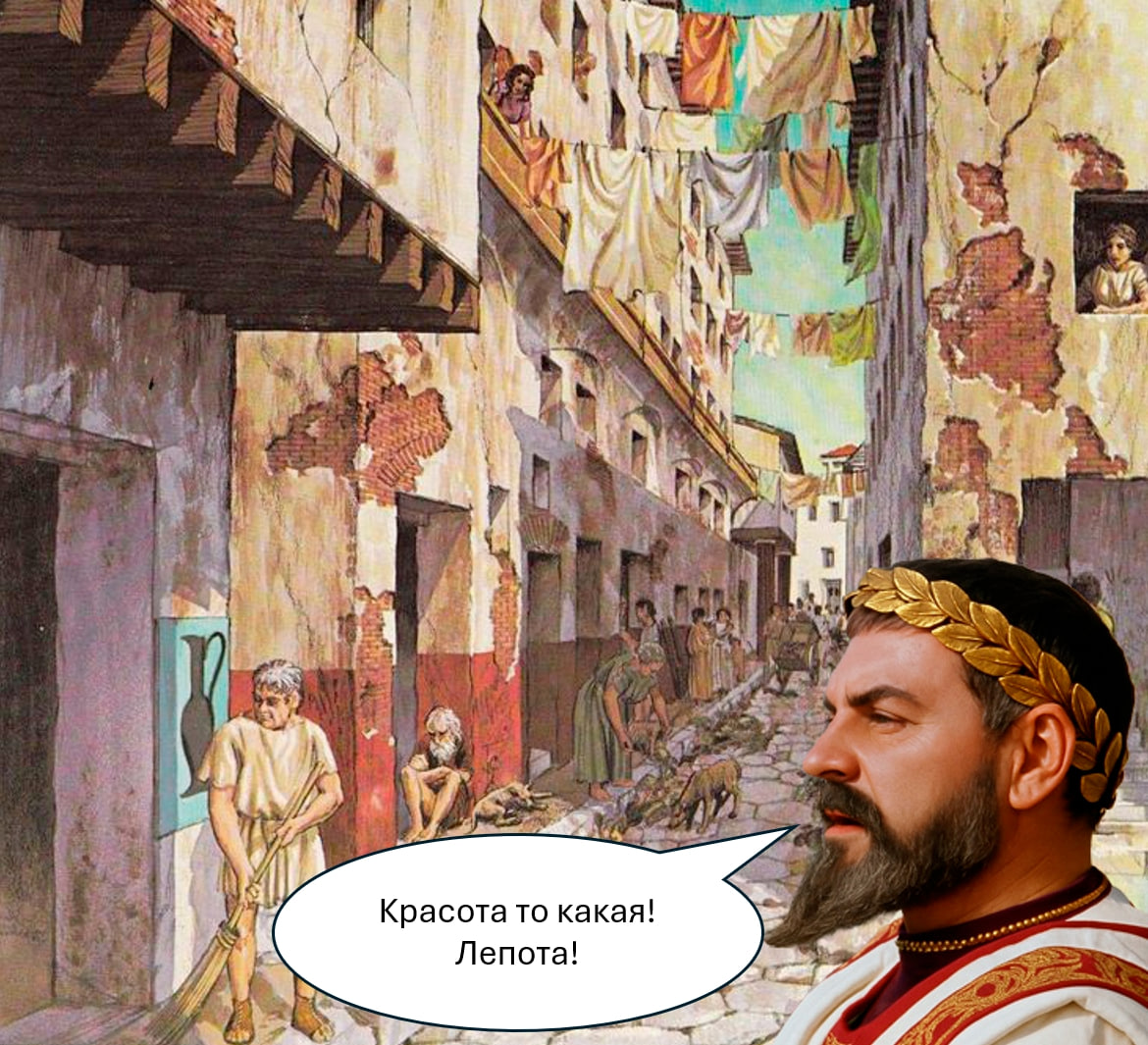
Another distinctive feature was the smell. Romans were used to it, but to us an ancient city would have smelled decidedly unpleasant. There was no sewage system in the modern sense. Rome's sewage system (including the famous Cloaca Maxima) was really an oversized storm drain. It was created because the city center (the Forum and surrounding area) sat in a low-lying area that was regularly flooded by the Tiber and by rainstorms. So drainage was built, which over time came to carry away excess aqueduct water and the contents of public latrines and baths. Wealthy homeowners could also connect to the sewer, but at great expense.
Everyone else was expected to use a chamber pot at home and then find somewhere to empty it. Insulae often had urine collection vessels on the ground floor — the urine was put to practical use. Similar vessels stood at some street intersections, as archaeologists discovered in Pompeii. The law prohibited dumping chamber pot contents onto the street, but this did not stop residents from doing so constantly.
Roman concepts of sanitation were extremely primitive. After eating, it was normal practice to toss food waste and leftovers onto the floor or the street pavement. In homes, trash was usually cleaned up quickly; on the streets, it was not. Cities in antiquity had designated people who collected and carted away street refuse, but they did not work around the clock or even daily. On a summer day, considerable food waste could accumulate on the streets, beginning to reek in the heat and attracting swarms of flies. Add to this the slops poured from houses. A lingering stench of filth was the normal companion of cities, especially in summer.

Hygiene and Disease
Where there is filth, there is disease — especially since Roman ideas about hygiene were also at an extremely rudimentary level. Remember the urine collected from insula residents? It was used for laundering clothes. Urine was also used as a mouth rinse (one hopes they used their own), since it was believed to be beneficial and to whiten teeth.
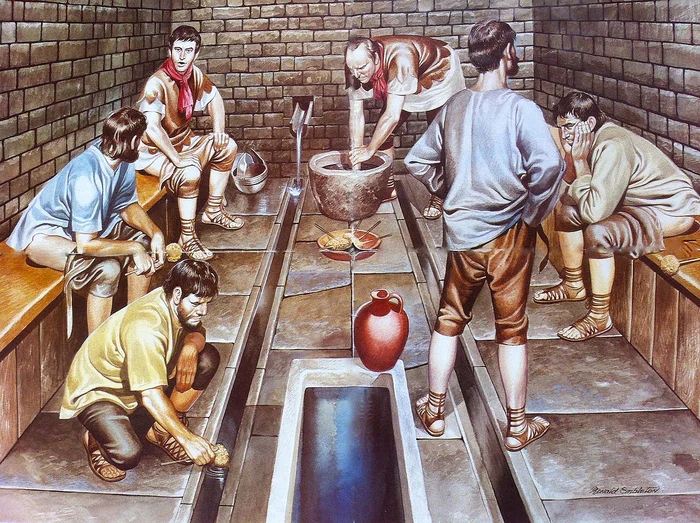
Romans saw no threat in other people's bodily fluids, so they thought nothing of a barber cleaning his blade with his own saliva. In public latrines, everyone had to wipe with the same sponge on a stick — though at least it was soaked in vinegar or rinsed in running water between uses. Some religious ceremonies required participants to be smeared with animal blood. Of course, people tried to wash off the dirt. But simply washing one's hands or changing from street clothes into house clothes was considered unnecessary.
Moreover, in an era before refrigeration, food storage — especially meat — was extremely problematic. Since meat itself was expensive, people ate even what had begun to smell.
You can understand that with these conditions and dense populations, cities were ideal breeding grounds for epidemics. But the medical knowledge of the era provided no means to fight them. The best advice when sick was to pray to the gods and make a sacrifice. Sometimes it even helped. More often it did not. Even a common cold, trivial today, could easily kill through complications before modern medicine. And influenza cut down populations far more effectively than our COVID. Before disease, all were equal — rich and poor alike — since the gap in medical quality was minimal. Dying from tetanus or a snakebite was also an ordinary event, since no treatments existed. Even a glass of cold water on a hot day could cause serious problems.
Food and Hunger
Archaeologists note that nearly all bones of ancient Rome's inhabitants show signs of repeated illness or malnutrition. The latter was a scourge of antiquity. The city of Rome required colossal quantities of food daily and was entirely dependent on external supply. Any disruption to deliveries immediately drove up prices, making food even more inaccessible. Such disruptions were so regular that the authorities were forced to create an alimentary system to feed the poor, who numbered up to 400,000 — as much as a third of the population. But state distributions provided only the bare minimum to avoid starvation.
As archaeologists also note, many Romans apparently ate poorly. Despite the absence of artificial additives, the poor had access mainly to the cheapest and most monotonous food: bread, grain porridge, seasonal vegetables and fruits, and mediocre wine. Malnutrition was the eternal companion of cities of the past. And most horrifying of all — even laborers who toiled from dawn to dusk apparently went underfed.
Work and Old Age
Such pleasant concepts as vacation, sick leave, pensions, labor legislation, and the regulated workday are all inventions of modernity. In imperial Rome, pensions were available only to senior officials and were more a token of imperial gratitude than a necessity — since the aristocrats who entered government service often took the job purely to satisfy personal ambition.
For ordinary people, work was the only way to secure food and a roof over their heads. The latter is not a figure of speech: most of Rome's population did not own their living space and rented apartments. Without money, a person quickly ended up on the street, sometimes beaten as an added warning. So without work, there was no life.

Labor in antiquity was primarily physical. White-collar workers were few, and such positions usually went either to educated slaves or to members of the upper classes — the necessary education was prohibitively expensive. So the path for most city dwellers was daily physical labor, in all conditions, even at the risk of injury. Although injuries were best avoided entirely — there were no benefits, and an unemployed person had no source of money.
And if you lost your ability to work entirely — through injury or old age — things looked grim. If you had no relatives willing to help, you were homeless. And if you were not on the lists for bread distributions, you were homeless with no means of survival. At that point, the only option was to beg for alms and hope you could hang on long enough.
Conclusion
So life in imperial Rome for most of its inhabitants was no picnic. Historians suggest that some sense of what it was like can be found today in the poor quarters of India or African countries. And even there, the population has access to relatively modern medicine and communications, which already significantly improves quality of life. But I would not want to live even in those conditions. And certainly not in ancient Rome. I think you would agree.
Author: Vladimir Gerasimenko