What the Internet Would Look Like If Adobe Hadn't Killed Flash
A deep dive into Flash's rise and fall, examining how the internet might have evolved differently if Adobe had continued developing the technology instead of abandoning it in favor of open web standards.
Flash. For millions of internet users, this word evokes memories of browser games, animated banners, interactive websites, and YouTube's early days. For an entire generation, Flash was the internet. But in 2020, Adobe officially pulled the plug on the technology that had shaped the web for over two decades.
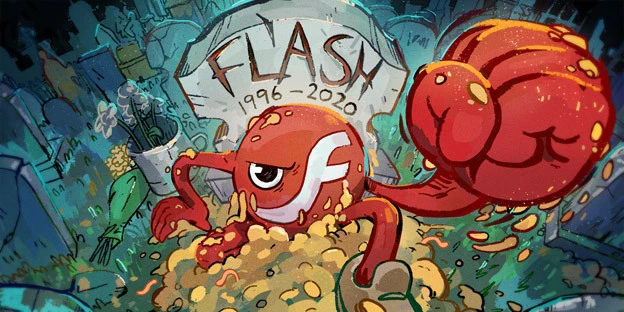
What if that hadn't happened? What if Adobe had continued developing Flash, fixing its problems, and adapting it to a mobile world? Let's explore an alternate timeline.
The Rise of Flash: From FutureSplash to Global Domination
It all started in 1996, when a small company called FutureWave Software released FutureSplash Animator — a tool for creating vector animations on the web. Macromedia quickly acquired it and rebranded it as "Flash." Later, in 2005, Adobe purchased Macromedia, beginning the "Adobe Flash era."

Flash's key advantages were revolutionary for its time:
- Vectorized animations compressed to kilobytes rather than megabytes
- ActionScript evolved from a simple animation controller into a sophisticated programming language with full OOP capabilities
- ActionScript 3 (2006) introduced compiled bytecode execution via the AVM2 virtual machine
- Hardware acceleration arrived via Stage3D in Flash 11, enabling GPU-accelerated 3D graphics
- Sophisticated browser games became possible with near-desktop quality

By 2009, Flash Player was installed on approximately 99% of internet-connected desktop computers. YouTube, Hulu, and Vimeo all relied on Flash for video playback using the RTMP protocol.
The Turning Point: Steve Jobs vs. Flash
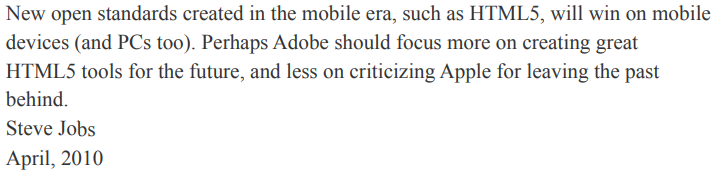
On January 29, 2010, Steve Jobs published his famous open letter "Thoughts on Flash," criticizing the technology as "proprietary and outdated." Apple refused to support Flash on iPhone and iPad, and this decision fundamentally shifted industry sentiment.

In November 2011, Adobe officially abandoned mobile Flash development. By 2018, only 5% of websites still used Flash. On December 31, 2020, Adobe officially discontinued all support.
The Real Problems: Not Just Apple Politics
Flash wasn't merely displaced by competition. It had genuine architectural problems:
- Security vulnerabilities: Eight of the ten most actively exploited internet vulnerabilities involved Adobe Flash. Hundreds of critical CVEs were discovered over the years.
- Performance drain: Flash consumed significant CPU resources, which was especially problematic on mobile devices with limited battery life.
- Memory management: The MMgc memory management library allocated memory in 4KB blocks using conservative reference counting, causing full application pauses during garbage collection cycles.

Alternate Reality: What If Flash Had Survived?
Now let's imagine an alternate timeline where Adobe invested billions into fixing Flash's problems and continued its development.
Browser Gaming Would Be Completely Different
Flash would have remained the dominant browser gaming platform. Unity WebGL and WebAssembly would occupy much smaller niches. Stage3D's GPU acceleration would have continued evolving, and Adobe AIR would enable packaging Flash games as native desktop and mobile applications. Flash Lite could have evolved into a full-featured Android gaming alternative.
Video Streaming: RTMP as the Standard

RTMP could have become a comprehensive video delivery standard rather than serving only as an ingestion protocol. Today, RTMP is still used for pushing streams to servers, but playback uses HLS with 10-30 second latency. A continued Flash ecosystem could have delivered near-real-time streaming with latency of just a few seconds. RTMFP, Flash Media Server's peer-to-peer protocol, might have filled WebRTC's eventual role in video conferencing and P2P applications.
ActionScript: The TypeScript That Came First

ActionScript 3 was one of the most advanced frontend languages of the mid-2000s, featuring strict typing and compiled bytecode execution. It was essentially what TypeScript became in 2012, but years earlier. In our alternate timeline, ActionScript could have accelerated the adoption of typed JavaScript, potentially making TypeScript unnecessary entirely.
Enterprise Development: Flex Framework Lives On

The Flex Framework built complete browser-based enterprise applications on ActionScript. In our alternate timeline, it would have continued evolving, saving companies from the endless cycle of rewriting interfaces — from jQuery to Angular to React to whatever comes next.
Mobile: Adobe AIR's Unfulfilled Promise
Adobe AIR allowed packaging Flash applications as native programs for Android and potentially iOS. Had Flash survived, AIR could have become a serious cross-platform development tool, competing with what React Native and Flutter do today.
So What Did We Lose?

The death of Flash allowed the internet to become faster, more secure, and more standardized. HTML5, CSS3, and JavaScript matured into a capable platform. But the web lost something too — a certain visual character, a creative freedom, a playfulness that defined the internet of the 2000s.
Flash Is Dead, But the Ecosystem Lives

For those feeling nostalgic, Flash content hasn't entirely disappeared. Newgrounds has integrated the Ruffle emulator, allowing you to play thousands of classic Flash games directly in your browser. The Internet Archive also maintains a massive collection of Flash games and animations.

Conclusion
Flash's death was probably inevitable — its architectural problems were real, and the open web standards were gaining momentum. But it's fascinating to imagine an alternate history where Adobe took a different path. The internet we have today is objectively better in many ways. But every time you encounter a laggy, JavaScript-heavy web app that takes 10 seconds to load, remember: Flash could render a complete interactive experience in under a megabyte.