What If the Sun Disappeared?
A detailed scientific thought experiment exploring what would happen to Earth and humanity if the Sun were to suddenly vanish — from the first 8 minutes of blissful ignorance to the long-term collapse of ecosystems and civilization's last refuges near geothermal vents.
In one terrible moment, the Sun — our star — simply ceased to exist. Vanished without a trace. No explosion, no collapse into a black hole, no warning. Just gone. What would happen next?
Light travels from the Sun to Earth for eight minutes. Eight minutes and twenty seconds. During this time, we would know nothing. People would continue going about their daily lives — commuting to work, drinking their morning coffee, scrolling through their phones — completely unaware that the source of all life on our planet had already disappeared.
Mercury and the Fabric of Spacetime
But let us start from the beginning — from the planet closest to the Sun. Mercury orbits at a distance of just 58 million kilometers. Scientists had long noticed that Mercury's orbit does not behave exactly as Newton's laws predict. It was Einstein who calculated the discrepancy: an extra forty-three arcseconds per century in Mercury's orbital precession. This was one of the first confirmations that spacetime near massive objects is curved.
When the Sun vanishes, gravity does not disappear instantaneously. From the now-empty center, a spherical wave races outward at the speed of light — a gravitational wave announcing that there is nothing left to orbit. Mercury, being closest, would be the first to know. Within about three minutes, it would be flung from its orbit into the void of space.
The First 8 Minutes and 20 Seconds
On Earth, nothing has changed yet. The last photons from the Sun are still racing toward us. People on the dayside see a perfectly normal sky. The planets continue their dance as if nothing has happened — because, from their perspective, nothing has. Not yet.
Then the wave of darkness arrives.
The Moment of Darkness
On the dayside of Earth, the Sun simply winks out. One moment it is there, the next — total darkness. Not like a sunset, not like an eclipse. Absolute, instantaneous blackness. Cars on the roads plunge into darkness as if entering a tunnel with no end. Planes in the air lose all visual reference.
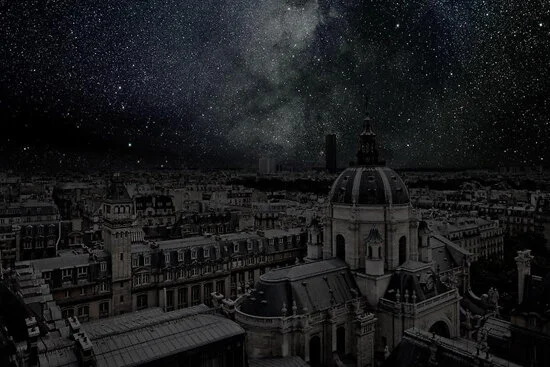
The nightside of Earth notices nothing at first. But within minutes, the Moon — which merely reflects sunlight — also goes dark. The familiar glow vanishes from the sky, leaving only the cold pinpoints of distant stars.
The First Hours
Panic spreads faster than any official announcement can contain it. Power grids experience massive shock as millions simultaneously switch on every light they can find. Solar power installations — a growing share of global energy — produce exactly zero. Wind patterns, driven by solar heating, begin to weaken.
Satellites start failing as their solar panels produce no power and batteries drain. GPS signals degrade. Communication satellites go dark one by one. Animals across the world are thrown into confusion — birds that navigate by the Sun become disoriented, nocturnal creatures emerge into a permanent night that offers no dawn.
The temperature begins to drop. Not dramatically at first — Earth's atmosphere and oceans hold enormous thermal energy. But the trend is unmistakable: roughly 5 degrees Celsius in the first day alone.
The First 24 Hours
Governments activate emergency protocols. Martial law is declared in most countries. Energy systems switch to survival mode — fossil fuel plants ramp up, nuclear reactors become the most valuable assets on the planet. Every watt counts now.
The atmospheric circulation that drives our weather begins to falter. Without the Sun's uneven heating of the Earth's surface, the great convection cells that create trade winds and jet streams start to lose their energy source. Weather as we know it begins to die.
Widespread deaths occur from hypothermia, stress, and accidents in the darkness. Hospitals are overwhelmed. Society begins to fragment as people realize this is not a temporary blackout.
The First Week
Temperatures have now fallen below freezing across most of the planet's surface. The oceans, with their vast thermal mass, remain liquid, but a thin crust of ice begins forming on lakes, rivers, and eventually coastal waters.
All photosynthesis has ceased. Plants are consuming their stored energy reserves but producing nothing new. The oxygen in our atmosphere is finite — though at current levels, it would take thousands of years to fully deplete, the psychological impact of knowing it will never be replenished is devastating.
One Month
The surface temperature has plummeted to minus 18 degrees Celsius and continues falling. The biosphere is in full collapse. Forests stand frozen and dead. Animals that have not found shelter have perished. The oceans are beginning to freeze from the surface down.
Surviving humans have clustered around heat sources: geothermal vents, nuclear power plants, underground bunkers with fuel reserves. Small communities form around these islands of warmth, rationing food and fuel with desperate precision.
One Year
The average surface temperature has dropped to roughly minus 70 degrees Celsius. The atmosphere itself is beginning to change — water vapor has long since frozen out, and carbon dioxide is approaching its freezing point. A thin layer of dry ice begins to form on the surface.
The oceans are frozen solid at the surface, but deep below — heated by Earth's own internal warmth and the residual heat stored in the water — liquid water persists. Near hydrothermal vents on the ocean floor, entire ecosystems of bacteria, tube worms, and bizarre fish continue living, completely indifferent to the catastrophe above. They never needed the Sun anyway.
The Last Refuge
At the foot of an old volcano, where the Earth still holds its own warmth, a small community endures. They have built their shelters over geothermal vents, tapping the planet's internal heat for warmth and energy. Greenhouses lit by artificial lights grow meager crops. Nuclear reactors nearby provide electricity.
Children born into this world have never seen the Sun. They learn about it from stories — a brilliant disk in the sky that once made everything green and warm. They study old photographs of blue skies and sunlit meadows as if they were images from an alien world.
Life goes on. Diminished, fragile, clinging to the thin warmth that rises from the Earth's core. Humanity survives — not as the dominant species of a sunlit world, but as a small, stubborn colony huddled around the last sources of heat on a frozen, wandering planet.
The Sun is gone. But we remain.