About Ultrasonic Knives: The Physics of Cutting
What happens when a knife blade vibrates tens of thousands of times per second? This article traces ultrasonic cutting from the Curie brothers' piezoelectric discovery through industrial applications in electronics, medicine, and food processing — all the way to consumer kitchen knives and DIY 3D-printing tools.
When we cut something with a knife, we move the blade across the surface. To cut faster, we increase the speed. So what happens when that speed reaches ultrasonic frequencies — tens of thousands of oscillations per second? And why does it matter?

A Brief History
The story begins in 1880, when Pierre and Jacques Curie discovered the piezoelectric effect: mechanical stress applied to certain crystals generates an electrical charge. In 1881 they found the reverse: apply an electrical current and the crystal deforms mechanically. This meant that if you supply an alternating current at the right frequency, a piezoelectric material will vibrate.
For decades, the discovery remained largely theoretical. In the 1920s, American physicist Robert W. Wood investigated what ultrasound does to materials — but he was doing fundamental physics, and the piezoelectric materials available to him were too weak for practical applications. Quartz crystals, the best option at the time, produced a relative elongation of just 0.001%.
The breakthrough came thirty years later, with advances in materials science. Barium titanate achieved 0.1% elongation. PZT (lead zirconate titanate) ceramics reached 0.15% — enough to generate powerful, controlled ultrasonic oscillations. Practical ultrasonic cutting technology emerged in the 1950s and 1960s, with multiple countries conducting parallel research simultaneously.
One of the early drivers was microelectronics. Semiconductor wafers needed to be cut cleanly and precisely, but the available methods — scoring with a diamond stylus and snapping, as with glass — were expensive, wasteful, and left rough, chipped edges. Ultrasonic cutting offered something new: a clean, controlled cut through brittle materials that conventional tools could not handle without causing fractures. It was one of the enabling technologies of the semiconductor industry.
How Ultrasonic Cutting Works
The principle is the same whether the application is a surgical scalpel or a kitchen knife. A piezoelectric transducer — a stack of ceramic rings bonded to a horn-shaped waveguide — converts electrical energy into mechanical vibration. This vibration travels through the horn and concentrates at the tip, where the blade is attached. The blade oscillates back and forth by 10–20 micrometers at frequencies typically between 20 and 60 kHz.
At these amplitudes and frequencies, the effective cutting speed at the blade tip is very high, even though the visible motion of the blade is imperceptible to the naked eye. The result: dramatically reduced cutting force, cleaner cuts, and the ability to handle materials that would deform, fray, or fracture under conventional blade pressure.
Industrial Applications
Electronics manufacturing: Cutting semiconductor wafers, substrates, and components is a standard application. Ultrasonic dicing became the industry norm because it produces clean edges without the chipping or cracking that diamond scribing caused.
Composite materials: Carbon fiber and fiberglass are notoriously difficult to cut cleanly. Conventional blades cause delamination and fraying at cut edges. Ultrasonic cutting eliminates both problems.
Food processing: Sticky, brittle, or delicate food products — cheeses, chocolates, confectionery — can be cut without compression, smearing, or crumbling. The blade passes through rather than pushing through.
Textiles: Ultrasonic cutting seals synthetic fabric edges at the same time as cutting, preventing fraying entirely. The technology can also weld non-woven synthetic materials together through localized melting — replacing thread in some applications. Chinese suppliers sell ultrasonic sewing machines that look like ordinary domestic machines but use this principle; prices start around 150,000 rubles.
Medical Applications
Bone surgery: Ultrasonic bone saws make extremely fine cuts with minimal damage to surrounding soft tissue. The oscillation frequency is selective: rigid bone absorbs the energy and fractures, while soft tissue flexes with the blade and is not cut. This selectivity makes ultrasonic instruments far safer than conventional saws in delicate anatomical locations.
Phacoemulsification: Invented in 1967, this technique revolutionized cataract surgery. A titanium tip vibrating at ultrasonic frequency is inserted through a tiny incision and used to fragment the clouded lens of the eye, which can then be aspirated out. Before this invention, cataract removal required a large incision and extensive recovery. Today it is a routine outpatient procedure.
Cast removal: Medical oscillating saws (technically sub-ultrasonic, operating up to around 500 Hz) exploit the same selectivity principle. The blade reciprocates a few millimeters at high frequency. Rigid plaster follows the oscillation and fractures; soft skin and tissue flex with the blade and are unharmed. A surgeon can cut through a plaster cast to the skin in one pass — something that looks alarming the first time you see it, but is entirely safe.
Consumer Ultrasonic Knives
The obvious question eventually occurred to entrepreneurs: why isn't this in every kitchen?
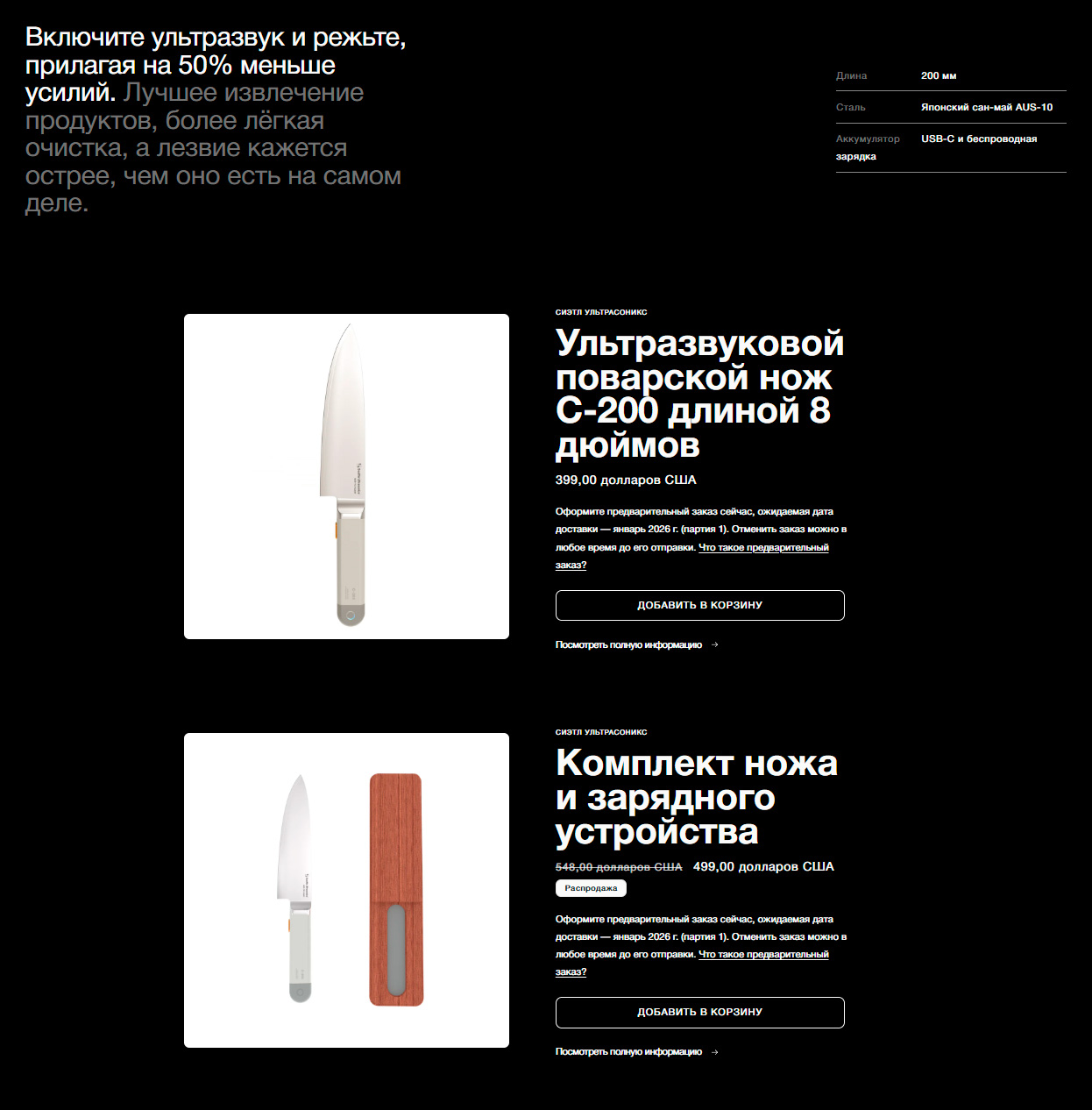
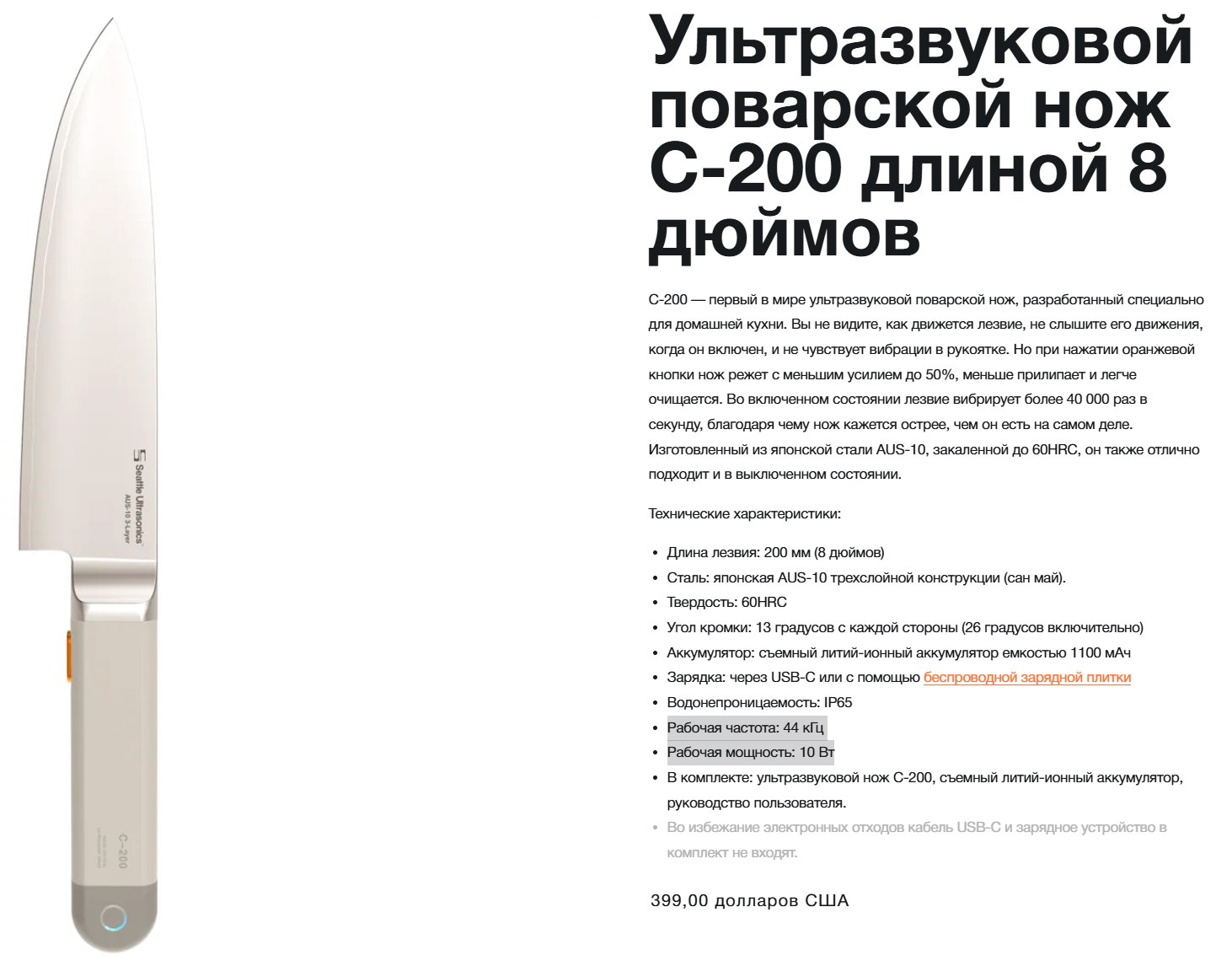
Seattle Ultrasonics (USA, ~2017–2018): Founded by Scott Heimdiniger, who spent 15 years developing the concept. The product: an 8-inch (20 cm) chef's knife with an integrated ultrasonic system. The blade vibrates at 44 kHz, consuming 10 watts. The claimed benefit: 50% reduction in cutting force required. The blade is mounted on a cylindrical tang inside the handle, which contains a stack of piezoelectric ceramic discs. When power is applied, the discs alternately compress and expand, driving the blade in 10–20 micrometer forward-and-back oscillations. The sound at operating frequency is essentially inaudible.
369Sonic (Czech Republic, 2023): A shorter blade (12.4 cm) in both a kitchen knife and a hobbyist cutting tool configuration. Launched on Kickstarter in October 2023, exceeding its funding target by 25%. The marketing claimed capability to cut "plastic, ABS, PLA, resin, carbon fiber, acrylic, foam PVC, MDF, plywood, PVC, leather, rubber, circuit boards, cotton, silicone" without effort. The mechanical design is identical in principle to Seattle Ultrasonics: a Langevin transducer driving the blade through a horn waveguide.
How the Langevin Transducer Works
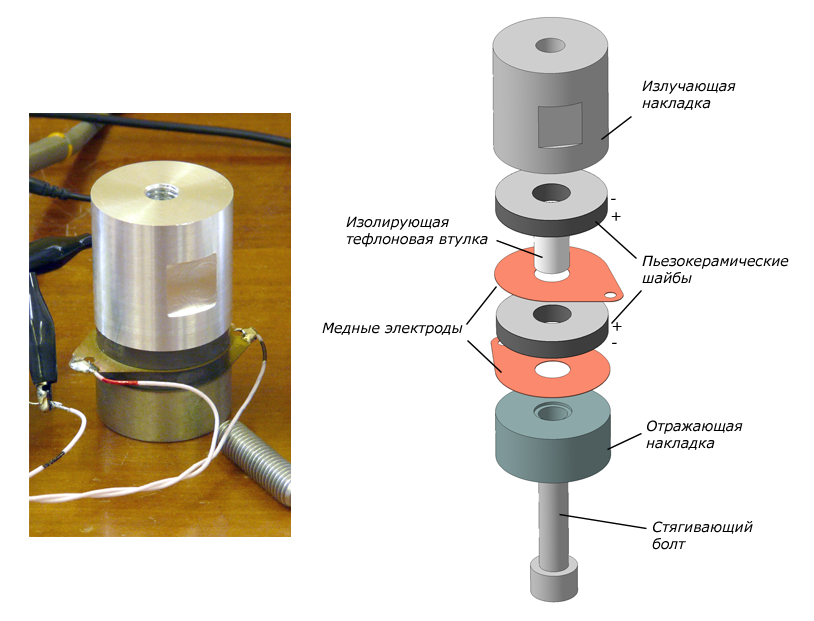
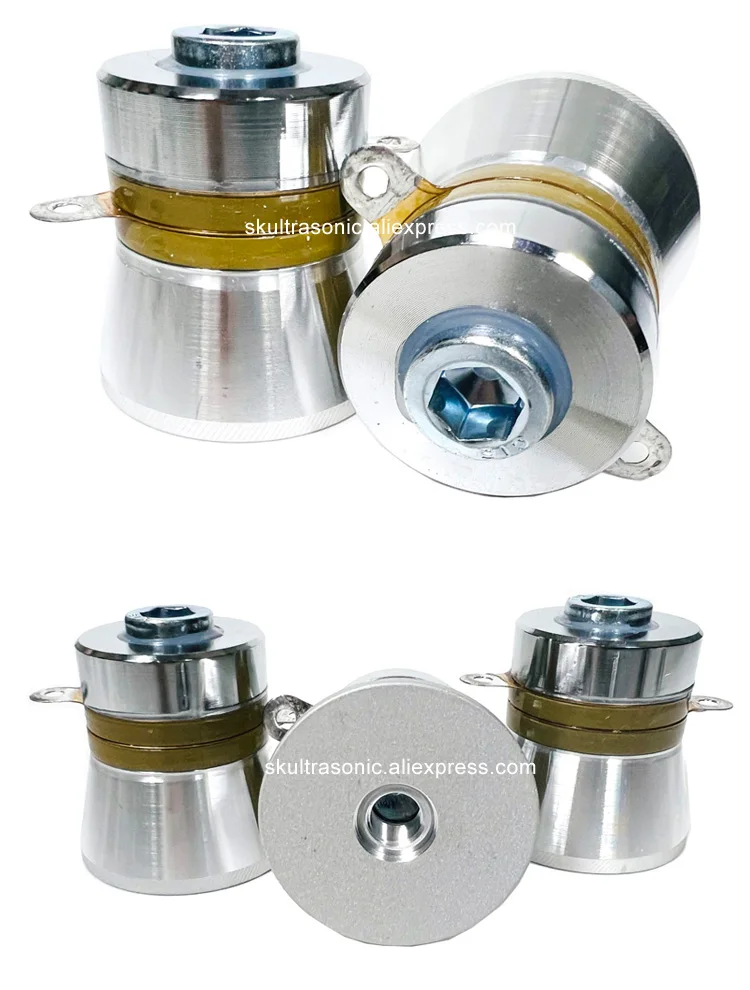
Both commercial knives use the same core technology: a Langevin transducer. In its disassembled form, you can see a stack of piezoelectric ceramic rings clamped by a central bolt to a horn-shaped waveguide-concentrator. The blade mounts on the resonating tip of the horn. A backing plate of the same diameter serves as a reflector, directing vibration toward the blade and providing a mounting point in the handle.
Every element — the backing plate mass and length, the waveguide length, the blade mass and length — must be calculated precisely to achieve resonance and maximize oscillation amplitude at the blade tip. This is genuinely non-trivial engineering: the system must account for how the resonant frequency shifts with different cutting loads, and commercial devices typically include real-time electronic tuning to maintain resonance dynamically.
A simpler approach is possible for hobbyists: start with the transducer assembly from an ultrasonic cleaning bath, attach a blade with a threaded tang matched in mass to the original bath load, and keep the blade length approximately equal to the bath's internal dimension. Results will vary, but functional prototypes are achievable this way.

DIY Applications: 3D Print Support Removal
Enterprising makers have found a practical near-term use for affordable ultrasonic tools: removing supports from 3D-printed parts. Ultrasonic dental scalers — sold on Chinese retail sites for around 6,800 rubles under the search term "ultrasonic knife" — have a small blade oscillating at ultrasonic frequency. Applied to support structures on photopolymer resin prints, they remove supports quickly, cleanly, and with minimal surface marking.
This is a narrow application, but it illustrates the broader point: ultrasonic cutting is no longer confined to industrial production lines and surgical theaters. The underlying technology is accessible, the physics are well understood, and the transition to everyday use is already underway.
Conclusion
Ultrasound has established itself as a precision cutting technology across a remarkable range of domains — from the fabrication of semiconductor wafers to the removal of cataracts to the slicing of cheese. The physics are elegant: high-frequency oscillation turns a blade into something that cuts with far less force, produces cleaner edges, and behaves selectively based on material rigidity. As the cost of piezoelectric components and drive electronics continues to fall, the technology is moving steadily out of the laboratory and into everyday life.