What's Wrong? Three Probability Paradoxes
The same question, asked the same way, can have two different correct answers — and both sides are right. Three classic paradoxes that reveal why probability is not a property of events, but a property of models.
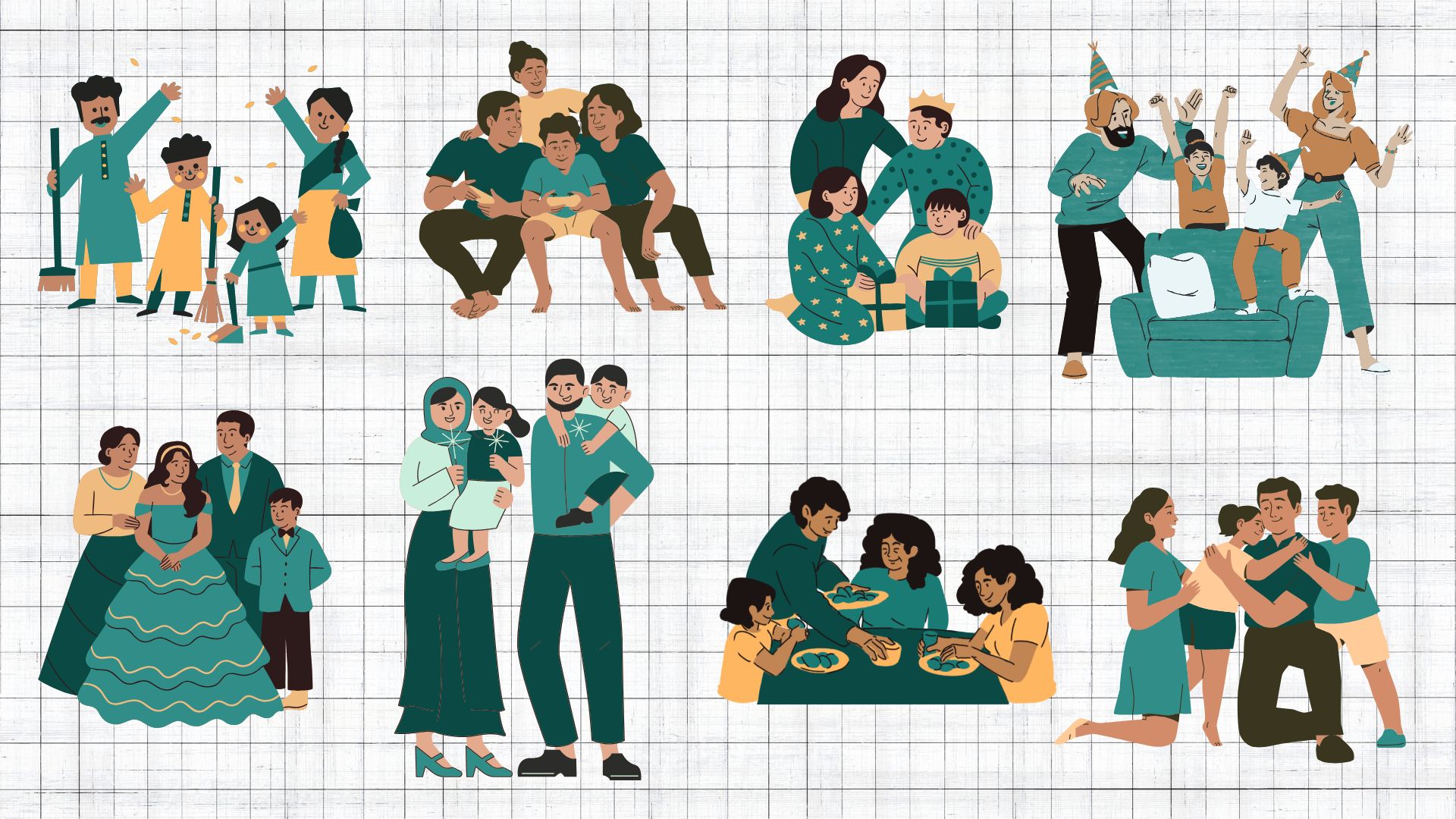
You run into your neighbor on the street. She's with her son. You know she has two children. What's the probability the other child is also a boy?
A passerby might say ½. A probability instructor might say ⅓. Remarkably, they can both be correct. The answer depends on something that isn't in the question itself: how the information reached you.
Gardner's Two Problems
In 1959, Martin Gardner published two nearly identical problems in Scientific American that produced a small storm of reader letters.
Problem 1: Mr. Jones has two children. The older one is a girl. What is the probability that both are girls? Answer: ½.
Problem 2: Mr. Smith has two children. At least one is a boy. What is the probability that both are boys? Answer: ⅓.
Gardner's reasoning for Problem 2: there are four equally likely gender pairs for two children — (B, B), (B, G), (G, B), (G, G). The condition "at least one boy" eliminates (G, G), leaving three scenarios, only one of which has both children as boys. Hence ⅓.
Hundreds of readers objected. They were not simply wrong. The same sentence — "at least one is a boy" — can describe fundamentally different experimental procedures, and those procedures lead to legitimately different probabilities. The text of the problem is ambiguous in a way that matters.
Exercise: The Monday Boy
Before going further, here is a problem to consider: "Mr. Smith has two children. One is a boy born on Monday. What is the probability that both children are boys?" (Bayes' formula may help.) The answer is less obvious than it looks — and it changes depending on how you interpret the setup.
The Friendship Network Problem
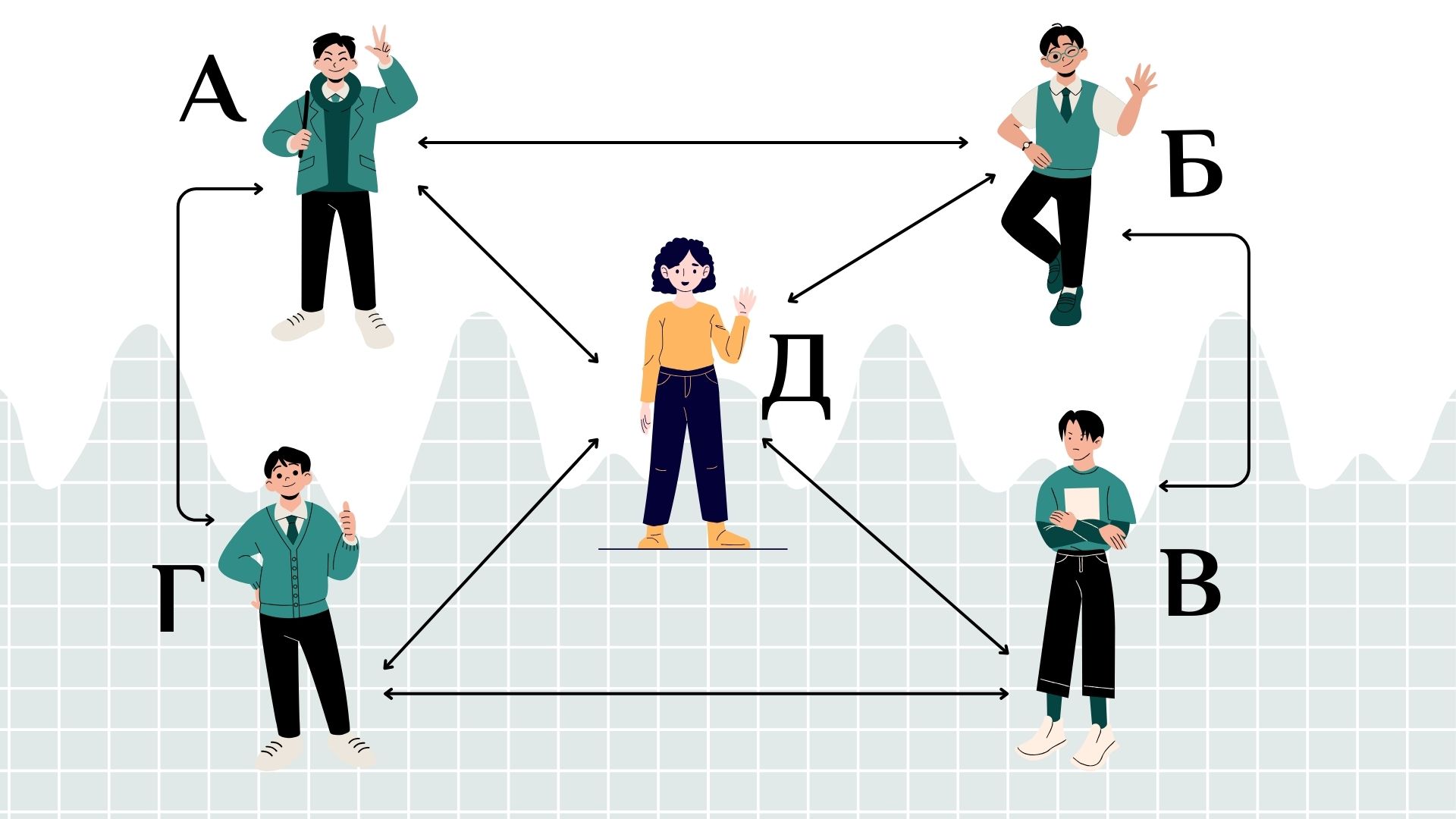
Five children go on a hike: Andrew, Boris, Vasily, Gleb, and Dasha. All pairs know each other, except Andrew–Vasily and Boris–Gleb. What is the probability that a randomly selected pair of acquaintances is mixed-gender?
Method 1 — Select a pair directly: There are 8 friendship pairs in total. Four are all-male (Andrew–Boris, Andrew–Gleb, Boris–Vasily, Vasily–Gleb). Four involve Dasha. Probability of mixed-gender: 4/8 = 1/2.
Method 2 — Select a person first, then a friend: If Dasha is selected (probability 1/5), all her acquaintances are male, so the probability of a mixed-gender pair is 1. If a boy is selected (probability 4/5), only Dasha is female among his acquaintances, and each boy has 3 friends, so the probability is 1/3.
Total: (1/5)(1) + (4/5)(1/3) = 1/5 + 4/15 = 3/15 + 4/15 = 7/15.
1/2 ≠ 7/15. Both calculations are correct for their respective procedures. The experiment described by Method 1 and the experiment described by Method 2 are simply different experiments.
Bertrand's Paradox
A chord is drawn at random inside a circle. What is the probability that the chord is longer than the side of an inscribed equilateral triangle?
This question has three mathematically correct answers, depending on what "random chord" means.
Method 1 — Two random points on the circumference: Fix one endpoint; choose the other uniformly on the circle. The inscribed triangle divides the arc into three equal parts. The chord exceeds the triangle's side length if the second point falls in the middle third. Probability: 1/3.
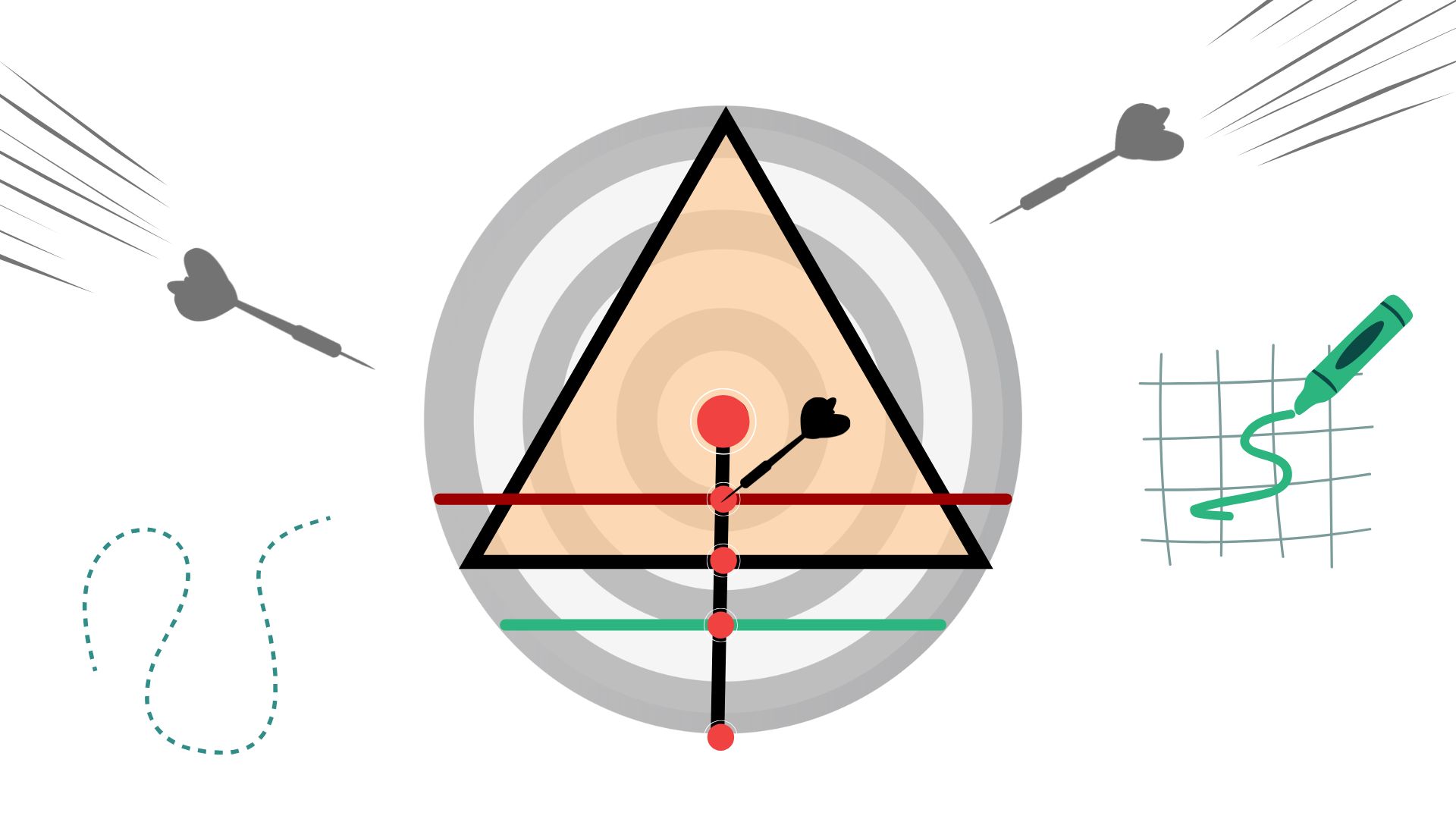
Method 2 — Random point on a radius: Choose a point uniformly on a fixed radius; draw the chord perpendicular to the radius at that point. The triangle's side bisects the radius, so chords whose midpoint is closer to the center are longer. Probability: 1/2.
Method 3 — Random point inside the circle: Choose a point uniformly inside the circle; draw the chord for which that point is the midpoint. The chord exceeds the side length when the chosen point falls inside the inscribed circle, which has 1/4 the area of the original. Probability: 1/4.
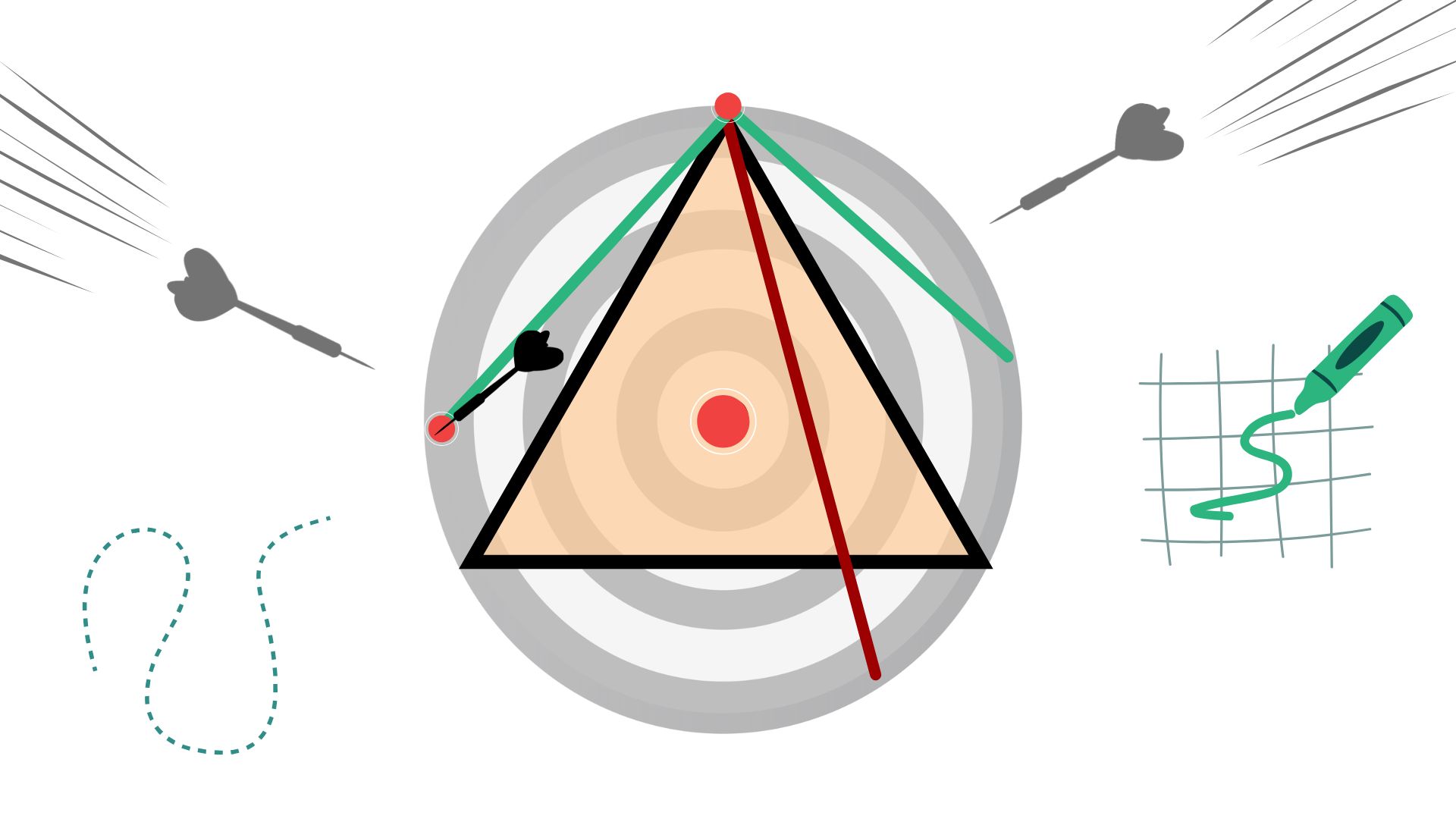
Each method is internally consistent. The question "what is the probability?" is simply under-specified. Three different meanings of "random" produce three different probability spaces.
The Wallet Paradox
Two players each open their wallets. Whoever has less money gives all of it to the other. Is the game fair?
Fairness means that the expected gain over many repetitions averages to zero. Now consider a seductive chain of reasoning:
- Let X be the amount in your wallet. Either you have less than your opponent or more.
- If you have less, you lose X. If you have more, you gain something greater than X.
- Therefore, your expected gain is positive — the game favors you.
- By the same reasoning, it favors your opponent too.
- And yet one person must win and one must lose, so it must be fair.
All three conclusions cannot be simultaneously correct. Where does the argument break down?
The flaw is hidden in the setup. The reasoning assumes a probability distribution where, for any fixed amount X, the probability of holding less than X equals the probability of holding more than X — that is, a distribution symmetric around every point. No such probability distribution exists. The paradox does not expose a logical contradiction; it exposes an implicit assumption about a non-existent object.
Exercise: The Two Envelopes
A host picks a random natural number X, places X rubles in one envelope and 2X in the other, and gives you one at random. You may keep the money or swap envelopes. Can you prove that swapping always increases your expected winnings? What is wrong with that proof?
Why Does This Keep Happening?
These paradoxes are not tricks or errors in arithmetic. They reveal something structural about probability:
- Probability is part of a model, not an intrinsic property of events. It depends on how the experiment is set up.
- The same sentence can describe different procedures, each giving a different — and legitimate — answer.
- You must specify the model before the formulas apply.
Theory alone cannot tell you which model is "correct." That is what statistics is for: you propose competing models, compute their predictions, and compare them against real data. The model that best matches observation is the one you adopt — not because it is metaphysically true, but because it is useful.
Final Puzzle
"Choose an answer at random from the options below. What is the probability you have selected the correct answer?"
- (a) 25%
- (b) 50%
- (c) 0%
- (d) 25%
Two options show 25%, which means the probability of choosing 25% at random is 2/4 = 50%. But if 50% is correct, only one option says 50%, giving a 1/4 = 25% chance. And if 25% is correct... the loop continues. This one genuinely has no consistent answer — which is itself the answer.