The Roar Heard for Dozens of Kilometers: The Legend of the An-22
The story of the An-22 Antey, the world's largest turboprop aircraft ever built, from its dramatic first flight in 1965 to its retirement in 2024 — including 41 world records, service in Afghanistan, and unrealized nuclear-powered variants.
Some machines are constructed. Others are born. The An-22 "Antey" belongs to the latter category. It came into existence during an era when humanity stormed the cosmos and engineers believed nothing was impossible. When this giant first lifted off from the runway near Kyiv in February 1965, seven people in the cockpit experienced something indescribable in flight logs: they had tamed a colossus.
The French would later call it "the flying cathedral." For its magnitude, its grandeur, for the distinctive rumble of four turboprop engines that made people on the ground crane their necks upward. The Americans assigned it the codename "Cock," alluding to its aggressive nature and loud voice. Soviet pilots simply called it "Antey," after the invincible giant from ancient mythology. Though the mythological Antey lost strength when lifted from the earth, his winged namesake only began to demonstrate his true capabilities once airborne.
In the Soviet Union of that period, there emerged a critical need to transport heavy equipment weighing up to 50 tons across vast distances. Previously, this seemed like fantasy — the An-12 could lift merely 16 tons, and only short distances. "Antey" aimed for a threefold superiority in cargo capacity.
The Birth of the Giant: Creating the An-22
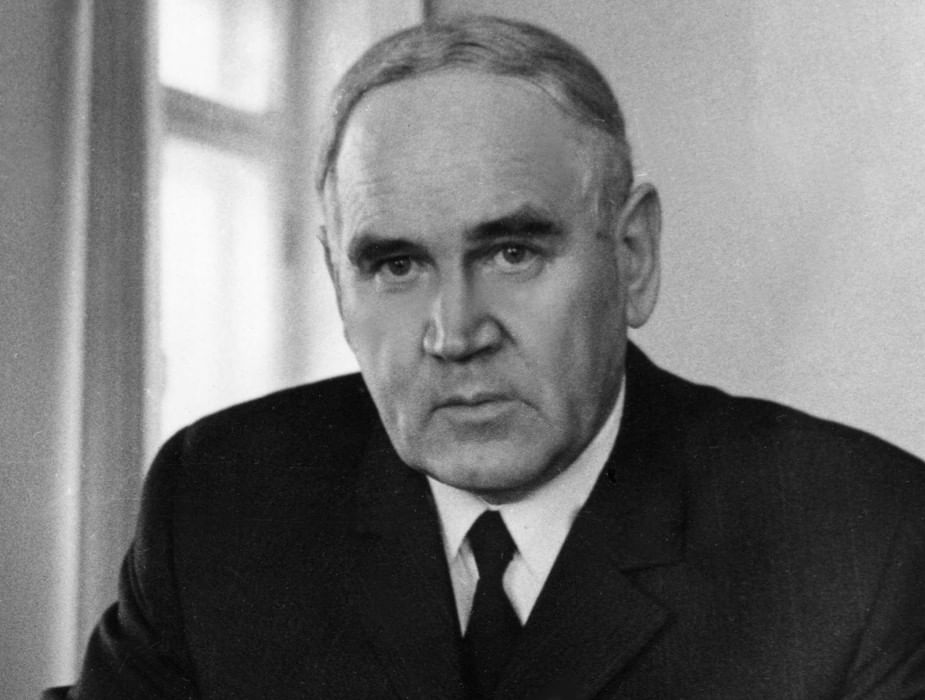
Development of "Product 100" (the An-22's designation before naming) commenced in 1960 under deputy chief designer A. Ya. Belolipetsky's leadership.
Oleg Antonov personally oversaw the project and named it "Antey" after the mythological giant. Ironically, the mythological figure lost power when elevated, yet the aircraft drew strength from the skies. As academician I. N. Fridlyander humorously noted: "The aircraft gathers energy from the earth by filling its fuel tanks."
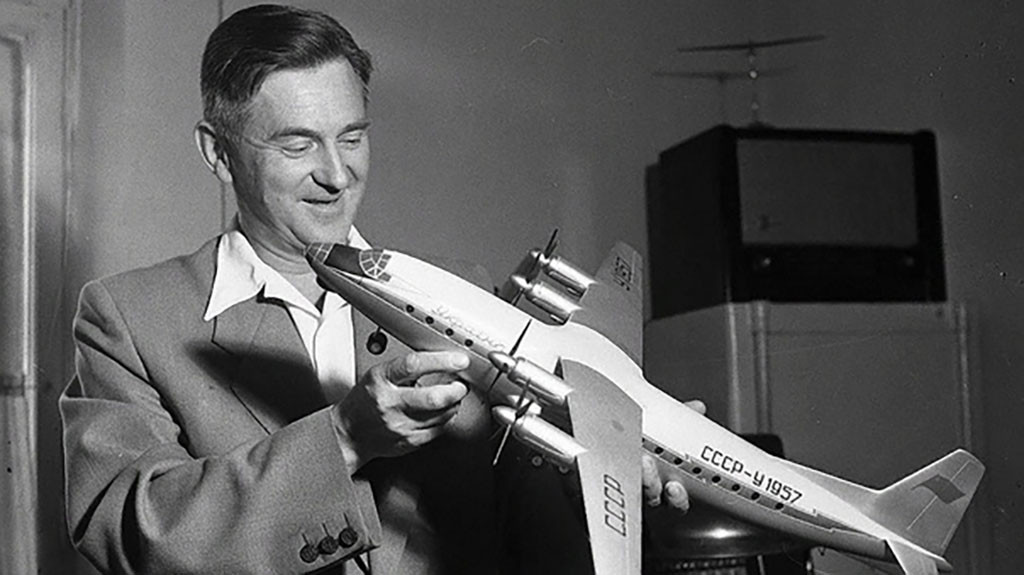
Several design bureaus competed for this contract. In the late 1950s, various heavy transport projects were simultaneously developed: Antonov proposed the An-20 and VT-22 variants, G. M. Beriev offered the Be-16 amphibian, and A. N. Tupolev presented the Tu-115 cargo aircraft. However, customer requirements were stringent: transport a 50-ton payload 5,000 kilometers, take off from unprepared strips no longer than 1 kilometer, and land on 800-meter strips. No existing turbojets of that era could achieve such range with heavy loads. Consequently, turboprop engines were selected — and here Antonov's bureau held advantages through collaboration with legendary engine designer Nikolai Kuznetsov.
Antonov's design was deemed most thoroughly developed and practical. Construction of the first prototype began in Tashkent (at TAPOiCh) during 1962-1963.
By August 18, 1964, the first aircraft transferred to flight testing. On February 27, 1965, from Svyatoshino airfield near Kyiv, the giant ascended for the first time.
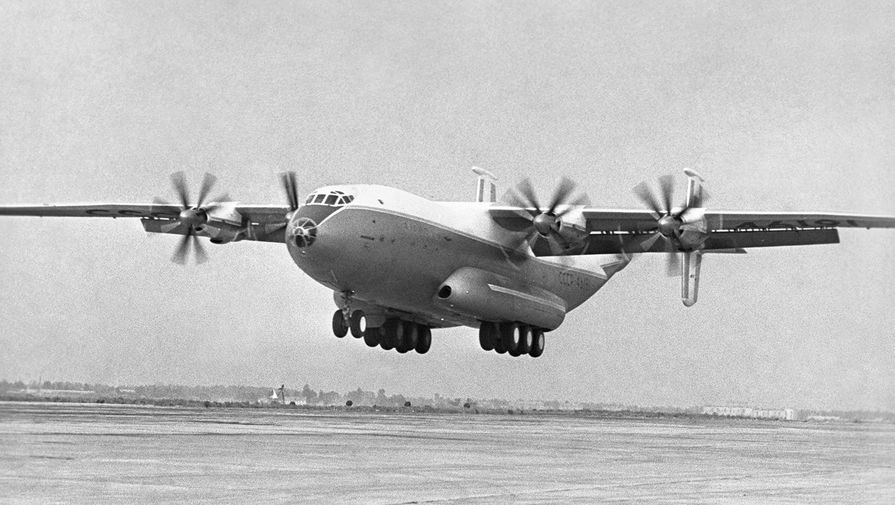
One can only imagine what pilot Yuri Kurlin's crew experienced: seven people in the cockpit — pilots, navigator, flight engineers, and radioman — all eyes fixed on instruments as the four-engine behemoth lifted off.
Later that year, the An-22 created a sensation at the Paris Air Show. A French announcer, seeing the Soviet transport descending: "The world's largest aircraft is arriving... they say it can carry 720 passengers or 80 tons of cargo." The An-22 "Antey" landed at Le Bourget as a triumph. The nickname "flying cathedral" became permanent — partly for gigantic dimensions, partly for motor rumble.
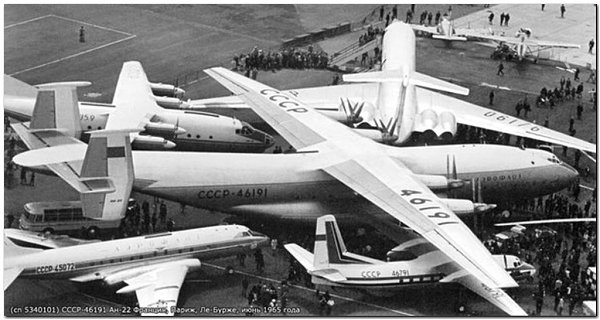
Americans, displaying humor, assigned it codename "Cock." The fuselage supposedly resembled a comb, and the aircraft had a loud, aggressive "voice." This seemed peculiar; the An-22 appeared more like a winged warrior. The Tu-95 thunders even louder, but the An-22's "songs" were formidable!
Construction
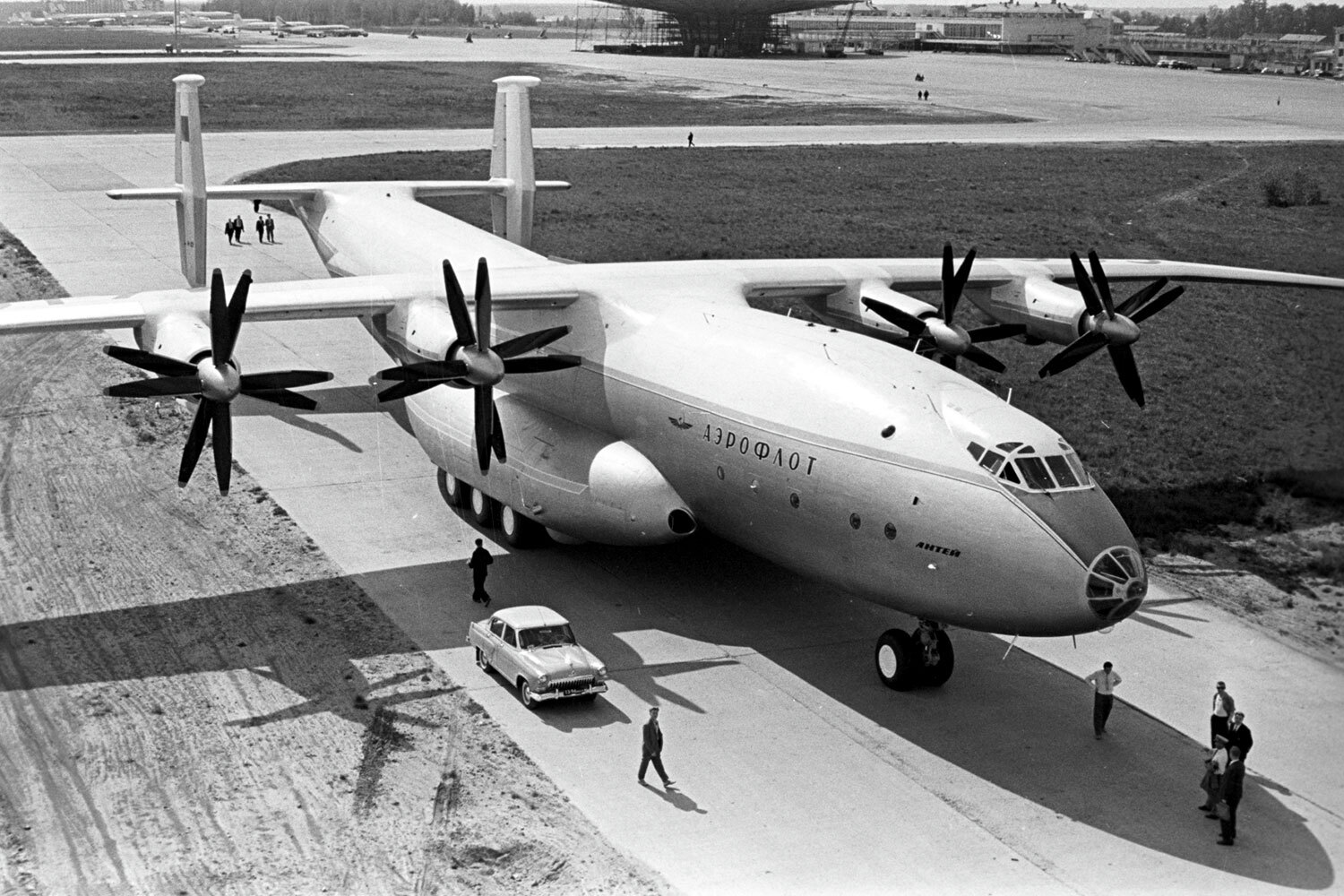
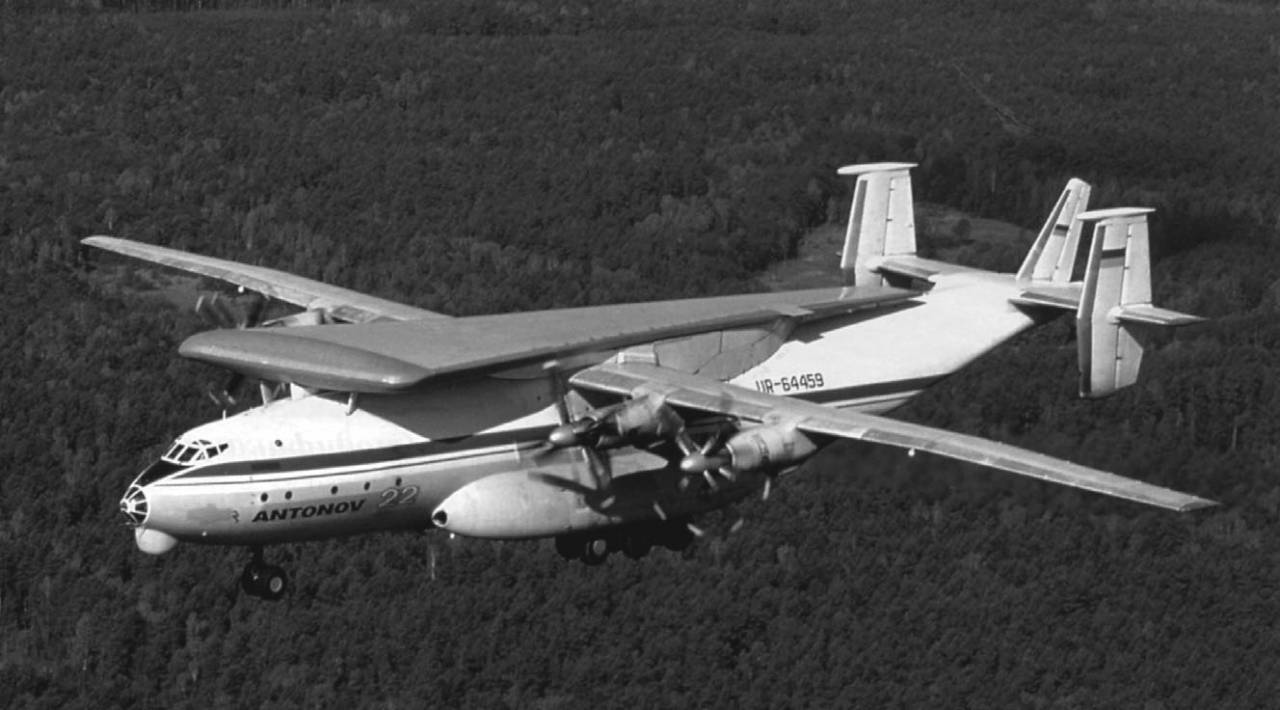
To meet stringent requirements, the An-22 received an original configuration impressive even by contemporary standards. The aerodynamic layout was classical high-wing configuration, but with twin-tail design (two vertical rudders) instead of the conventional single rudder. Twin tails reduced the twisting effect of the enormous rudder, stabilizing the giant more effectively. Moreover, the gap between vertical keels permitted a wide loading ramp where tanks or armored vehicles could drive in easily.
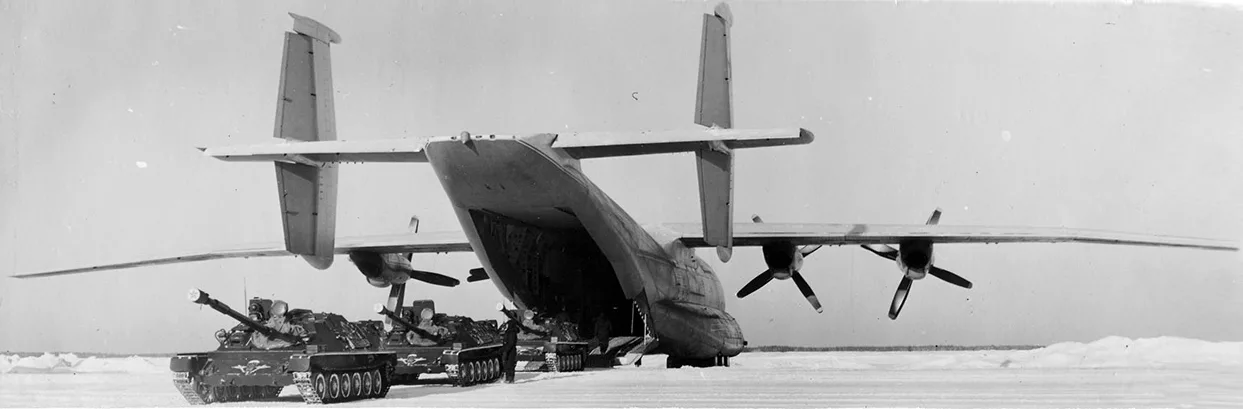
The landing gear possessed seven support struts: one forward, six main — three per fuselage side. Each main strut had its own low-pressure wheels, totaling 12 wheels. This arrangement distributed the 200-ton machine's weight, permitting landings on waterlogged ground. Tire pressure measured only 5 kg/cm2, less than many trucks. Legend claimed early An-22 crews could regulate tire pressure during flight, deflating before landing on soft ground, then reinflating afterward.
The "Antey's" fuselage was wide-bodied, six meters in diameter. For the 1960s, this was extraordinary. For the first time globally, an aircraft received such a spacious fuselage. Inside fit two T-62 tanks, four armored vehicles, or nearly 300 soldiers. Cargo cabin dimensions: 33 x 4.4 x 4.4 meters.
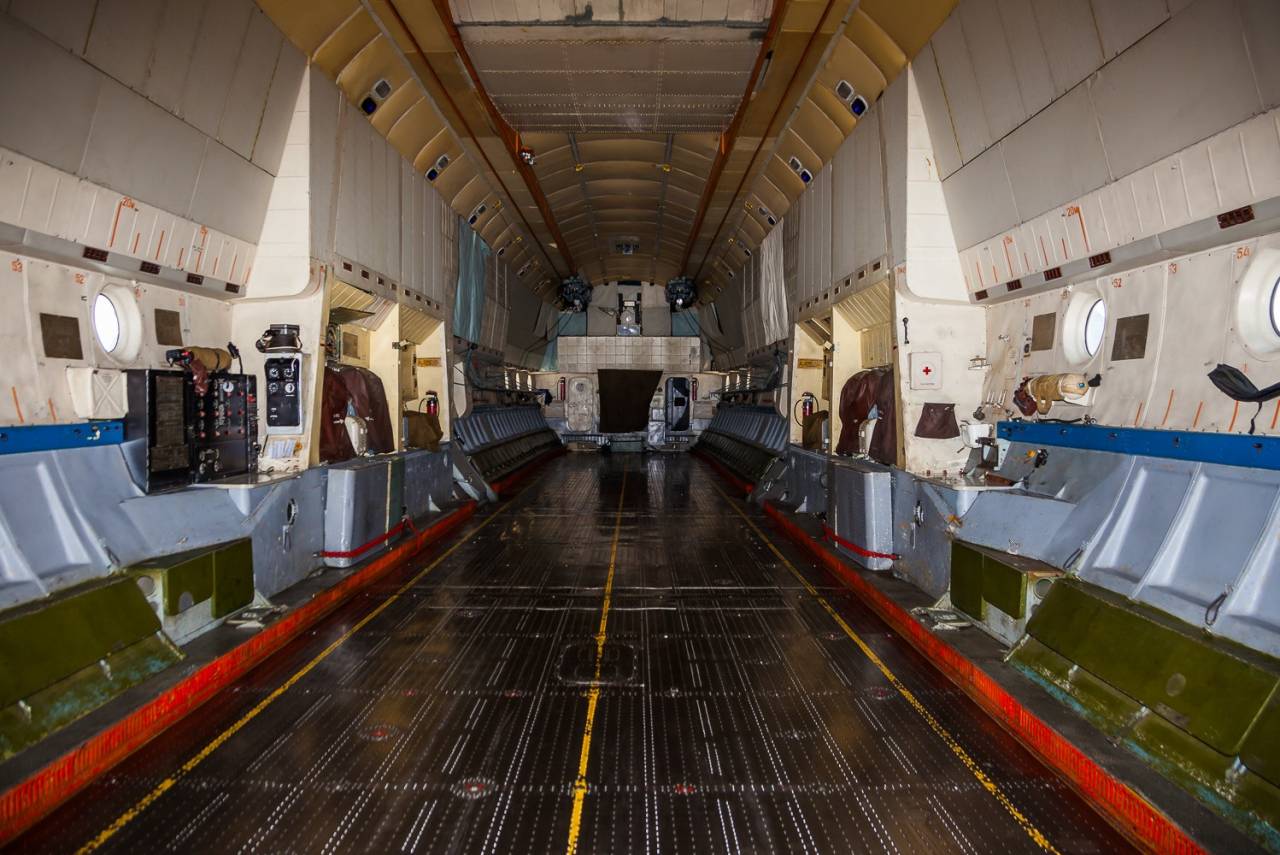
Remarkably, the An-22 was aviation's first aircraft with two side passages alongside cargo — essentially double-decked in the nose section: the crew cabin occupied two levels.
In the nose's lower level sat the navigator with a glazed "bombardier cabin," behind him two compartments for accompanying personnel. The upper deck housed pilot workstations for other crew members, plus another section for supporting personnel — up to 21 accompanying personnel could occupy the pressurized nose section.
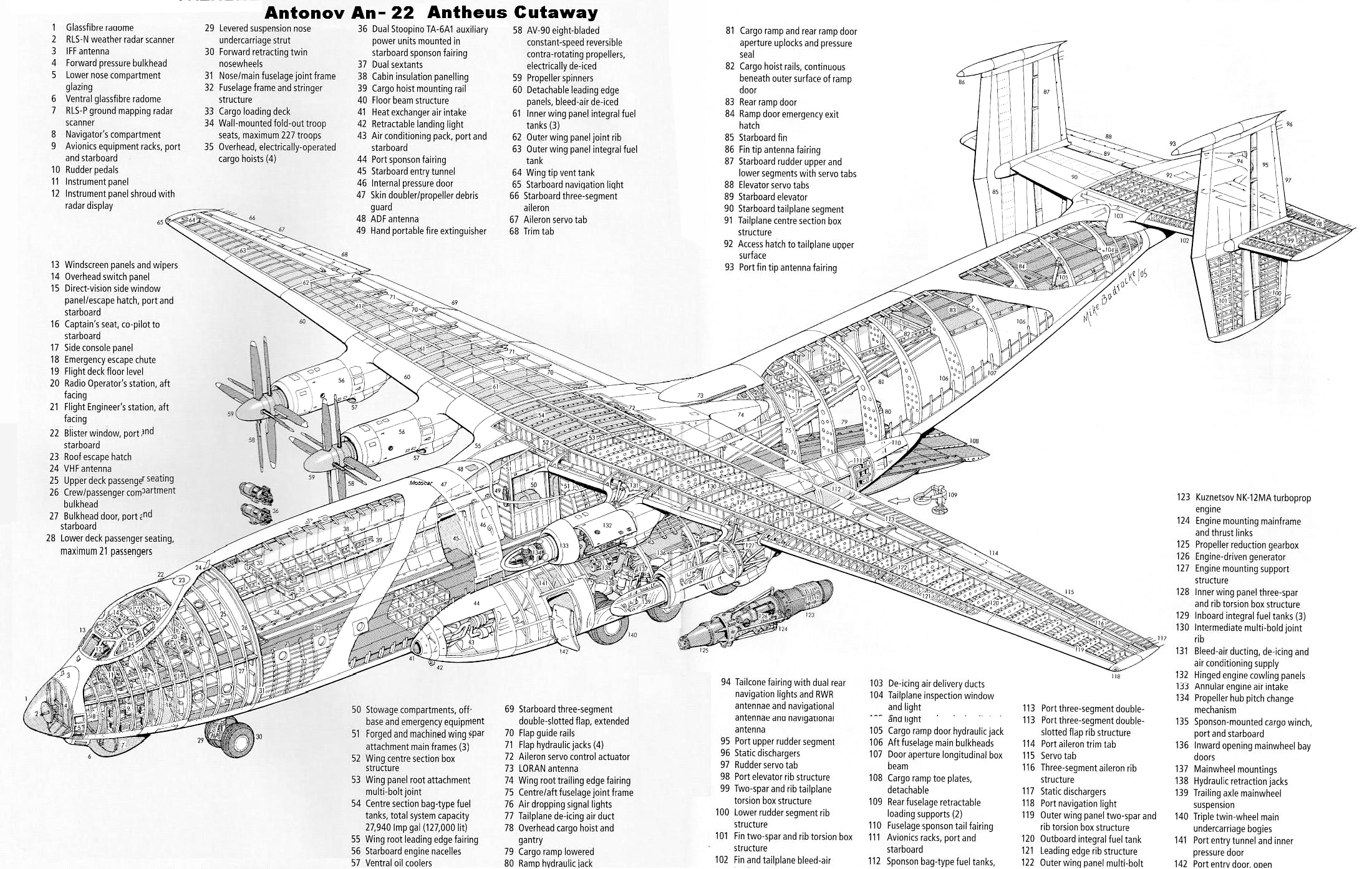
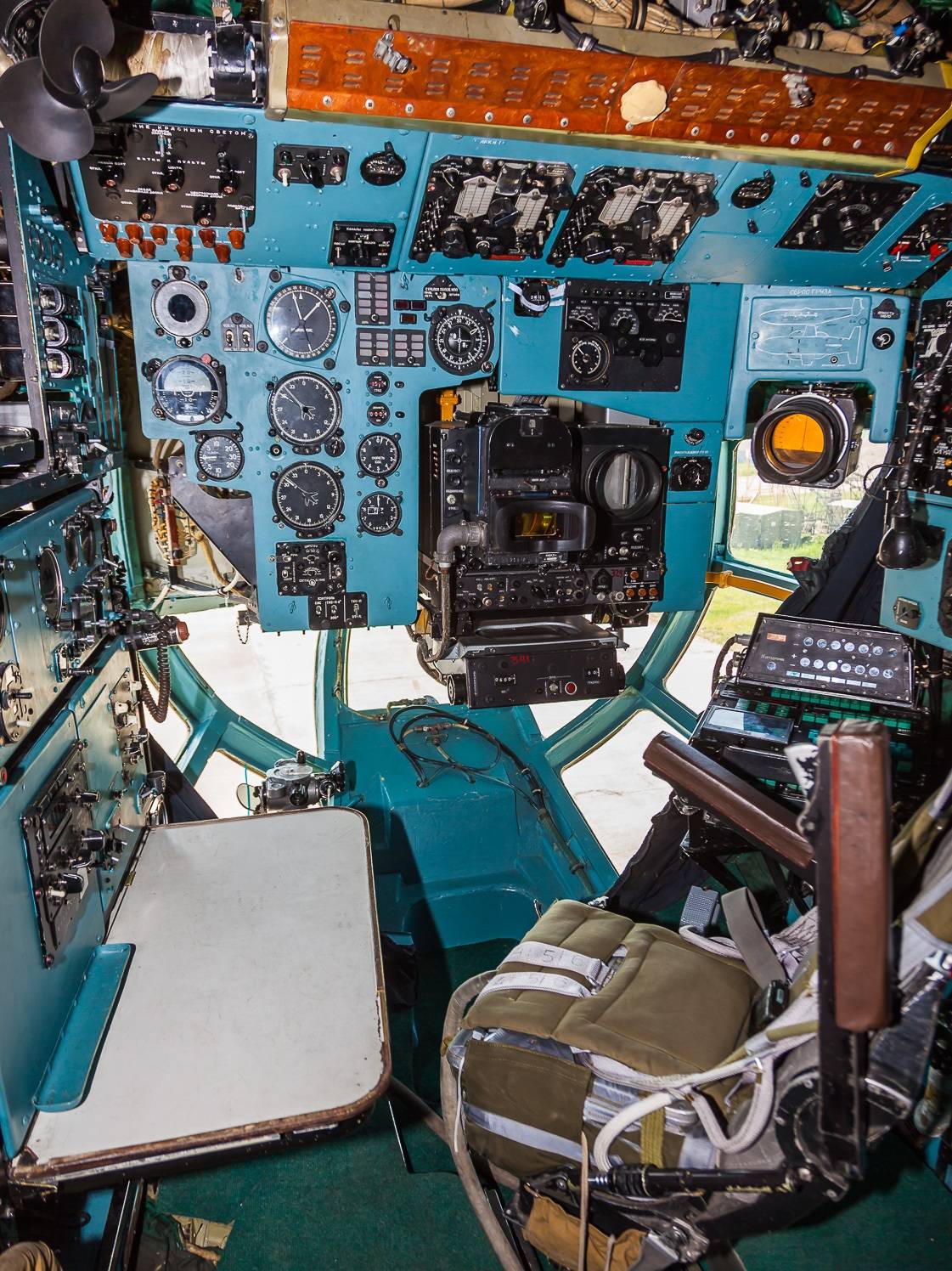
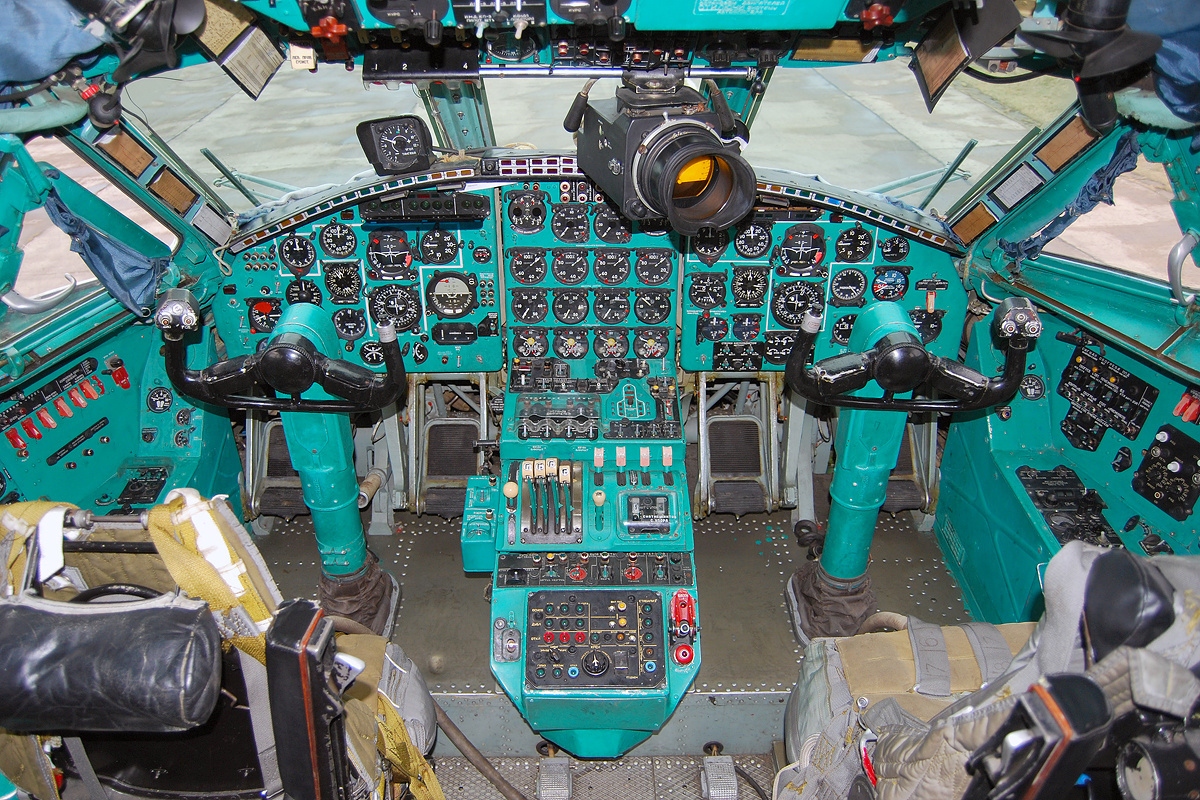
The cargo section itself was pressurized (though slightly depressurized relative to the nose), enabling the "Antey" to cruise at 7-8 kilometers altitude with equipment and personnel aboard without respiratory hazard.
For emergency evacuation, the crew would exit through a special inclined tunnel-sleeve alongside the nose.
The fuselage framework employed sturdy aluminum alloys; in highly-stressed areas, titanium and steel were used. The cargo cabin floor was titanium — preventing tank tracks from penetrating. In the 1960s, using titanium in aircraft construction was genuinely advanced, previously reserved for strategic reconnaissance aircraft like the SR-71, though that presented different circumstances.
Most interestingly: four turboprop engines NK-12MA, each producing 15,000 takeoff horsepower. Combined, this equaled 60,000 horses — equivalent to an entire fleet of diesel locomotives.
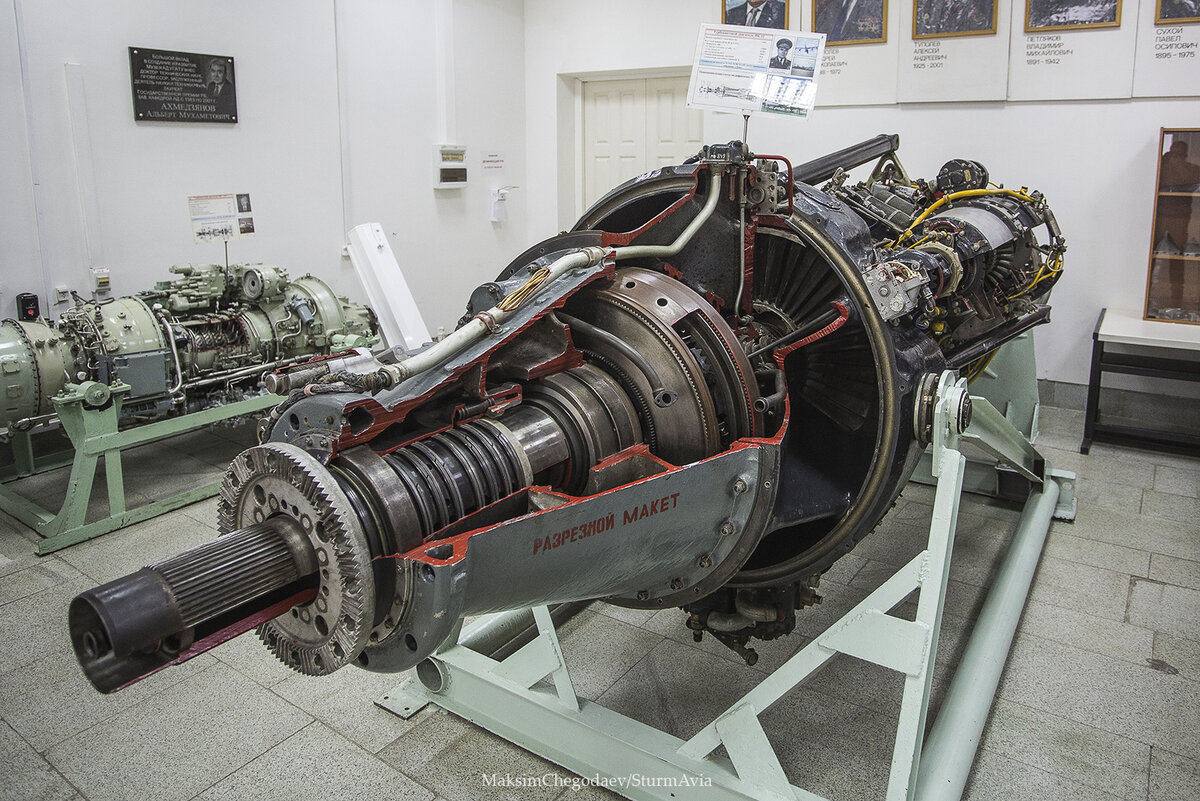
During the initial full-power start, a remarkable incident occurred. The exhaust jet's reactive force was so powerful it knocked an engineer down and overturned a security booth at the airfield's edge. These engines were originally designed for the Tu-95 strategic bomber; the An-22 received an updated variant.
Each engine drove a coaxial dual-row propeller (AV-90) with 6.2-meter diameter. Each engine nacelle essentially contained two four-bladed propellers rotating counter to each other. This arrangement eliminated reactive torque effects and achieved tremendous takeoff thrust — approximately 14,600 kilogram-force per engine section.
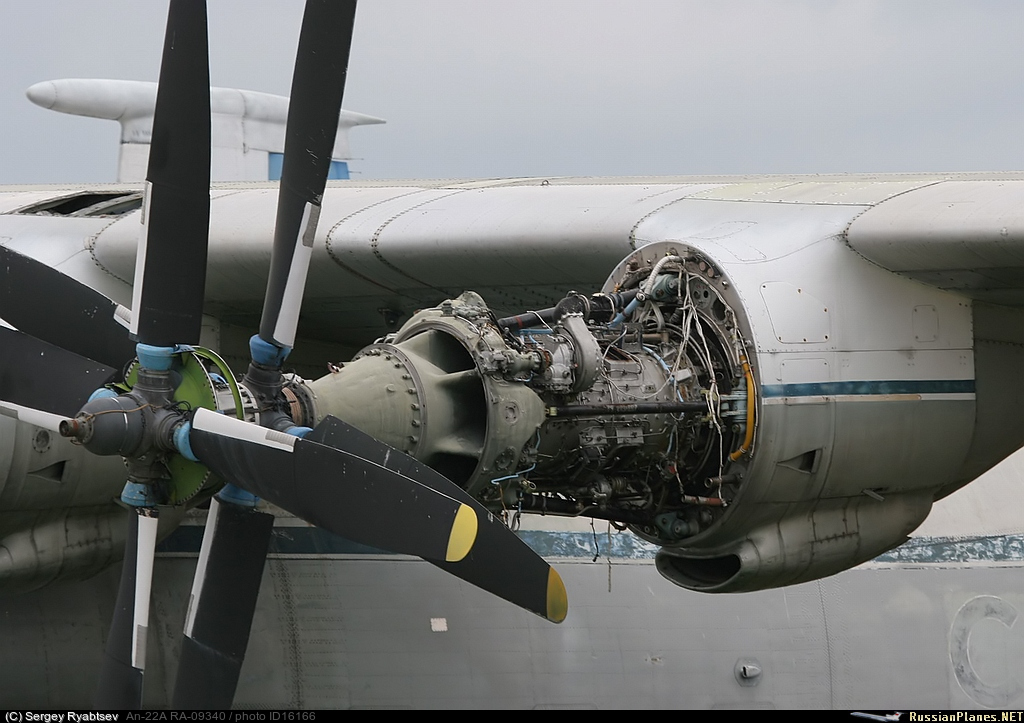
No comparable power existed in those years.
However, complications arose. Operating engines generated deafening noise — crews required headsets to avoid hearing damage, constantly communicating via intercom. Vibrations were substantial; four turboprops buzzed so intensely that coins in pockets bounced.
Interestingly, vibration precisely prevented developing a passenger An-22 variant. Indeed, Antonov seriously considered a double-deck airliner accommodating 724 passengers based on "Antey," featuring cinema, bar, sleeping compartments, and mother-child facilities. The project was presented at air shows, but practically converting a thunderous military transport into a comfortable airliner proved challenging.
Intriguingly, "Antey" eventually flew with passengers, establishing records. In 1972, evacuating Soviet specialists from Egypt, an An-22 transported over 700 persons in a single flight — precisely the number Antonov had promised in Paris. Passengers certainly didn't occupy first-class seats — they sat on floors and cargo areas — but the fact remained: 700 passengers in one sortie.
The crew comprised seven: commander, second pilot, navigator, flight engineer, equipment technician, cargo equipment technician, and radio operator — a complete brigade.
Flight Characteristics
Despite its dimensions, the An-22 possessed confident flight performance.
Maximum takeoff weight reached 225 tons; cruise speed approximately 560 km/h (roughly 300 knots) at 7-8 kilometer altitudes. For turboprop aircraft, this represented excellent results. Additionally, turboprops prove more economical at moderate speeds.
Range was approximately 5,000 kilometers with maximum cargo, extending to 10,000 kilometers unloaded. Service ceiling: roughly 8-9 kilometers — higher altitudes lacked sufficient thrust in thin air. The An-22, however, could land on strips under one kilometer, or considerably shorter with braking parachutes. Takeoff was equally impressive: roughly 800-1,000 meters — remarkably brief for such a massive airframe. By comparison, jet-powered C-5s and An-124s require double the distance.
A particular distinction: the An-22's world records. During initial service years, records accumulated continuously. Altogether, the An-22 established 41 international records for payload and range. For instance, it lifted 100,444 kilograms to 7,848 meters altitude. Another flight covered 1,000 kilometers carrying 50 tons at speeds exceeding 600 km/h.
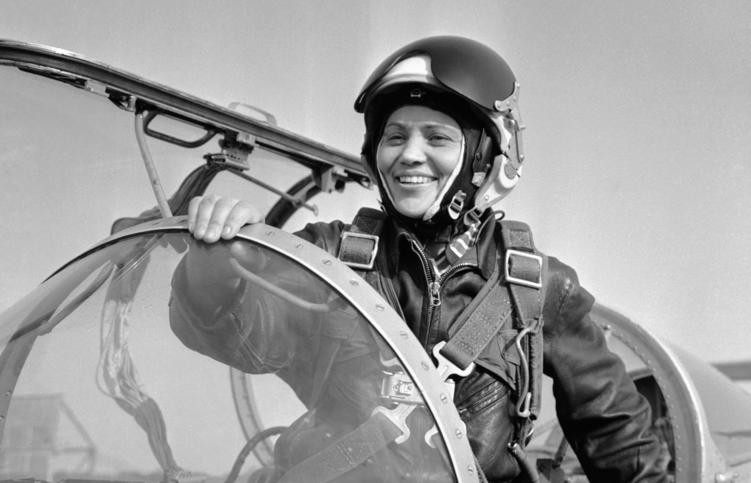
Renowned aviator Marina Popovich, wife of cosmonaut Pavel Popovich, established these records. As the sole woman commanding an An-22, she extracted every capability, rightfully entering aviation history.
The Career of the Antey
Soviet military transport aviation became the primary operator. First production aircraft entered service January 1969, assigned to the 81st military transport squadron.
Sixty-eight examples were manufactured through 1976. During the Cold War, "Anteys" provided strategic mobility — single loads could relocate entire battalions with armored vehicles or deliver ballistic missiles to remote garrisons. The An-22 transported intercontinental rockets, massive radars, construction equipment for Siberian airfields — everything exceeding An-12 or Il-76 capacity.
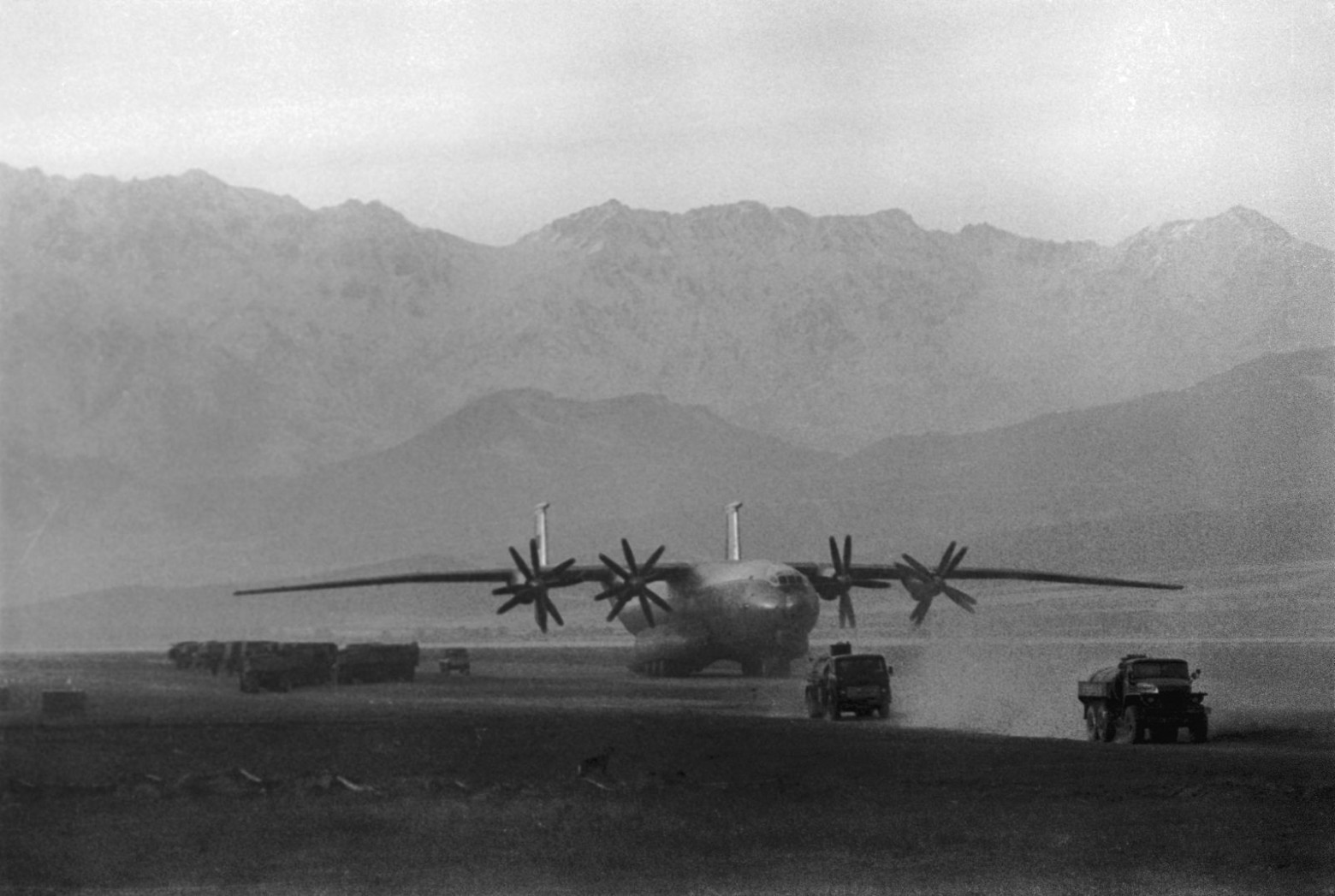
The Afghanistan war tested them severely. "Anteys" hauled heavy helicopters, artillery, even bridges for crossings. Crews reportedly felt like ducks in a shooting gallery during Kabul approaches — the ungainly transport maneuvered poorly, and anti-aircraft fire proved unwelcome. Yet armor plating and redundant systems endured; one "Antey" absorbed a hundred shrapnel holes in Afghanistan but returned under its own power. Perhaps apocryphal, but structural integrity proved genuine.
The An-22 also served peaceful missions. Following 1980s detente, several retired military aircraft transferred to Aeroflot. They executed charter cargo operations: transporting outsized freight worldwide. Humanitarian operations occurred — African nations received An-22 food and equipment deliveries, notably Ethiopia during the 1985 crisis.
Remaining "Anteys" concentrated at Migalovo base near Tver by the 2000s. Long serving as reserves, they periodically operated. In the 2010s, avionics underwent modernization, extending service life. Nevertheless, time exacted its toll.
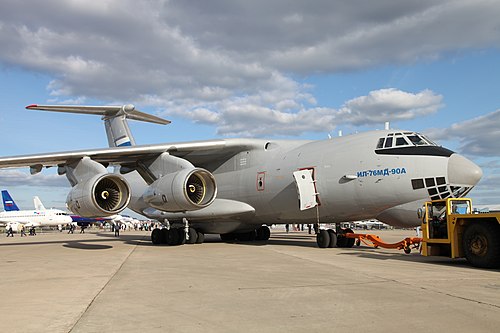
From 2024, Russian military transport concluded An-22 operations; aging aircraft exhausted their resources, yielding to newer Il-76MD-90A variants.
Regrettably, the final flight ended tragically. One refurbished aircraft crashed in December 2025 after exceeding 50 years of service.
Several aircraft survive in museums; Moscow's Monino permits close examination of this giant. One stands on a pedestal near Tashkent's manufacturing facility.
The aircraft paved roads for subsequent giants. Based on "Antey" experience, designers later created the An-124 "Ruslan," surpassing its records.
Unrealized Projects
Exceptional aircraft naturally inspire designers to attempt further achievements. The An-22 spawned ambitious concepts.
The An-22 RZ "Perevozchik" (Carrier) project deserves mention: during the early 1980s, three aircraft underwent reconfiguration for transporting ultra-large external cargo loads. These examples received reinforced triple-tail designs.
An amphibious An-22 concept emerged from early 1960s development. Plans included water-hull flooring, nose hydrofoil, and retractable submarine wings for hydrofoil operation. Purpose: enabling the heavy transport to land on water, jettison cargo at sea, resupply submarines, conduct rescue operations, even lay naval mines. Admittedly, this sounded fantastical. The project advanced to CAGI hydrochannel testing but progressed no further. The task proved excessively complex with substantial risks.
Most audacious — or frankly, insane — was the An-22 ASW variant with nuclear propulsion! During the 1960s technology race, atomic-powered concepts emerged. The ultra-long-range anti-submarine aircraft could loiter over ocean nearly 48 hours without landing. Designers intended mounting nuclear reactors powering specialized turboprop engines. The scheme: conventional kerosene engines handled takeoff; at altitude, the reactor activated, heating working fluid and powering propellers, enabling thousands-of-kilometers transit without fuel consumption.
Calculations projected 50-hour endurance and 27,500-kilometer range without landing. In 1972, two An-22s received first a reactor simulator, then actual compact nuclear reactors in lead protective casings. Reportedly, these aircraft flew with this apparatus, testing crew radiation protection. Yet the fully-nuclear An-22 never materialized, thankfully. An airborne Chernobyl served no purpose. Notably, American experiments with aircraft reactors similarly stopped at test specimens.
Another concept: the An-22R — an air-launched ballistic missile carrier. Designers considered suspending substantial ballistic rockets beneath the "Antey" for airborne launching. No evidence of prototype development surfaced; it was probably never constructed.
Finally, the passenger-application concepts: the double-deck 724-seat airliner proposal remained theoretical, though life amusingly validated the figure. As noted, the An-22 actually transported 700 individuals simultaneously. Humorously, Antonov promised precisely 720 seats in Paris; years later, he nearly delivered.
Curiously, Aeroflot briefly maintained its An-22 fleet for civilian cargo service. However, such operations proved short-lived. When turbojets like the Il-76 appeared in the 1970s, turboprop giants seemed antiquated — demanding greater maintenance, noisier, slower-flying. Gradually, "Anteys" shifted to secondary roles, eventually disappearing from civilian aviation, unable to compete against quieter, faster competitors.
Conclusion
Different aircraft eras arrived, yet the An-22 "Antey" permanently entered aviation history.
Enormous, loud, occasionally temperamental in maintenance — yet remarkably charismatic. From a contemporary perspective, certain past solutions invite smiles: seven-person crews or onboard nuclear reactors? Yet the onboard cinema merited consideration...
The aircraft addressed different times and missions, accomplishing them brilliantly. It pioneered paths for wider-fuselage passenger airliners; five years later, the Boeing 747 emerged as aviation's first turbofan dual-deck salon. Yet width-precedent remained with the An-22. It remains aviation's largest turboprop aircraft globally.
The An-22 "Antey" lived the life every machine dreams: it was first, it was superior, it was essential. It lifted what nobody else could elevate. It landed where nobody else could descend. It left behind not merely scrap metal, but proof: humanity constructs everything imagination conceives.
Only the courage to commence remains necessary.