The Evolution of Twisted Pair Ethernet
Hello! My name is Maxim Kupriyanov. For about thirty years I have been working closely with global and local computer networks. Mainly at the level of routing and proxying traffic, but previously it was necessary to design and install Ethernet networks in offices and server rooms
Editor's Context
This article is an English adaptation with additional editorial framing for an international audience.
- Terminology and structure were localized for clarity.
- Examples were rewritten for practical readability.
- Technical claims were preserved with source attribution.
Source: original publication
Hello! My name is Maxim Kupriyanov. For about thirty years I have been working closely with global and local computer networks. Mainly at the level of routing and proxying traffic, but previously it was necessary to design and install Ethernet networks in offices and server rooms.
Like many other computer enthusiasts, I have my own small server room at home, and sometimes I wonder what I can improve in it. This time I decided to think about upgrading the network, because the gigabit Ethernet that I have there is already quite an old technology.
I started reading about what is now proposed for use in home and office networks, and the situation turned out to be quite confusing. If 400 Gbit/s is already actively used in data center networks, 800 Gbit/s is on the way, and the main question is which form factor of the plug-in module to choose, then for copper networks based on twisted pair, everything is not so obvious. There are many standards, but the most common are the same as twenty years ago. At the same time, one of the most common questions on the Internet about home/office Ethernet is “Which category of twisted pair cable should I install?” I had to sit down with the list of published IEEE 802.3 standards (that’s all about Ethernet) and dig deep into it.
In this article, I want to dive a little into the history of twisted-pair Ethernet, touch on coaxial cable, and figure out where we are heading and why things are happening the way they are. This excursion turned out to be very educational for me, I hope you will find it interesting too. At the end, I will try to give a motivated answer to this most common question about cable selection.
Let's start from the very beginning.
1973 Network idea for printer sharing
In the early 1970s, Xerox Corporation began to think about the idea of creating a wired local network that would allow many computers to be connected to one laser printer at once. In 1973, Xerox PARC Research Center employees Robert Metcalfe and David Boggs presented a description of an experimental network that transmitted data at a speed of 2.94 Mbit/s over a thick coaxial cable (bus). The network was named Ethernet (over-the-air network) due to the similarity of the mechanism for sharing the transmission medium with the radio network of the University of Hawaii ALOHA (ALOHAnet).
1983 10BASE5 thicknet
Xerox, together with DEC and Intel, decided to use Ethernet as a standard networking solution, leading to the creation of the Ethernet II specification in 1982. And in 1983, the Institute of Electrical and Electronics Engineers (IEEE) approved the official Ethernet standard - IEEE 802.3. It also described the network physical layer standard 10BASE5, aka thicknet (thick network). By the way, the standard was officially published only in 1985, after it was approved by the ANSI Institute. Therefore, it is more correct to call it IEEE 802.3–1985.
10BASE5 implied the use of thick (9 mm) coaxial cable type RG-8X with a characteristic impedance of 50 Ohms. It was proposed to connect network clients directly to this cable using special devices that pierce the outer shell - vampires. The central spike of the vampire was in contact with the central core of the coaxial cable, and two side spikes were in contact with the screen of the main cable. The vampires themselves connected to the transceivers, and those through the AUI interface (DA15F) to the computer.
The image below shows what this assembled structure looked like.
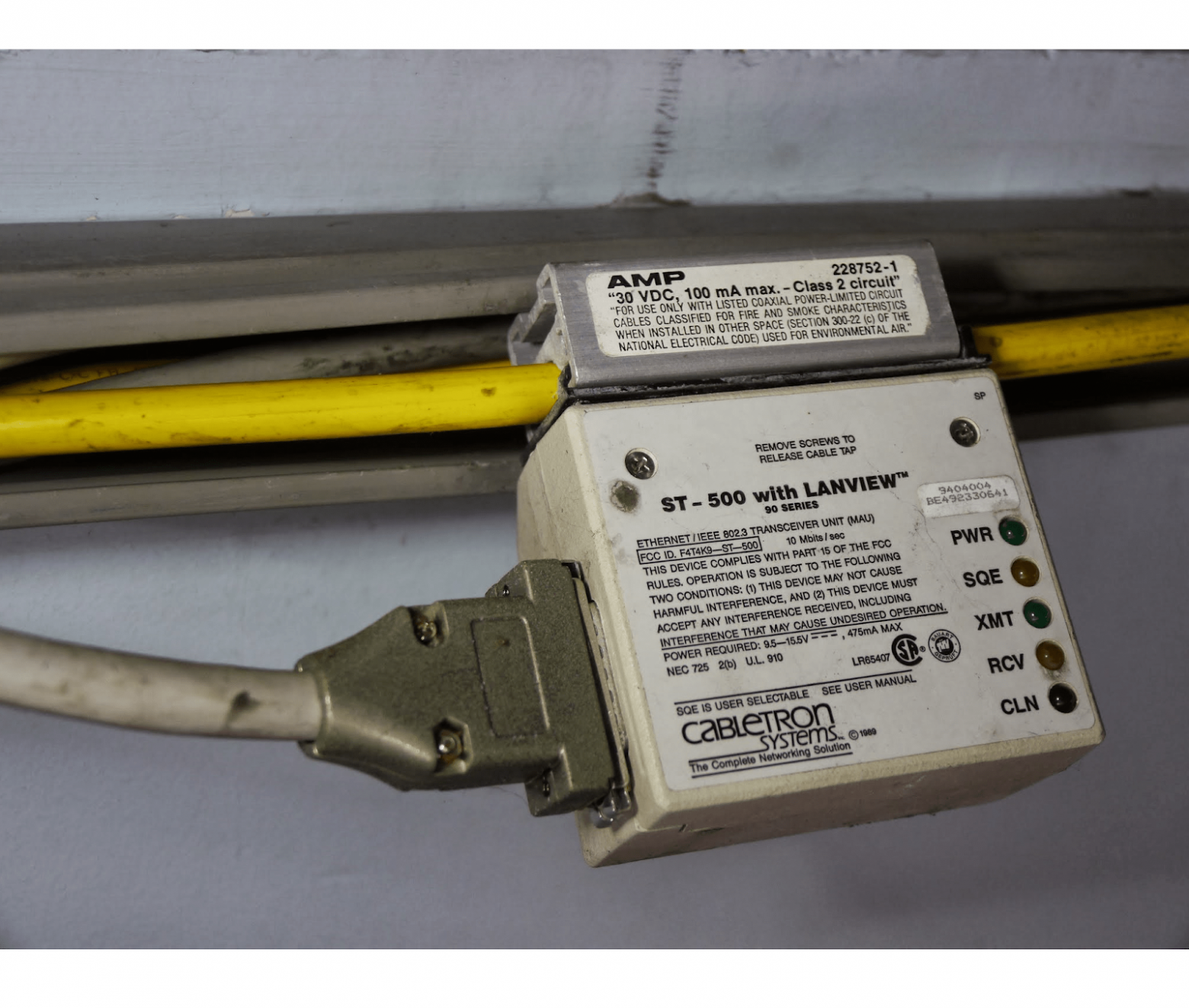
The maximum bus length of the coaxial cable itself was limited to 500 meters, which is reflected in the name of the standard. It was possible to connect up to 100 participants, and the bandwidth of 10 Mbit/s was shared by everyone. Interestingly, participants had to connect to the cable at precise intervals in multiples of 2.5 meters.
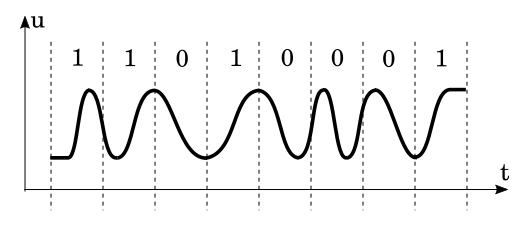
Important point: 10BASE5 used the so-called Manchester encoding. Its key feature is the ability to self-synchronize network participants due to the fact that each transmitted bit is a transition in the middle of a clock cycle from one level to another. This means that a separate line is not needed to transmit the clock signal.
1985 10BASE2 thinnet
Obviously, 10BASE5 thicknet was not very convenient for practical use, and also expensive. It was replaced in 1985 as part of the IEEE 802.3a document by a new standard - 10BASE2, also known as cheapernet (cheap network) and thinnet (thin network). The standard assumed the use of cheaper and more convenient coaxial cable RG-58. But the length of the segment was limited to 185 meters, and the number of simultaneous participants could reach 30. Simple and cheap BNC T-connectors began to be used to connect participants to the network.
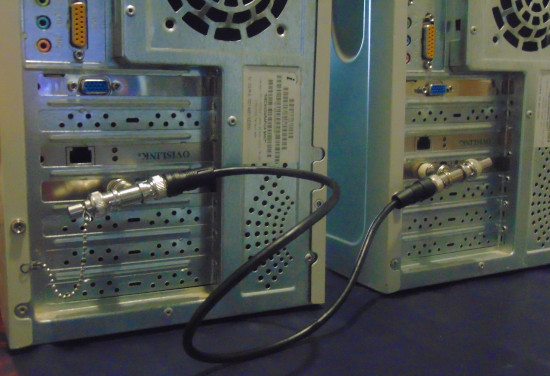
Lyrical digression: 10BASE2 was the first local network that I built and supported. I still remember without any pleasure how much effort went into diagnosing the network because of poorly crimped connectors or a cable laid in such a way that it could be touched by a cleaning lady’s mop. By the way, it’s interesting that 10BASE5 was officially declared obsolete only in 2003, and 10BASE2 - in 2011. I sincerely sympathize with those who continued to accompany him all this time.
What is important for future development brought by 10BASE2? Firstly, it helped to significantly increase the popularity of Ethernet due to ease of deployment, low cost of the solution and good speed. Secondly, it caused a problem - a reduction in segment size. To solve this problem, in the same 1985, the IEEE 802.3c standard appeared, where a repeater device was described. Repeaters made it possible to link several network segments into one. For 10BASE2, it was allowed to use up to four repeaters, and this made it possible to spread the network by as much as 925 meters. Repeaters are essentially Ethernet concentrators (hubs), without which a twisted pair network is unthinkable.
1986 1BASE5 StarLAN
And this part of the story usually remains behind the scenes. In 1986, the IEEE 802.3e document was published, which described a twisted-pair Ethernet network. The network was named StarLAN, since the standard used a star topology from a central node, unlike 10BASE2 and 10BASE5. An early version of StarLAN was developed by Tim Rock and Bill Aranguren of the company AT&T Information Systems back in 1983.
Why twisted pair at all? And it’s all very simple: at that time, twisted pair cables in the USA were very actively used for regular telephony in offices, just as “noodles” were used in the USSR. Imagine if, instead of installing an additional network of coaxial cable, you could use your existing telephone infrastructure. This is such a saving of effort and money.
So, even the signal modulation and wire pairing used in StarLAN were carefully selected so that they do not affect or be affected by the analog signal of a regular telephone call.
Moreover, the well-known standard TIA/EIA-568-B - this is nothing more than a standard AT&T 258A (Systimax), which was originally developed specifically for StarLAN. Pair 1 (blue) was left unused to accommodate the pair for analog phones. Pairs 2 and 3 (orange and green) provided the transmission of StarLAN signals. Yes, and the 8P8C telephone connector was invented by Western Electric, it owned it Bell System, which was then broken up into several smaller companies. One of these companies was AT&T Information Systems.
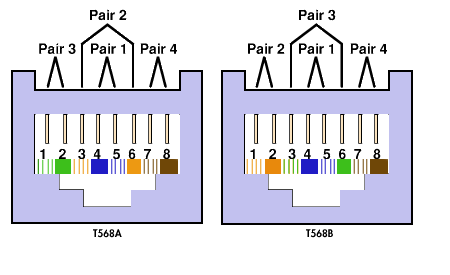
Why was StarLAN called 1BASE5? The first number is the maximum speed (1 Mbit/s), the second is the maximum link length (up to 500 meters depending on the cable quality and conditions). Two pairs were required for operation: one for reception, the second for transmission. StarLAN also supported the use of up to five hubs simultaneously. Well, plus the same Manchester signal coding.
1987 LattisNet
In 1987 the company SynOptics Communications, formed by people from Xerox PARC, introduced the first network hub that supports data transfer at a speed of 10 Mbit/s over unshielded twisted pair cable over a distance of up to 100 m. As well as its own variation of an Ethernet network running on top. The network was named LattisNet. It reminds me a lot of something, doesn’t it?
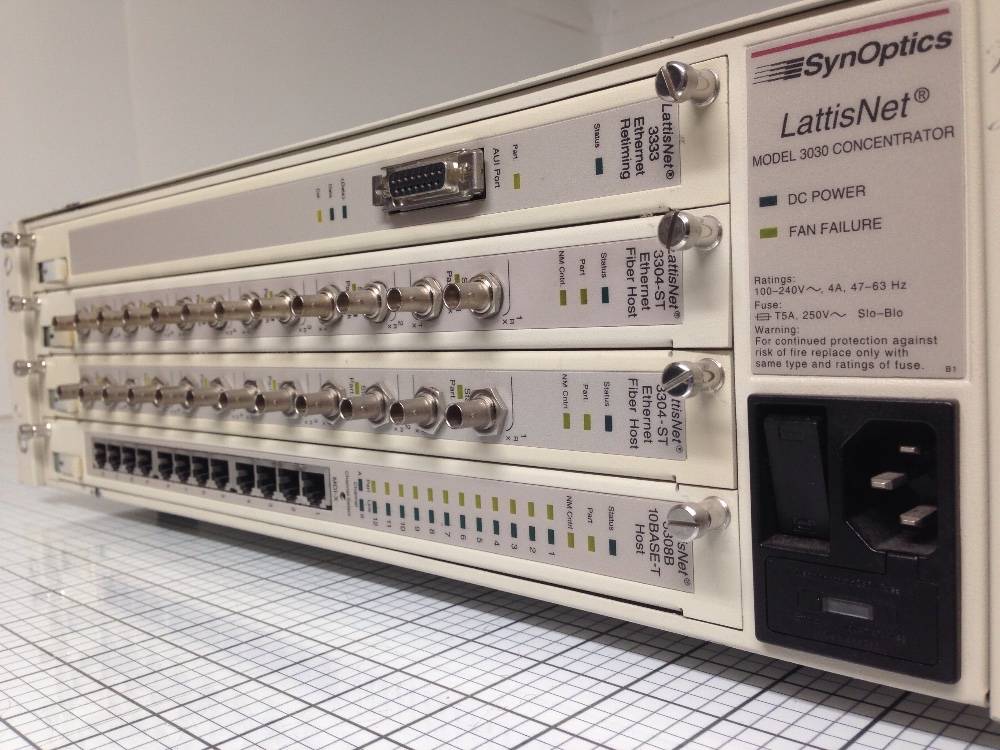
1988 StarLAN 10
Following LattisNet, StarLAN also upgraded the network to support 10 Mbit/s over hundred-meter sections of unshielded twisted pair cable.
The situation was heating up. And then there are the networks Token Ring from IBM with their 16 Mbit/s.
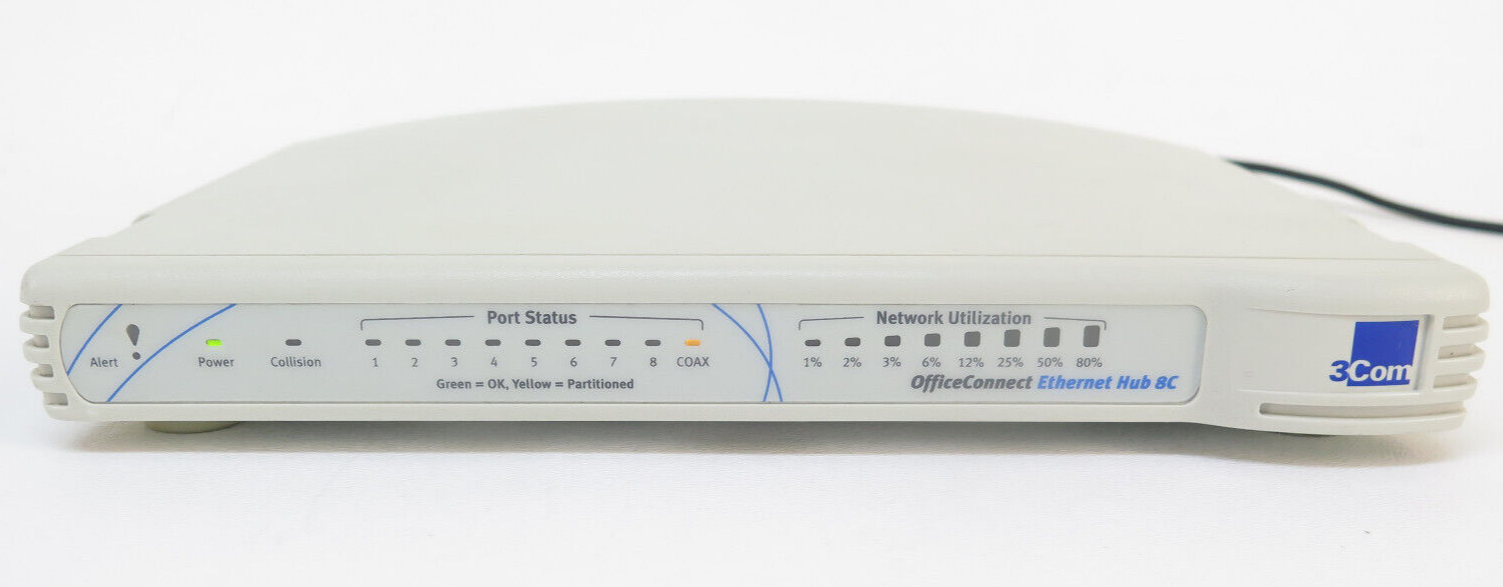
1990 10BASE-T
And in 1990, having collected all the developments and secured consent to transfer the patents, IEEE released the 802.3i document, which defines the use of unshielded twisted pair (UTP) for data transmission at a speed of 10 Mbit/s (1.25 MB/s) in a star topology. The one is born 10BASE-T, which laid the foundation for all NBASE-T standards. 10 in the name of the standard is the maximum speed (10 Mbit/s), T is twisted pair, that is, twisted pair.
What strategically new and important does 10BASE-T bring us?
It brings together the developments of StarLAN and LattisNet, freeing them from patent restrictions.
Unifies signaling and data coding.
Prescribes a star topology specification, although internally it is still a bus.
Specifies the requirements for the unshielded twisted pair cable used (UTP Cat 3).
Adds a so-called link beat signal to quickly determine the presence of an active connection between nodes.
1990 Kalpana
Let me remind you that the Ethernet network, even the latest 10BASE-T standard, worked according to the method CSMA/CD. If, while transmitting a frame, the workstation detected another signal occupying the transmission medium, it stopped transmission, sent an interference signal, and resent the frame after some random time (here is the whole algorithm). Imagine a bazaar where a bunch of buyers and sellers are talking loudly, trying to shout over each other. Ethernet was about as effective with a relatively large number of active participants in one collision domain.
It was proposed to solve the problem by dividing network segments with routers.
Around 1990, a new product entered the market - the Kalpana Ethernet Switch EPS-700. The idea was not new: back in 1986, DEC introduced the implementation of an intelligent bridge LANbridge 100. But the EPS-700 made it possible to combine up to 7 network segments in one chassis, providing a throughput of 30 Mbit/s and a latency of only 40 μs. At the same time, the cost of the port was only around $1500, which was much cheaper (and much faster) than using routers.
The second major innovation was full duplex. Two of the seven ports could be used to connect to another switch. In this case, one of the ports worked only for transmission, and the second only for reception.
And thirdly, Kalpana invented the EtherChannels link aggregation technology.
It's funny that the EPS-700 did not meet the requirements of the standard to be called a bridge, so the marketers simply came up with a new fancy name Switch. This is how switches came into being. And the Kalpana company itself was absorbed by Cisco Systems in 1994.
1995 100BASE-TX
Five years passed, Ethernet was gradually conquering the world, and the consumer wanted more. And in 1995, IEEE 802.3u was born, which describes a series of physical layer standards for data transmission in Ethernet networks at a speed of 100 Mbit/s (12.5 MB/s) over both optical fiber and twisted pair.
For twisted pair, 802.3u offered two options, both with 100 Mbps over sections up to 100 m. The cable requirements differed.
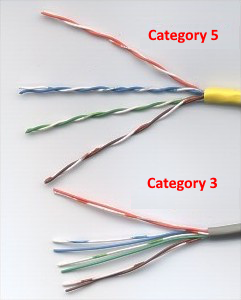
100BASE-TX required two pairs in a Cat 5 cable: one pair worked for reception, and the other for transmission in full duplex.
100BASE-T4 required four pairs, but in a Cat 3 cable: one pair was allocated for transmission, one for reception, but the remaining two could work both for reception and transmission, but not at the same time. In other words, there was no full duplex here.
100BASE-T4 did not catch on, but it introduced the idea of parallel data transmission over several conductors, which we will see a little later. Plus 100BASE-T4 was the first to use PAM-3 modulation, which was also not in vain.
100BASE-TX was accepted by the market, and it, like twisted pair cable of the fifth category, began to be actively implemented. By the way, it is widely used even in new products to this day. What benefits did the new standard bring, besides speed?
First of all, this is the rejection of Manchester coding. It required twice the symbol rate, which for 100BASE-TX would be 200 MHz, which is a lot. They were replaced by a 4B/5B combination for redundant coding and a three-position MLT-3 (Multi Level Transmission - 3). The peculiarity of this approach is that you can significantly save on the frequency required for data transmission. In particular, 31.25 MHz of bandwidth is sufficient for 100BASE-TX operation, although taking into account 25% redundancy, the actual data transfer rate is 125 million symbols per second.
Twisted pair cable of the third category is not designed for frequencies above 16 MHz. Even the now exotic fourth category of twisted pair cable allowed a maximum of 20 MHz. We had to change the standards. Hence the requirements for the presence of the fifth category of twisted pair (Cat 5), which guarantees the passage of signals with a frequency of up to 100 MHz.
And finally, full duplex. Instead of working on a common bus, it was proposed to use one pair only for transmission, and the second only for reception. This made it possible to significantly reduce delays (according to some sources, up to five times) and obtain a total throughput of 200 Mbit/s (100 in each direction). There was only one “but”: full duplex is only possible using switches, which at that time were obscenely expensive. I can assume that the technology was supposed to be used for the aggregation level, but it turned out differently - cheaper switches began to appear on the market and collision storms, fortunately for everyone, gradually became a thing of the past.
The story of 1995 would not be complete without this moment: that same year, a competing standard from Hewlett-Packard was released: IEEE 802.12–1995, known as 100BaseVG. The standard, like 100BASE-T4, offered operation over four Cat 3 pairs in half-duplex mode: all four pairs either transmitted or received data. VG is voice grade, just about the twisted pair category. 100VG-AnyLAN, as it was also called, despite being half-duplex, offered better network utilization through the use of a so-called data transfer token, which was previously used in Token Ring networks. Unlike Token Ring, the token in AnyLAN did not leave the hub, which made it possible to utilize up to 95% of the theoretical capacity of the network, while the 100BASE-TX and 100BASE-T4 standards produced 45% when using hubs. Although with switches, Ethernet efficiency has already reached 96%.
1997 100BASE-T2
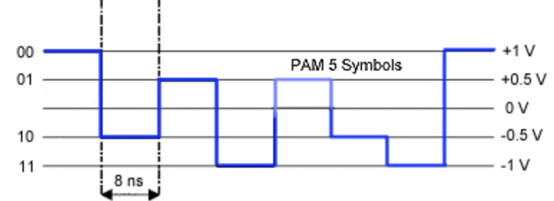
Another attempt to reuse the existing cable infrastructure was made in 1997 with the advent of the IEEE 802.3y standard, which described 100BASE-T2. The standard offered the same 100 Mbit/s, but over two Cat 3 pairs. This was achieved through complex signal coding and modulation using the PAM-5 method (Pulse Amplitude Modulation with 5 levels). PAM-5 uses 5 voltage levels to encode the signal, which allows you to encode two bits of data in one symbol and leave another level for error search/correction algorithms.
The standard died safely, but the PAM-5 modulation method has taken root.
1999 1000BASE-T
And finally, we have reached the peak of technological excellence of the last century in terms of speed and convenience of data transfer. In 1999, IEEE 802.3ab appeared, which describes 1000BASE-T - transmission at a speed of 1 Gbit / s (125 MB / s) over unshielded twisted pair cable of the fifth category (Cat 5). I’ll add right away that the engineers were overly optimistic about the quality of the cable products being sold, and already in 2000, the requirements for cable quality were tightened by introducing a new category - Cat 5e. It should be noted that a high-quality Cat 5 cable also met the requirements of Cat 5e.
So how did they do it? Look how it all turned out.
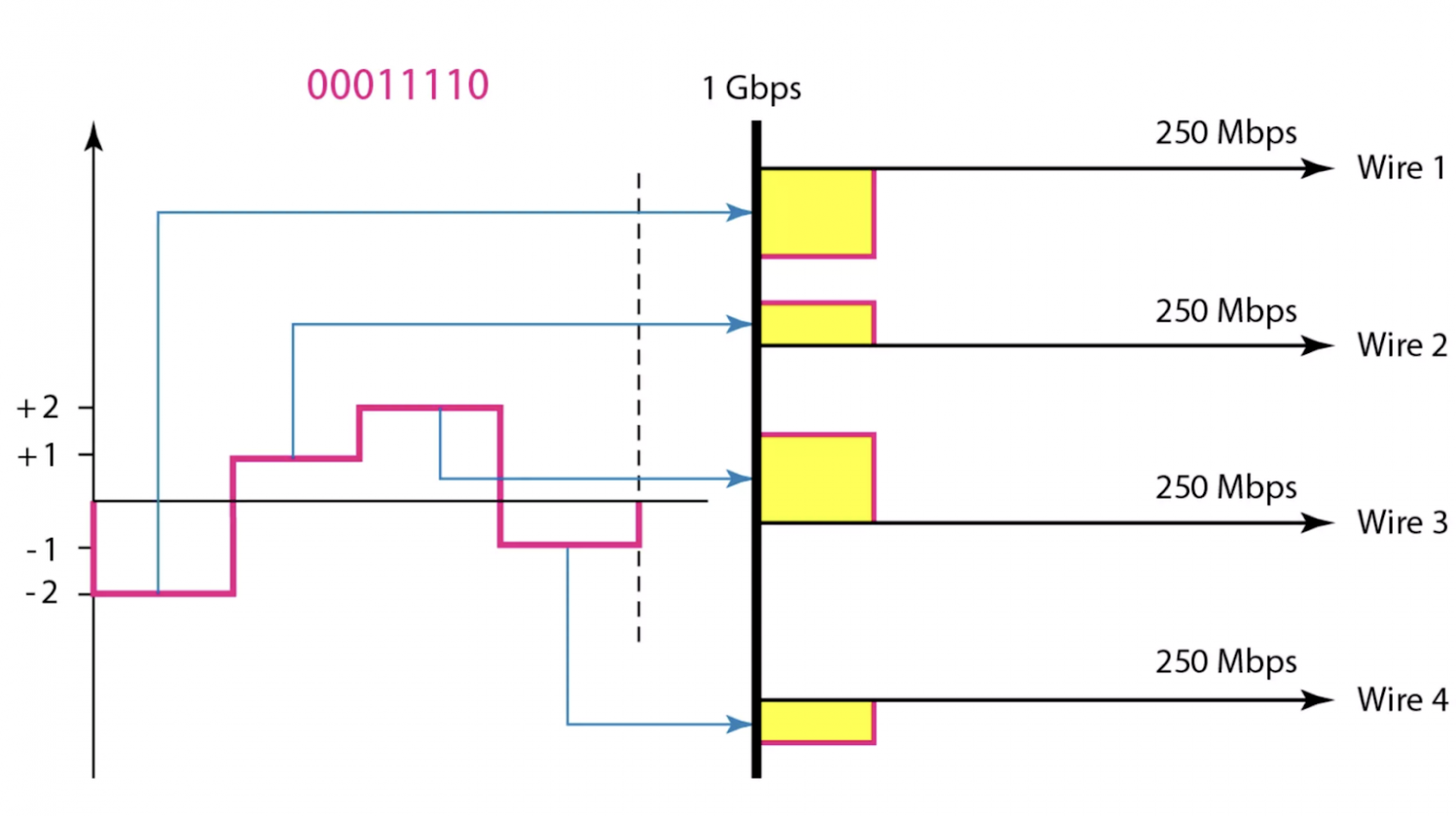
The standard uses all four pairs of conductors, that is, there is no half-duplex, dedicated pairs for reception/transmission or telephone signal on the first pair.
All pairs can transmit and receive data synchronously thanks to clever echo cancellation, filtering and crosstalk compensation.
Each byte of transmitted data is divided into four parts of two bits, and these parts are transmitted in parallel over four pairs (came from 100BASE-T4).
For modulation, 4D-PAM-5 is used (essentially taken from 100BASE-T2), which allows you to fit two bits into one symbol. That is, in one clock cycle, an entire byte is transmitted over four pairs.
Since PAM-5 uses five fixed voltage levels, and four are enough to encode two bits, the fifth (zero) is used for error correction, which helps offset the costs of redundant encoding.
Thus, the maximum data transfer rate over one pair increases from 100 Mbit in 100BASE-TX to 250 Mbit in 1000BASE-T.
Frequency range requirements double to 62.5 MHz, but still remain within the capabilities of Cat 5 (and Cat 5e).
The 1000BASE-T standard highlighted three main subsequent directions for the development of the Ethernet network:
Parallelization of transmission. For a twisted pair cable on a standard connector, four transmission lines are already the limit, but for optical fiber it is not at all.
Increasing the maximum data transmission frequency and reducing interference. And this is a very sore subject for twisted pair cables.
Complication of coding algorithms. On the one hand, this means transmitting more bits per clock cycle. On the other hand, special preliminary signal preparation, error detection and signal recovery algorithms, as well as the modulation itself reduce the requirements for the quality characteristics of the cable.
It was along this vector that Ethernet developed over the next 25 years. Let's see exactly how. In order not to go into the weeds, I will only talk about networks built on the basis of unshielded (but sometimes foil-coated) twisted pair.
2006 10GBASE-T
So, seven years have passed since the release of gigabit Ethernet. The standard for ten-gigabit Ethernet over fiber (802.3ae) appeared in 2002.
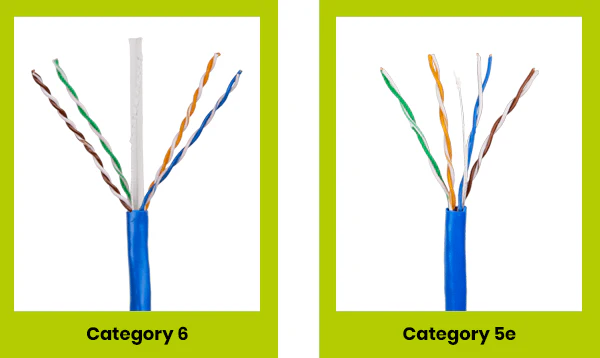
It is worth adding that in the same year a standard for twisted pair cable of the sixth category (Cat 6) appeared. It was served with sauce: with the sixth category, you will definitely be ready for the ten-gigabit networks that are about to appear. After all, Cat 6 guaranteed signal transmission at a frequency of up to 250 MHz. An attentive reader will immediately compare 250 MHz Cat 6 and 100 MHz Cat 5 and Cat 5e and will not see a tenfold increase. And he will be absolutely right: a miracle did not happen. As a result, Cat 6 was approved to operate at 10 Gbps only for short sections.
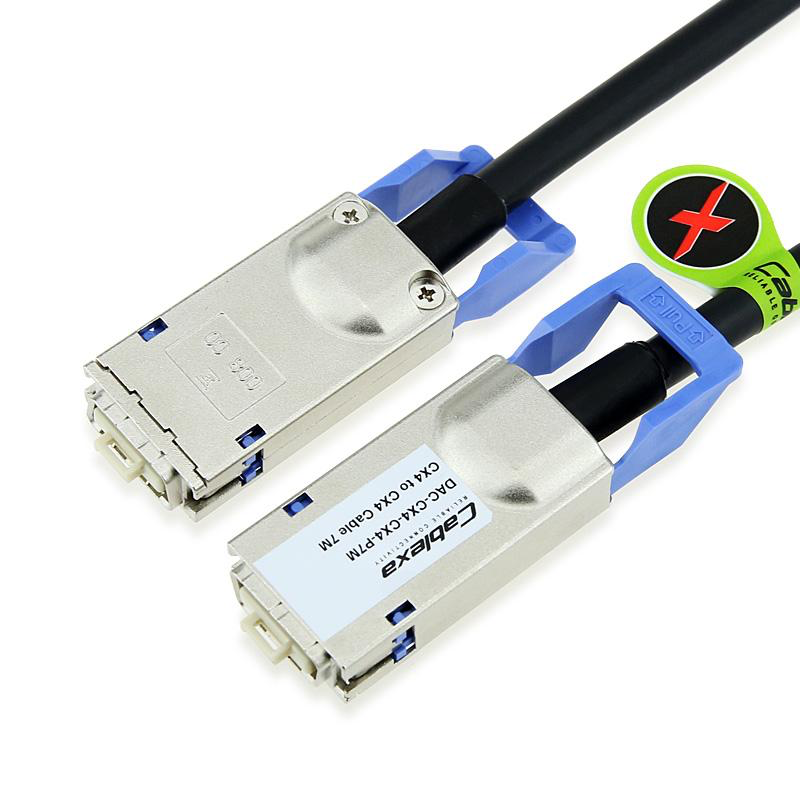
We continue to analyze the complex path of the birth of ten-gigabit Ethernet over twisted pair. In 2004, a transmission standard over twinaxial cable (10GBASE-CX4, 802.3ak) appeared, which was well accepted by the market, as it allows solving switching issues inside racks. Later they were replaced by more convenient DAC cables (Direct Attach Copper) with SFP+ or QSFP connectors at the ends.
And only in 2006, 802.3an, also known as 10GBASE-T, was finally released. Engineers spent four years thinking and experimenting on compacting the signal in UTP. They succeeded, but it was very difficult and expensive.
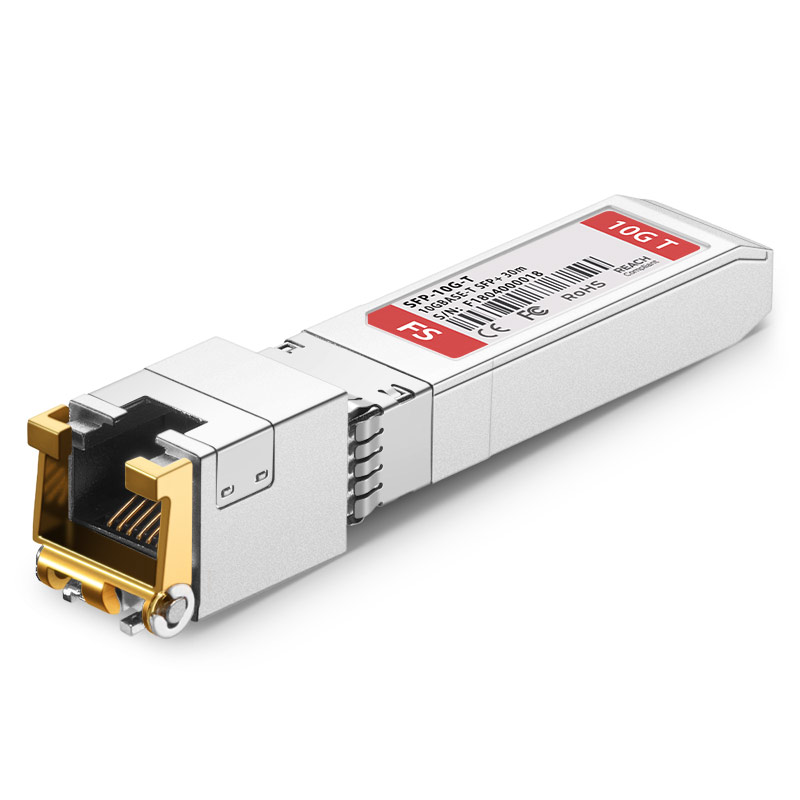
To transmit the signal over short distances, up to 55 meters, unshielded twisted pair Cat 6 was required (maximum signal transmission frequency - 250 MHz). For transmission to areas up to 100 m, category 6a was already required (long live the investments in the future made by someone earlier). Cat 6a provided signal transmission at frequencies up to 500 MHz. And yes, this was already a breakthrough. But how was it achieved?
And they achieved it through complex data coding: a combination of PAM-16 and DSQ128 algorithms. If 4D-PAM-5 from 1000BASE-T could transmit two bits per clock, then PAM-16 is capable of transmitting four.
As a result, 10GBASE-T appeared on the market in the form of real-life ports two years later, in 2008. Unfortunately, he probably hasn’t become successful yet. There are at least three reasons for this:
Firstly, the Cat 6a is expensive and quite uncomfortable. The cables have become significantly thicker due to foiling and the appearance of a dividing cross. The connectors have also changed a little. In offices, no one will upgrade SCS to ten gigabits - where one gigabit is usually more than enough. As a rule, data centers already have fiber optics. For home users, the price is exceptionally high. Who is the consumer then?
Secondly, 10GBASE-T interfaces consume quite a lot of power and get noticeably hot.
Thirdly, compared to fiber optics, 10GBASE-T shows ten times higher latency per link. Here are the results measurements taken are confirmatory.
As a result, the standard remained niche and somehow did not catch on. But not everything is so bad, the engineers made conclusions, and now we will see what happened ten years later.
2016 2.5GBASE-T and 5GBASE-T
17 years after the emergence of the 1000BASE-T gigabit standard, what should have appeared with a reduction in the cost of the element base for implementing complex modulation algorithms appeared. Engineers from companies that are members of the Ethernet Alliance decided to apply the algorithmic developments of 10GBASE-T to widespread cable systems based on Cat 5e and Cat 6. And yes, PAM-16 modulation (and everything else that is in there) over Cat 5e made it possible to get 2.5 Gbit/s over sections of up to 100 meters, and over Cat 6 - 5 Gbit/s. Both physical standards, 2.5GBASE-T and 5GBASE-T, were published in one document - IEEE 802.3bz.
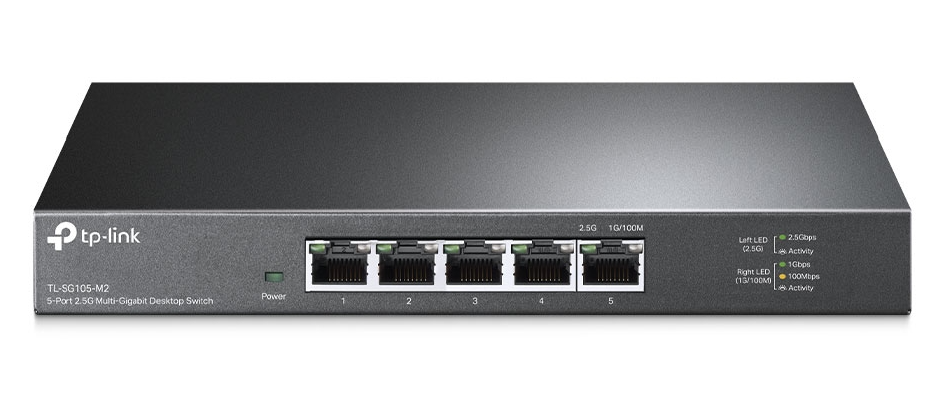
It is interesting and even unique that within the same document support for Power over Ethernet (IEEE 802.3at, PoE+) was recorded. Thus, the authors of the document very strongly hint that both of these standards are primarily intended for connecting Wi-Fi 5 and more modern access points that require more than gigabit uplinks.
From my own practice of home use: I tried to connect 2.5GBASE-T devices to an existing and rather old Cat 5e cable system, and... everything went well, they worked great. In my opinion, this is the very modern sweet spot that you should focus on when building home networks.
But 2016 did not end there.
2016 25GBASE-T and 40GBASE-T
Yes, in the same 2016, not only Ethernet standards over twisted pair at 2.5 and 5 Gbit/s were released, but also two more super-fast standards at 25 and 40 Gbit/s.
“How did they do it?” - you might ask. But in reality there is no magic here. Well, except for the magic with which it is planned to find consumers of these standards. The most significant thing that has changed regarding 10GBASE-T is the cable requirements.
Now you need a cable with a frequency range up to 2 GHz. And this, let me remind you, is four times more than what Cat 6a offers, which 10GBASE-T requires.
The second requirement, or rather limitation, is the maximum length of the section. Both standards offer a maximum of 30 meters versus 100 meters previously.
For stable operation with 40 Gbps ISO, the version of the standard recommends using Cat 8.2, which, in particular, requires other connectors: TERA / GG45 / ARJ45.
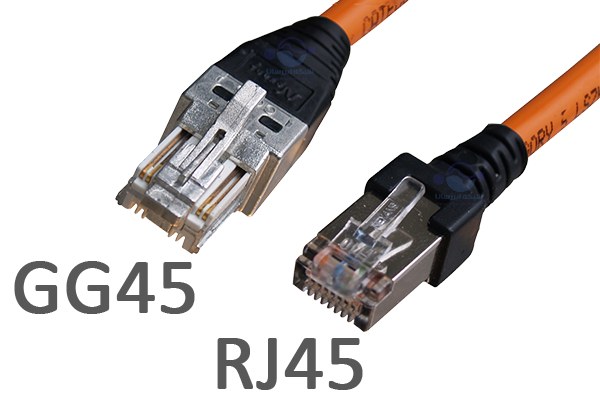
I'm sure you've often seen foiled Cat 7 cable on sale, advertised under the slogan "investment in the future." So, it does not meet the requirements of both standards. The question arises: why is it needed if Cat 6a is enough for 10GBASE-T, and Cat 8 is already needed for 25GBASE-T? I didn't find the answer. It seems that we have already seen this story with Cat 6. But it is reassuring that Cat 6 has been completely revived for 5GBASE-T.
Fun fact: the new Cat 8 cable is significantly thicker than Cat 6a. For example, American Tech Supply's Category 8 outdoor cable has a diameter of 9.9 mm, which is 0.9 mm larger than the so-called thick coax cable that started it all.
Both standards use the lighter-weight PAM-4 modulation, which allows two bits of data to be transmitted in one symbol, just like PAM-5, but with less power. To increase noise immunity and reliability of data transmission, the LDPC coding algorithm is used.
Will these standards survive? Quite doubtful. As of today (2024), I could not find freely available devices that support them, although such products certainly exist. In addition, the question of replacing the cable and, probably, patch panels again arises.
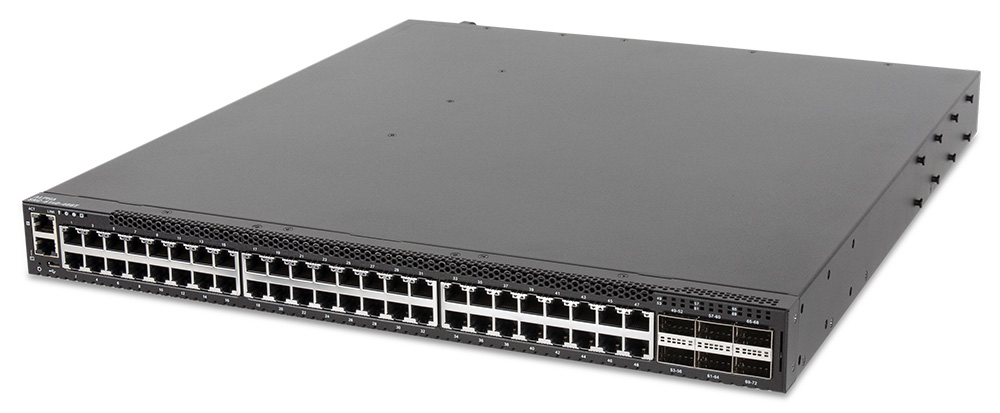
It seems that this is where the history of using twisted pair cables in an Ethernet environment ends, since for switching in a rack it is easier and cheaper to use a twinaxial cable or a fiber-optic patch cord, and for everyone who cares about network performance, the racks have long been supplied only with optics. Users in offices and homes, as well as various devices that do not require bandwidth, are on Wi-Fi.
Ethernet, of course, has an ace up its sleeve: Power Delivery. After all, the same access points, video cameras or self-service kiosks somehow need to be powered. Additionally, if there are many consumers, Wi-Fi may not always be a good option. But if you think that Ethernet has resigned itself to development in such a narrow segment, then you will be surprised.
2016 1000BASE-T1
I immediately apologize for the slight manipulation. I should have written “2015” in the title, but this somewhat broke the chronology of the story.
So, in 2015, the IEEE 802.3bw document was published, and in 2016, IEEE 802.3bp with descriptions of the 100BASE-T1 and 1000BASE-T1 standards, respectively. These standards describe the operation of an Ethernet network over twisted pair cables. On a single twisted pair cable, however, limited in length to 15 meters.
Why is this necessary? Cars! Modern cars have many sensors that transmit readings to the corresponding controllers via some kind of bus, for example CAN. And the CAN bus works - that’s a success! - over twisted pair. As a rule, all these controllers and sensors belong to different circuits. And, for example, a rear view camera cannot just be taken and connected to a new consumer, for example, to an application that will recognize the license plates of cars driving behind. The idea arose to unify the data transmission network inside a single car. In addition, the need for data transfer speeds between devices is growing. And in general, the market is already large, and competition is wonderful.
By the way, an interesting fact: 100BASE-TX appeared inside the car back in 2008 - on the seventh series BMW for connection to the OBD2 diagnostic port.
Welcome to the wonderful world of automotive Ethernet!
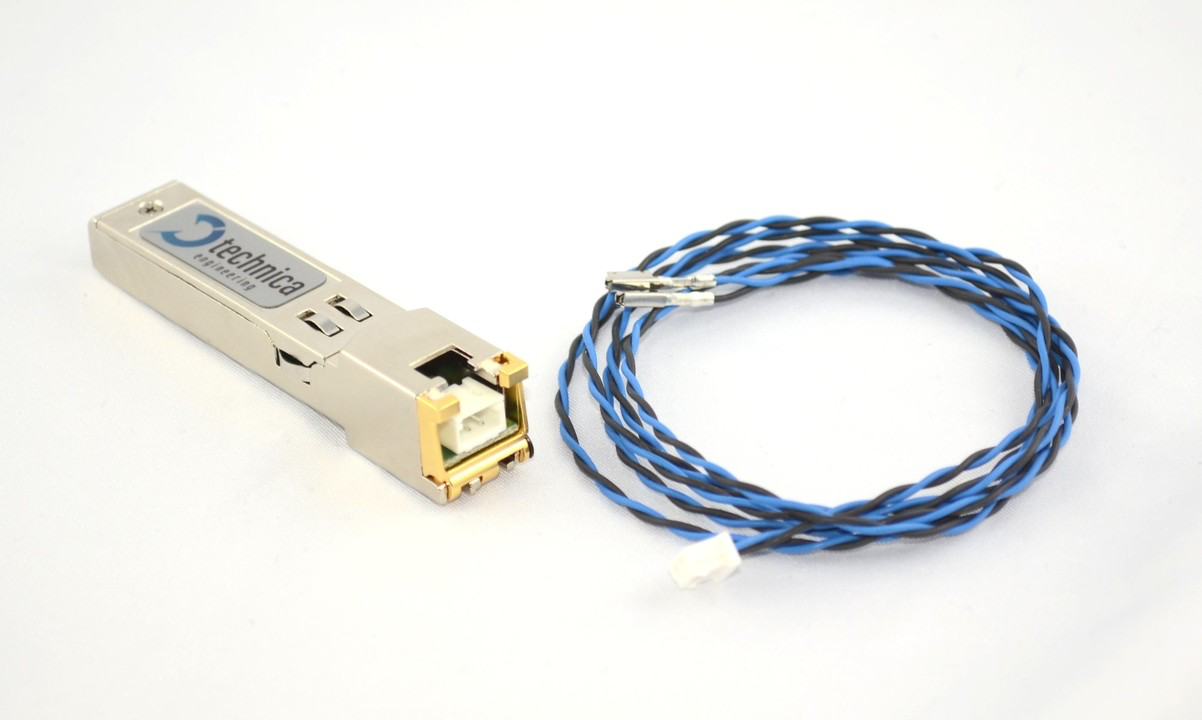
2019 10BASE-T1L and 10BASE-T1S
There is no mistake in the title: the speed of the new standards is indeed 10 Mbps. And yes, it's 2019, almost 30 years after 10BASE-T was introduced. But everything has its reasons. Let's see what these standards are.
Both of them operate only in full duplex over one pair of wires, capable of providing a frequency range of 20 MHz (which is close to the 16 MHz that 10BASE-T required).
10BASE-T1S is intended primarily for use in cars and can operate at a distance of up to 15 m in bus mode, and even uses Manchester encoding. Ethernet 10 Mbps in bus mode? What year is it now? I’ll also add that the network uses something like a token to work without collisions, and let me remind you about VG-AnyLAN and Token Ring. Hello again from the eighties. But it is obvious that a bus in cars is more convenient than a point-to-point connection, so we had to take this step.
10BASE-T1L operates over areas up to 1,000 meters and supports Power over Data Line (PoDL) power delivery technology. The modulation used is PAM-3, which came from 100BASE-T4 (1995). Obviously, the standard is aimed at promoting Ethernet in industrial networks. We don't have enough cars anymore. Let me remind you that the Ethernet Alliance is a consortium of very large suppliers and consumers of network solutions (list). So I would venture to guess that over the next 10 years, Ethernet will penetrate deeply into industrial networks, despite the skepticism that is heard now.
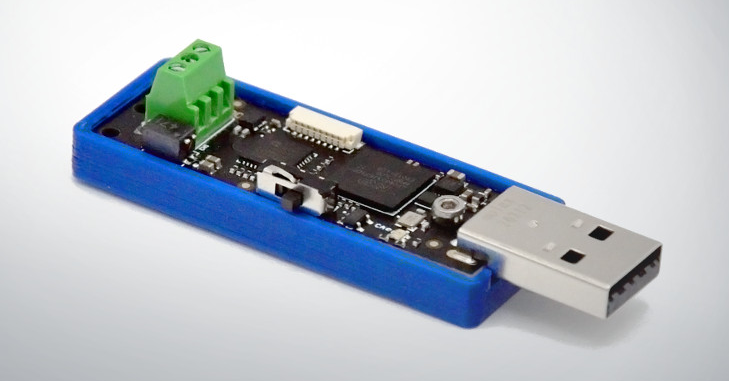
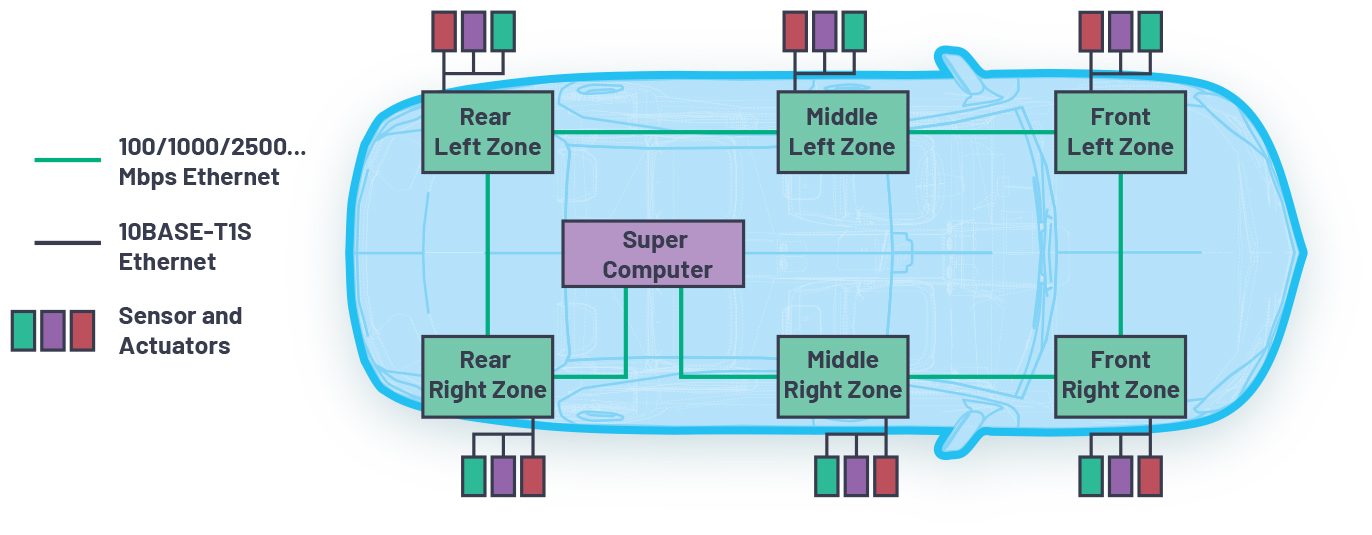
The most interesting thing for us as consumers in these branches is that it is still the same Ethernet that is familiar to us. And we can connect it to a simple home, office and other network by simply adding the appropriate port to the switch. Look at how it is proposed to organize a car network: there is both traditional Ethernet and the new 10BASE-T1S. Similar schemes can be invented with 10BASE-T1L. For example, connect all smart sensors to the building network with unified control.
What will happen next?
2020 2.5GBASE-T1, 5GBASE-T1, 10GBASE-T1
Four years later, we are jumping from 1000BASE-T1 to 10GBASE-T1 and its multi-gigabit subsets. These standards were published in the IEEE 802.3ch document.
All three standards use the same encoding and modulation algorithms (LDPC and PAM-4) as 25GBASE-T and 40GBASE-T. And they have similar requirements for the frequency characteristics of the cable; something close to Cat 8 is clearly needed.
2.5GBASE-T1: up to 600 MHz. This is where Cat 7 should be just right.
5GBASE-T1: up to 1250 MHz.
10GBASE-T1: up to 2,000 MHz.
It is important not to forget that all T1 standards (except T1L) are so far designed for very short cable sections - up to 15 meters.
2023 25GBASE-T1
In 2023, IEEE 802.3cy approves the super-fast 25-gigabit standard 25GBASE-T1 over a single twisted pair cable. All the same PAM-4 and LDPC as in 10GBASE-T1, and the same cable requirements (up to 2,000 MHz), but over even shorter sections - 11 meters.
There are no live samples on the market yet, but nevertheless, look at how interesting it is: the industry demands speeds comparable to the reading speed from a good NVMe disk for the automotive network. Any ideas for what? Are they really self-driving cars?
2025 Ethernet Alliance Plans
The immediate plans for 2025 are as follows:
IEEE 802.3da - increasing the maximum length of a 10BASE-T1S segment from 15 to 50 meters;
IEEE 802.3dg - increases the maximum segment length of 100BASE-T1 and 1000BASE-T1 to 500 meters.
It looks like the Ethernet Alliance has made a bet on single-pair networking, and we'll see a lot of interesting things there in the next few years. Yes, first of all it will appear in cars and industrial networks, but something will also come to the home and office. After all, Wi-Fi 8 (IEEE 802.11bn) is just around the corner, and they promise a throughput of up to 46 Gbps (in theory), which will need to be connected somewhere.
Conclusion
We got acquainted with the main stages of the emergence and development of an Ethernet network based on a twisted pair cable. They realized that the main problem that the developers of its new, higher-speed standards have to contend with is the frequency characteristics of the cable. In fact, unshielded twisted pair has exhausted its capabilities, and the only viable development path at present is the improvement of data preparation and modulation algorithms, which reduce the requirements for the transmission medium. Considering that the Ethernet Alliance is now very actively investing in automotive and industrial Ethernet, where combating interference is one of the most important tasks, we can be optimistic about developments in these areas. This means that we will most likely see high-speed standards that are less demanding on cables in classic Ethernet over four pairs.
And I’ll try to answer the question of what category of twisted pair cable to install at home or in the office.
If you already have a network based on twisted pair cable of category 5e, you can use 2.5GBASE-T devices and, without touching the cable component, significantly increase network performance.
If you need a low-cost yet reliable network to quickly transfer data and deliver power to devices, Cat 6 will give you a guaranteed 5 Gbps and sometimes as much as 10 Gbps. Sales of cables in this category, by the way, are now at their peak. However, I advise you to pay attention to the thickness of the conductors and not use thinner than 23 AWG (0.573 mm). Just in case: 24 and 26 AWG are thinner. In addition, it is better to connect at least two cables to the locations of bandwidth-intensive devices - access points, NAS, video servers, etc. - so that you can, if necessary, combine them into one logical port (port channel) and, in some cases, double the available bandwidth.
If you can spend more and want to be prepared for the upcoming arrival of Wi-Fi 8, Cat 6a is worth considering. It is thicker, stiffer, but now it will allow you to get 10 Gbit/s, and in the future, I think, with the appropriate development of signal processing algorithms, and 25 Gbit/s.
The ultimate option today is Cat 8. A very expensive, foil cable will allow you to use all available modern data transfer rates - of course, if you can find the appropriate equipment. But I would pay attention to fiber optics. Moreover, data transmission over plastic fiber is now being discussed within the automotive Ethernet line, which should clearly have a positive impact on both the cost of the cable and its reliability.
And think about single-pair Ethernet. It seems to me that the same T1L standard with extensions of up to 1 km and simultaneous power supply can be useful not only in enterprises. Products based on it will gradually appear, then they will become cheaper and finally come to every home. Wired Ethernet has big plans: look at fresh road map Ethernet Alliance.
Obtain a sought-after specialty or expand your competencies in online bachelor's, master's and professional retraining programs developed with leading Russian universities:
Why This Matters In Practice
Beyond the original publication, The Evolution of Twisted Pair Ethernet matters because teams need reusable decision patterns, not one-off anecdotes. Hello! My name is Maxim Kupriyanov. For about thirty years I have been working closely with global and local computer networks. Mainly at th...
Operational Takeaways
- Separate core principles from context-specific details before implementation.
- Define measurable success criteria before adopting the approach.
- Validate assumptions on a small scope, then scale based on evidence.
Quick Applicability Checklist
- Can this be reproduced with your current team and constraints?
- Do you have observable signals to confirm improvement?
- What trade-off (speed, cost, complexity, risk) are you accepting?
FAQ
What is this article about in one sentence?
This article explains the core idea in practical terms and focuses on what you can apply in real work.
Who is this article for?
It is written for engineers, technical leaders, and curious readers who want a clear, implementation-focused explanation.
What should I read next?
Use the related articles below to continue with closely connected topics and concrete examples.