The Tale of How a Provincial Kid Applied to MIT
A 17-year-old from Ufa, Russia shares his complete journey of applying to MIT — from registration and SAT prep to interviews, essays, and the final decision letter.
Hello everyone, my name is Oleg, I'm 17 years old, and today I'll tell you about the process of applying to MIT.
To preserve the narrative's integrity, it should be noted that this article was written on March 15, 2013 — the day admission decisions were announced.
When I was applying to the Massachusetts Institute of Technology, I was surprised to discover that the Russian-speaking internet had not just a lack of any halfway decent "success story" about getting into MIT, but no guide whatsoever on applying to top American universities on your own. Especially for undergraduate programs. I thought: "Well, I guess I'll have to write one myself." I'll try to present the information as clearly as possible.
The Beginning
I decided I wanted to apply to MIT about a year and a half ago, at the start of 10th grade, but for the time being, this intention seemed like nothing more than an unattainable dream, an ideal. Back then I only knew the approximate requirements, something like "you need to take, well, the SAT, TOEFL, uh… what else?" At one point I actually asked the question — what else?
In September, I went to the MyMIT website — the site that accepts applications for admission. I read through the information, took a deep breath — and decided to register. The registration process took me about twenty minutes, after which I, incredibly happy about my first small step, began waiting for an interviewer to be assigned.
After Registering on MyMIT
After registering on MyMIT, you should be assigned a person who will conduct your interview — an Educational Counselor. If you haven't been assigned an EC, you should email the admissions office.
I was assigned an EC ten minutes after registering, and — oh my God — he turned out to be Russian!
Kirill, if you're reading this, I send you my regards!
After registering, I began reading the website's information more carefully, looking for the requirements for applicants. They are as follows: you must take two SAT Subject Tests — one in math and one in a science discipline: physics/chemistry/biology. You must also choose one of three exams: SAT, ACT, or TOEFL.
A Bit About the Exams
SAT or Scholastic Assessment Test — a standardized test accepted by almost all American universities. It consists of three parts: Math, Critical Reading, and Writing. You can score up to 800 points on each, and universities usually evaluate the sum of all three parts. Taking it in Russia costs around 90–100 USD.
SAT Subject Tests — tests on specific subjects, about twenty subjects in total. They consist of 40–100 questions at a level roughly comparable to sections A and B of Russia's Unified State Exam (USE), which you must answer in one hour. You can also score up to 800 points. Five answer choices, everything is in English, of course.
Regarding the subjects required by MIT:
- Mathematics comes in two levels: Level 1 focuses on statistics and combinatorics, while Level 2 covers trigonometry, solid geometry, logarithms, and introductory calculus. You get 50 questions in one hour.
- Physics — 75 questions in one hour. Keep in mind that the American approach to teaching differs from the Russian one.
- Biology also splits into two types: Ecological and Molecular.
For two tests — Math Level 2 and Physics — I paid 78 USD.
The organizing body is CollegeBoard.
TOEFL — a test of English language proficiency. In this case we're only talking about the Internet-Based Test. It consists of four parts, each worth up to 30 points: Reading, Listening, Speaking, Writing. The maximum score is 120 points. There's a ton of information about TOEFL online that you can find on your own. Taking TOEFL costs 250 USD.
The organizing body is ETS.
ACT — some esoteric alternative to the SAT. Don't take it, guys.
In addition to the exams, you must send two recommendation letters: one from a humanities teacher and one from a math or science teacher. You must also have your vice principal or principal fill out a Secondary School Report — this is your GPA, along with a questionnaire evaluating you on various criteria. Also, in your application, you must write two short responses (100 words) and three essays (250 words) about yourself on specific topics.
Deadline — January 1, 23:59 EST. There are actually two deadlines: November 1 and January 1, but don't rush, my little applicants: the November 1 deadline is only available to US citizens. And Canada, I think.
It should be noted that at most top American universities, deadlines range from December 1 to January 3. At mid-tier universities, the deadlines are much more forgiving.
Now, let me go through everything in order.
The Interview and Exam Registration
September 6. Panic. At the time, I thought the deadline was November 1, and registration for the last available SAT date — October 7, I think — closed on September 7. I was terrified that I'd have to take the exams in just a month, but then I read everything properly and the weight lifted off my chest.
I decided not to procrastinate and immediately wrote to my interviewer. He responded, saying he was currently busy with other things and that I could schedule an interview in October. Meanwhile, I decided to sort out the exams. I chose to take the TOEFL and SAT Math II/Physics.
A Very Important Note for Those Applying to the US
Here I need to mention one very important point: I only applied to MIT, ignoring other universities. Only later did I realize how reckless that was. If you intend to apply to several top universities at once, you should note that MIT has a fairly logical policy for test selection for international students. Many other universities don't. Caltech, for example, requires both the SAT and TOEFL, and it's like that at most universities. On the other hand, you can get into Princeton without the SAT at all (though if you actually get in that way, I'll build you a monument — but the option is technically there).
Despite the fact that my English was pretty decent, I had to go to a TOEFL tutor for the first time in my life. Amazingly, since then my English became significantly better. My confidence especially grew. I would recommend that you find a specialist one way or another.
September and October flew by quickly. I went to my tutor once a week, completed a large number of TOEFL practice tasks, and blew off the SAT Subject Tests, figuring they were elementary. That was another mistake, the consequences of which I'll describe below. I decided I would take the SAT Subject Tests on December 1 in Moscow, and TOEFL on December 22 back home in Ufa.
I exchanged messages with my interviewer, and we agreed on November 11. The interview was over Skype and lasted an hour and a half. Interviews are conducted by MIT master's program graduates, so it consists of two parts: for the first half, you answer questions about yourself; for the second half, you ask questions about MIT. The interview went smoothly — I was told the report would be positive. I was pleased as punch.
Meanwhile, December was approaching.
The Exams
For two months I prepared for TOEFL, and only on November 27 did I turn my attention to the SAT. And I was plunged into despair, because it was not easy at all. Sure, the individual questions were manageable, but there were too many of them. I found a wonderful website that I recommend to you as well — SparkNotes — on this site you can immediately take several practice SAT, GRE, and GMAT tests, see your results and their in-depth analysis. Unfortunately, I also got sick around then, and for the remaining three days I tortured that website, squeezing out everything I could.
I should note that my first attempts at math and physics weren't particularly impressive — 670 points each. On my second try, I scored 780 on math, but I couldn't get physics above 710. I started a special notebook where I analyzed every mistake and looked for solutions.
Test day. I needed to bring a printed Admission Ticket, my passport, and just in case, my international passport, and show up at 7:45 AM at MUM (a fancy school for rich kids on Leningrad Prospect, where the Dean of the Faculty of Large City Management was Luzhkov, lol). The problem was that I had to get there from the Minsk Highway, and I had no idea where the place was. When I arrived at the Belorussky Railway Station, I realized what a horrible jumble of buildings Moscow is — I fell out of love with the city that day.
We arrived, and there were about thirty to forty people there. Everyone seemed quite sharp, which sent me into a depression first thing in the morning. However, it turned out that almost everyone there was a Muscovite who was taking the SAT not for the first time because they had already messed up. And that was a pretty cool feeling, but it only hit me after the test — during the exam I was beside myself.
How the Exam Works
You're seated in classrooms, given test booklets covering all subjects and answer sheets where you can write up to three tests. You can change your list of subjects on test day, unlike the Russian state exam. You listen to the briefing, fill in your answer sheets, then one by one you mark the subjects you're taking, the timer starts, you open the booklet to the right page and take the test. The booklet itself is your scratch paper. They'll give you pencils there. You can only use a calculator on math, but it can be the fanciest one you want — you can even use graphing calculators like the TI-86.
The hour is up — you step out of the classroom for a break. If you're afraid of filling in the answer sheet as you go, leave five minutes to spare. I learned this the hard way: I didn't have time to fill in the bubbles on math, and only through begging was I barely allowed to fill in my sheet during the physics section.
I walked out, and I was shaking all over, even though I'm usually calm. I thought I had bombed physics and was hoping for math. Results were supposed to come on December 20, and those were very nerve-wracking three weeks. Finally, the results arrived.
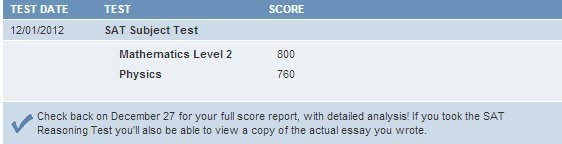
I was the happiest person on Earth.
A bit of statistics: most MIT students have scores between 760 and 800 on math and between 740 and 800 on their science subject. I fit these benchmarks more than perfectly. All that remained was TOEFL.
I took the TOEFL on December 22 in Ufa. After an hour of waiting in a freezing classroom, I got terribly nervous again. I was very worried about the Speaking section, since I can't answer those questions quickly — that's a problem for me. I won't go into detail — I'll just say that I also thought I had failed TOEFL and scored about 60 points.
To get into MIT, you need a minimum TOEFL score of 90; the recommended score is over 100. On January 4, my results came in, and I was stunned again:

My chances of admission were growing rapidly.
New Year, Fussing with Recommendations and Essays
New Year was relentlessly approaching, and with it the deadline, but I had neither essays nor recommendations ready. I had a very awkward situation with the recommendations: I had asked for them in early December, they agreed to give them, then suddenly refused on a whim, and then, already in the twenties of December, took their words back. In short, by the end of December I had no recommendations. I won't lie — I had to write them myself. However, the problem was that they needed to be sent on official letterhead from my school, and I didn't manage to get them done before my lyceum building was sealed for the holidays. So I was left without a recommendation, but to my good fortune, the document deadline was extended all the way to February 1! I immediately ran to the lyceum when it reopened and got everything done. One recommendation was actually written for me, and the second was approved by its "author."
At the same time, I had to fill out the application. Let me tell you a bit about the essays that were required. The art of writing MIT essays is best described in Chris S.'s article Show, Don't Tell!
For Those Too Lazy to Read the Article
For MIT you need to write two extended responses to two questions in 100 words and three essays of 250 words.
In the first short response, you basically need to talk about something you do for fun. I wrote about drawing epic pictures and aspiring to become like Toshihiro Egawa, but there were some absolutely fantastic essays — for instance, one person wrote about experimenting with methods for treating nearsightedness.
In the second short response, you need to write about which major at MIT is closest to your heart and why. Hello, Electrical Engineering and Computer Science!
The first essay is about the most appealing trait of your personality. I was totally stuck on this one — I'm not going to say what I wrote.
In the second essay, you're asked to describe your environment, your everyday life, and how they influenced your aspirations and dreams.
The last essay is about the biggest challenge of your life. You can also describe a situation where something didn't go according to plan, but you somehow managed to fix everything.
I started writing essays on December 30 and finished at 5 AM on January 2, so here's the most important piece of advice:
Never leave everything until the last moment!
At this point, all I needed to do was send in my semester grades. I did that, and so my application was complete:
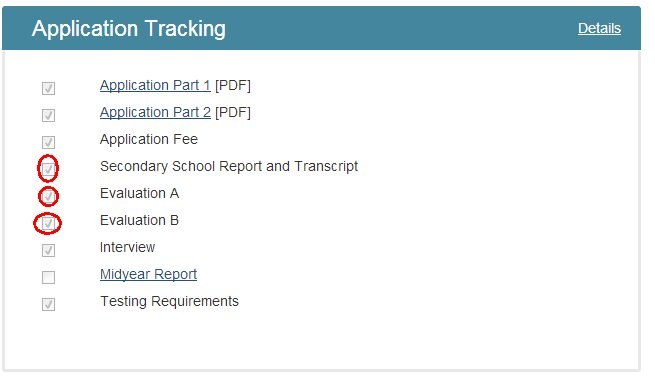
The requirements list has only survived in this format — please don't be upset.
The Financial Question
Those of you who haven't fallen asleep by this point are probably most interested in the question of tuition costs.
The cost of tuition with on-campus housing for the current academic year is 57,010 USD, 42,000 of which goes toward tuition and the remaining fifteen thousand toward campus, textbooks, and meals. I should say that I'm from an ordinary family, so I don't have that kind of money. To be honest, MIT was only a realistic option for me with full financial aid, which was possible to get — difficult, but possible.
To qualify for financial aid at MIT, you need to do several things:
- Fill out the CSS Profile on Collegeboard.org. It costs 25 USD.
- Send a letter from your parents' employers with income information. With a notarized translation, of course.
- If your parents are divorced, fill out a form for the non-custodial parent.
I filled out the CSS Profile but didn't get the rest done on time. I figured that if I got in, they'd let me send the remaining documents.
And then came the month of waiting…
The Letter
On the night of March 8, a rather interesting email arrived in my inbox:
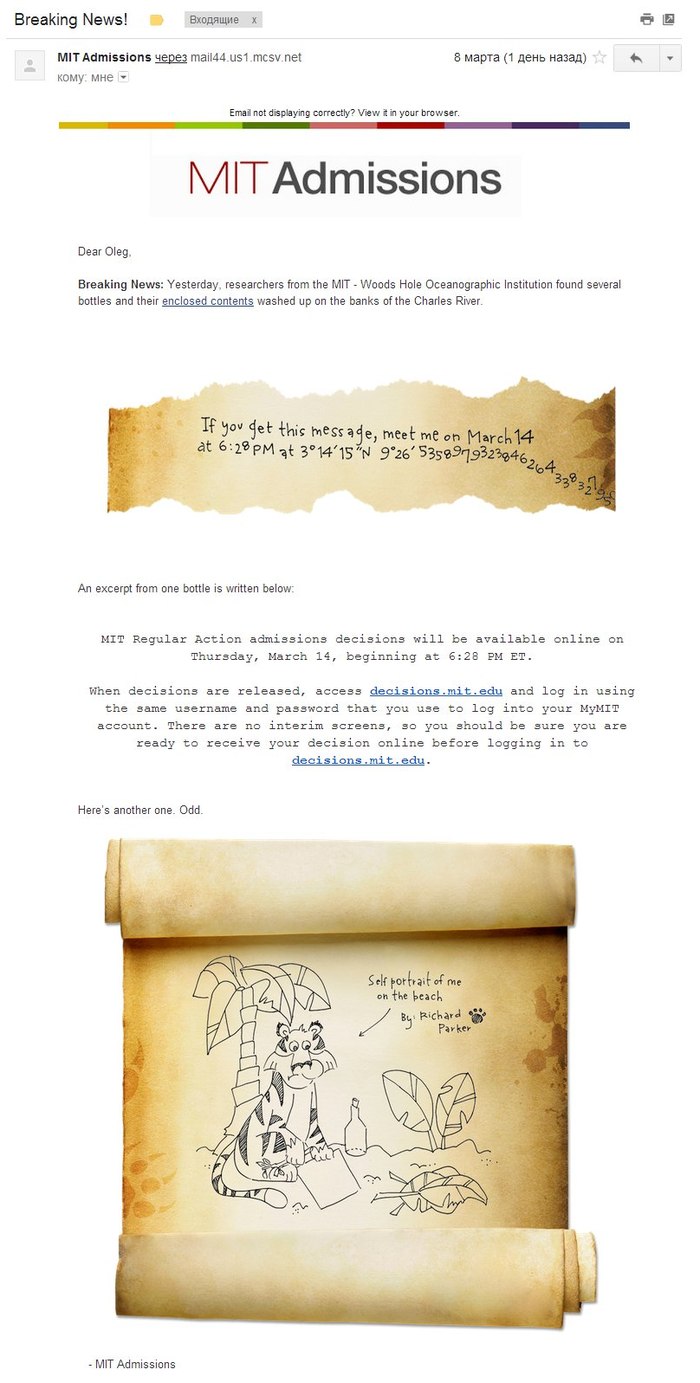
Hello, 12sd
I immediately followed the link and confirmed the system was working. But I lost the screenshot.
And then came Day X — everything was supposed to be announced on March 15 at 3:28 AM Ufa time. Everyone wished me luck, while I was in a slightly apathetic state, like — I did everything I could, come what may.
Today, March 15, I accidentally woke up at 4:50, immediately went to the website and…
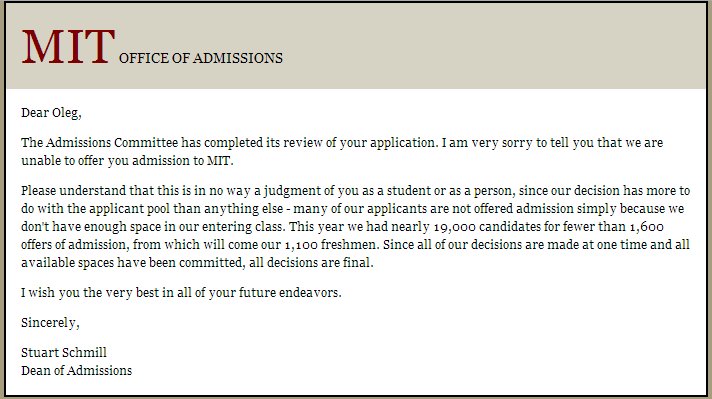
I hope this won't be too much of a disappointment for you, but I didn't get in.
That's all the return on my efforts. I think I had decent chances, but it didn't work out. However, to my own surprise, I'm not terribly upset. After all, it was a great experience, and now I have the opportunity to tell you about the application process and perhaps inspire you to pursue new goals.
I wholeheartedly congratulate those five to ten lucky people from the former Soviet Union who got into MIT! I'm sure one of you is on Habr or will stumble upon this article — I await your response, I think it will be interesting not only to me.
Finally, I want to leave a short list of tips for those applying to top American universities:
- Always apply to several universities. A backup option is simply essential in this case.
- If possible, take both TOEFL and SAT.
- Be careful and don't stress out.
- Never, never leave sending your documents to the last moment.
- To avoid problems, don't damage your relationships with your teachers. They can ruin the whole picture for you.
- Fill out all forms carefully and correctly. This especially applies to financial aid.
- Believe, and you will succeed.
That's all. If anyone wants to chat and learn more, you're welcome to reach out.