I Solved LeetCode for 600 Days Straight
One developer's account of building and sustaining a 600-day LeetCode streak — what it actually taught him, where it plateaued, and an honest answer to whether any of it was worth it.
LeetCode tends to split programmers into two camps: people who swear by it and people who think it's a pointless ritual. When I started, I belonged to neither. I was just a developer who found algorithms a little intimidating and figured I should probably do something about that.

How It Started
In July 2023, I casually worked through a few problems. Then in December 2023, I made a bet with a friend: 100 problems solved before January 1st. That meant 50 in December alone. I made it. The momentum carried into 2024 — next target, 200 problems by summer.
Then, on February 24, 2024, I hit a week of accessible daily challenges and accumulated a 10-day streak almost by accident. I didn't want to break it. That small, irrational reluctance is what started the actual 600-day story.
The Daily Method
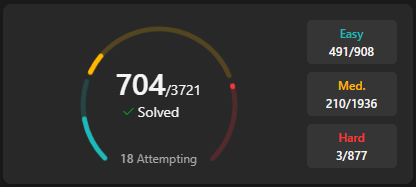
The approach was simple: prioritize the daily challenge when it was within reach. If it looked like it would take more than an hour, solve any other accessible problem instead. I mostly worked at Easy and Medium difficulty. Hard problems were not part of the routine.
Over time the anxiety that came with unfamiliar problem shapes dissolved. Not because the problems got easier, but because the shapes started to feel familiar. Pattern recognition replaced panic.
Is It Worth It? Three Qualifying Questions
Before recommending LeetCode to anyone, I ask three questions:
- Do you work on high-load systems where algorithmic efficiency directly affects users?
- Are you targeting Big Tech employment, where whiteboard-style algorithm interviews are standard?
- Do you genuinely enjoy algorithmic puzzles for their own sake?
If you answer yes to any of these, training through at least 100 problems is probably worth your time. If you answer no to all three, you might be better served elsewhere.
Four Things 600 Days Actually Taught Me
1. Complexity intuition. After enough problems, O(n²) starts to feel wrong before you can articulate why. That instinct has real value in production code review.
2. Language fluency. Extended practice reveals standard library features you never knew existed. After 600 days I rarely needed IDE autocomplete to remember what tools were available. In interviews where you write by hand, that matters.
The difference in practice is visible. A junior approach to counting character frequencies might involve a manual loop with conditionals. A developer who has spent time on LeetCode reaches for:
s.groupingBy { it }.eachCount()3. Pattern recognition. Most problems reduce to a small set of recurring templates. Once you have internalized those templates, reading an unfamiliar solution becomes much faster. You stop asking "how does this work" and start asking "which pattern is this."
4. Data structure intuition. Arrays, hash maps, trees, graphs, stacks, queues — you stop thinking about them abstractly and start recognizing which structure a problem is really asking for.

Why I Skipped Hard Problems
Hard problems are not a better version of Medium problems. They are a different activity. Solving a Hard problem well requires hours of focused preparation, emotional resilience for repeated failure, and a specific goal — usually a top-tier company interview. For building broad algorithmic fluency and sustaining a daily habit, they are counterproductive. I made peace with skipping them.
The Seven Patterns That Cover Most Problems
If I had to compress 600 days into a reading list, it would center on seven fundamental techniques:
- Prefix sum
- Sliding window
- Hash table
- Depth-first search (DFS)
- Binary search
- Two pointers
- Stack and queue
Fluency with these covers the vast majority of Easy and Medium problems. The book Grokking Algorithms is a readable introduction for anyone starting from scratch.
The Plateau
Around day 200, something shifted. Problem-solving had become routine — a daily checkbox rather than a learning experience. Without a defined goal driving the practice, I stopped getting better. I was maintaining a habit, not building a skill. This is worth knowing in advance: consistency is necessary but not sufficient. You also need direction.
Practical Interview Advice
If interview preparation is the goal, use LeetCode's topic-organized problem sets rather than random daily challenges. Some companies (Yandex, notably) publish curated problem lists that match their actual interview format. Work from those.
Rough benchmarks from experience:
- 100 Easy/Medium problems: baseline interview readiness
- 300+ problems: genuine confidence in a broad range of topics
- No upper bound guarantees anything: there are 3,000+ problems, and there will always be one you haven't seen
Six Things I Would Tell Someone Starting Today
- Define your purpose first. Knowing why you're doing this shapes how you should do it.
- Start with easy problems. Sort by acceptance rate and build confidence before increasing difficulty.
- Study other people's solutions. The editorial and top solutions often contain functions or patterns you didn't know existed.
- Try multiple approaches. Most problems have several valid solutions. Exploring them is more educational than polishing one.
- Build the habit, not the motivation. Motivation runs out within weeks. Daily consistency compounds over years.
- Share your solutions. Writing an explanation for someone else is the fastest way to find the gaps in your own understanding.
Final Verdict
600 days. 700+ problems. Was it worth it? For me, yes — with the caveat that I went in without a clear goal for too long, which cost me several months of real progress. LeetCode is a separate world with its own rules and its own rewards. It will tell you fairly quickly whether algorithmic thinking is something you want to develop, and whether it is relevant to the career you are actually building. That clarity alone is worth a few weeks of daily problems.



