The Russian Origins of the PostgreSQL Logo
The true story of how PostgreSQL's iconic elephant logo was born in a small St. Petersburg bar in 1999, designed by a Russian studio, and how the filename 'slonik.gif' became permanently embedded in international IT lexicon.
The story of the PostgreSQL logo was told by Oleg Bartunov, CEO of Postgres Professional, who was a direct participant in the events and preserved an archive of correspondence and visual identity development for the DBMS.

Our famous PostgreSQL logo, our "slonik" (little elephant), has already come a long way — it will soon turn thirty! Over the years, its history has become overgrown with so many myths and speculations that I, as one of the community veterans, decided: it's time to restore the truth, relying on the memories of direct participants. Who actually invented it? Why an elephant? How did it end up in a diamond, and how did the Russian word "slonik" become permanently part of international IT vocabulary? This story, worthy of a novel, began at the end of the last century, in St. Petersburg, on Malaya Morskaya street, in that very small bar where internet pioneers gathered over beer.
The Idea Is in the Air
It all began long before the appearance of the image we know as Slonik. It was 1997. Our PostgreSQL community, then very young, was looking for its symbol. Heated debates raged in the mailing lists. Among other ideas, a proposal emerged that changed everything. David Yang, a community member, suggested making an elephant the mascot.
Why an elephant? Yang recalled Agatha Christie's detective novel "Elephants Can Remember." The idea was brilliant in its simplicity: a database, like an elephant, should store information reliably and for a long time. And practically in all countries, elephants are viewed positively.
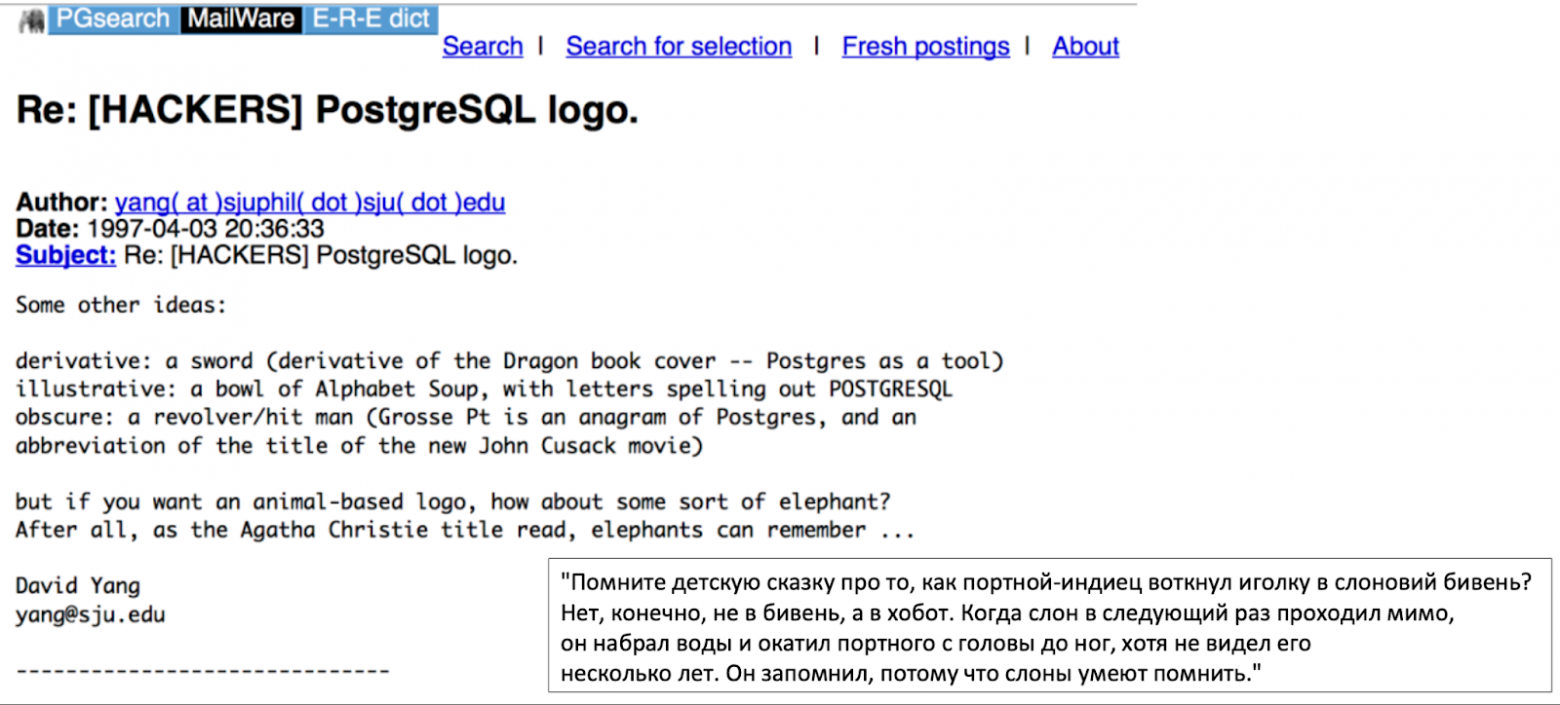
A unique email discussing the future PostgreSQL logo
The proposal was well-received by many, but remained just an idea. In those days, PostgreSQL had other, temporary symbols — from the "Powered by Postgres95" logo to a cheetah. We clearly lacked a strong visual identity.
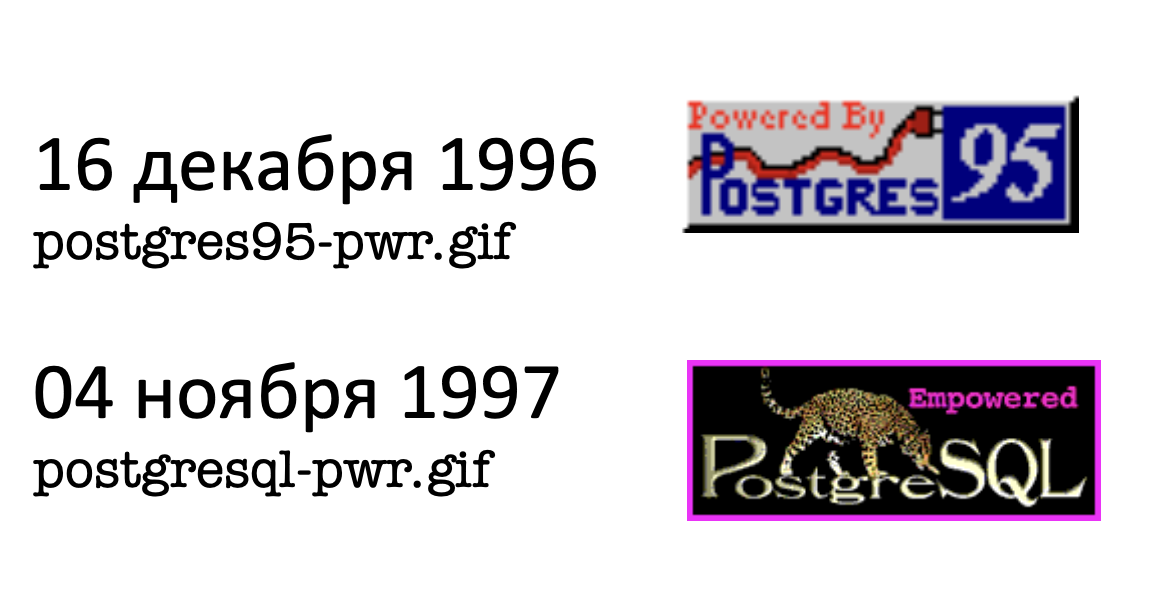
First PostgreSQL logos
The Birth of the Elephant in St. Petersburg
Let's fast-forward to St. Petersburg, April 1999. The end of the century, the birth of the Russian internet. The key role in this part of the story was played by Dmitry Samersov. As he recalls: "There was no IT community yet. I remember there was a small bar on Malaya Morskaya street where people gathered to drink beer. And everyone did whatever they could."
Dmitry worked at WebPlus at the time and was actively deploying the young PostgreSQL. "Many things had to be invented and finished by yourself. And therefore, willingly or not, you had to participate in the PostgreSQL mailing list," he says.
Dmitry had his own small design studio called "Kamen" (Stone). So when a discussion about a new design for the postgresql.org website erupted in our mailing list, he decided to contribute. He asked his studio's designer, Ekaterina Papchinskaya, to sketch a website layout and logo.
This wasn't a formal commission. As Dmitry explains: "It was a free discussion, and this was a sketch that I simply threw into the discussion. Look, in my opinion, it should look like this."
The Visual Concept of "Elephant in a Diamond"
How was the visual concept of "elephant in a diamond" born? The idea of an elephant already existed, but how to embody it? "At that time, finding any decent clipart was difficult," says Dmitry. "So it was substantially easier to take and process a photograph of an elephant... Most likely, this elephant was based on some figurine that was photographed right on the desk." The "Kamen" studio specialized in exactly these kinds of "tricks."
The diamond faceting appeared for a reason. "Visually, a realistic elephant on an IT site didn't look very good," Dmitry explains. The diamond gave the image a technical, "IT-like" quality, and symbolized how the natural ability of elephants to remember was "faceted and turned into a brilliant useful to the community."
An important detail was the intentional asymmetry. Dmitry and Ekaterina wanted to avoid the "dead," perfectly symmetrical computer graphics of that era. "It was important to us that this elephant turned out more alive rather than computer-generated... In nature, nothing is symmetrical," says Dmitry. This "liveliness" became part of the logo's philosophy.
Even the color — blue — was chosen deliberately, more from practical considerations. "We didn't want harsh colors... from the palette available at that time, blue was the most natural. Closest to nature," recalls Dmitry.
Presenting to the Community
Dmitry posted the finished website sketch with the logo on his personal site devnull.wplus.net (which underscored its informality) and sent the link to our mailing list. And this isn't just memories: his letter to the pgsql-hackers mailing list from April 12, 1999 has been preserved. In it, responding within the discussion "RE: [HACKERS] PostgreSQL Webpage," Dmitry wrote: "I was committed to show how postgres webpage should look by my opinion. See http://devnull.wplus.net/pub/postgres/" So the fact is documented: it was precisely then, in April 1999, that the sketch was presented to the community.
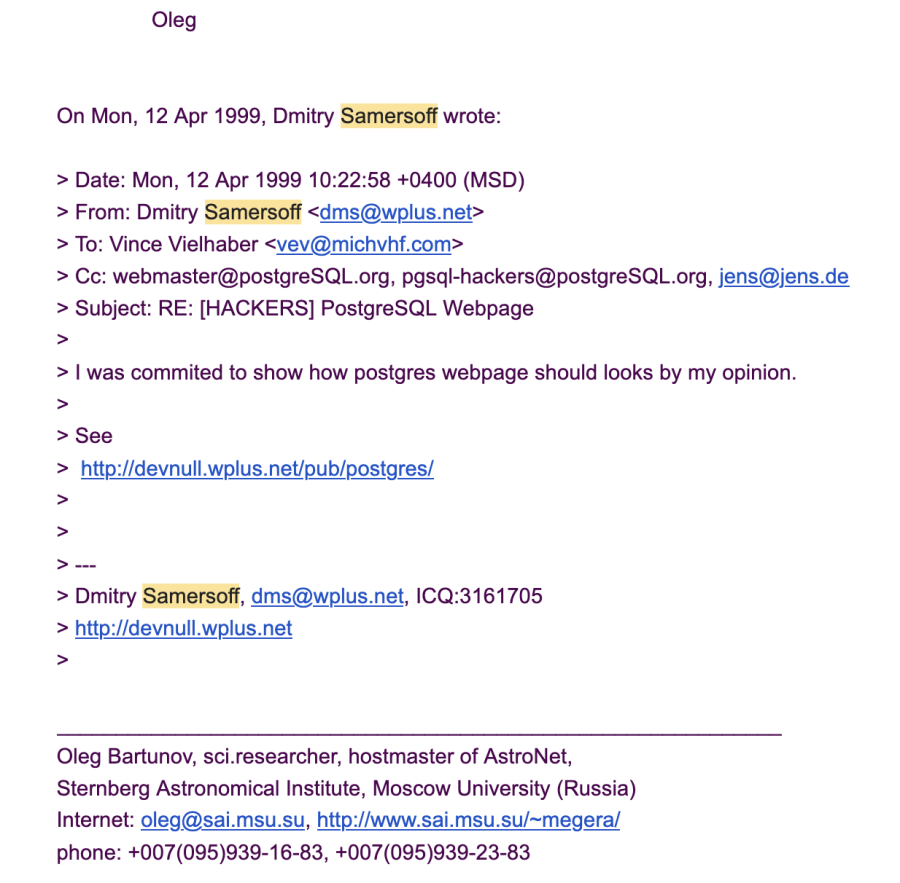
Documentation of the PostgreSQL logo appearance date in correspondence
"There was no formal transfer at that point," confirms Dmitry. It was a gift to the community, a desire to contribute and give back for the openness and support.
The Birth of a Name
It was precisely then that the name that became legend was born. Ekaterina, according to Dmitry, "named files in whatever way was comfortable for her, mostly Russian words in Latin letters." Moreover, if you look at the web archive of the postgresql.org community site from 1999, you can see other "telling" filenames from which the logo was assembled — for example, aser.gif (probably from "seredinka," meaning "middle part") and adovesok.gif ("dovesok," the bottom part of the logo). Thus, in the image directory for the proposed site design appeared the files slonik.gif and zaglushka.gif. "The people who took this file [slonik.gif] didn't bother renaming it — they used it as-is," adds Dmitry.
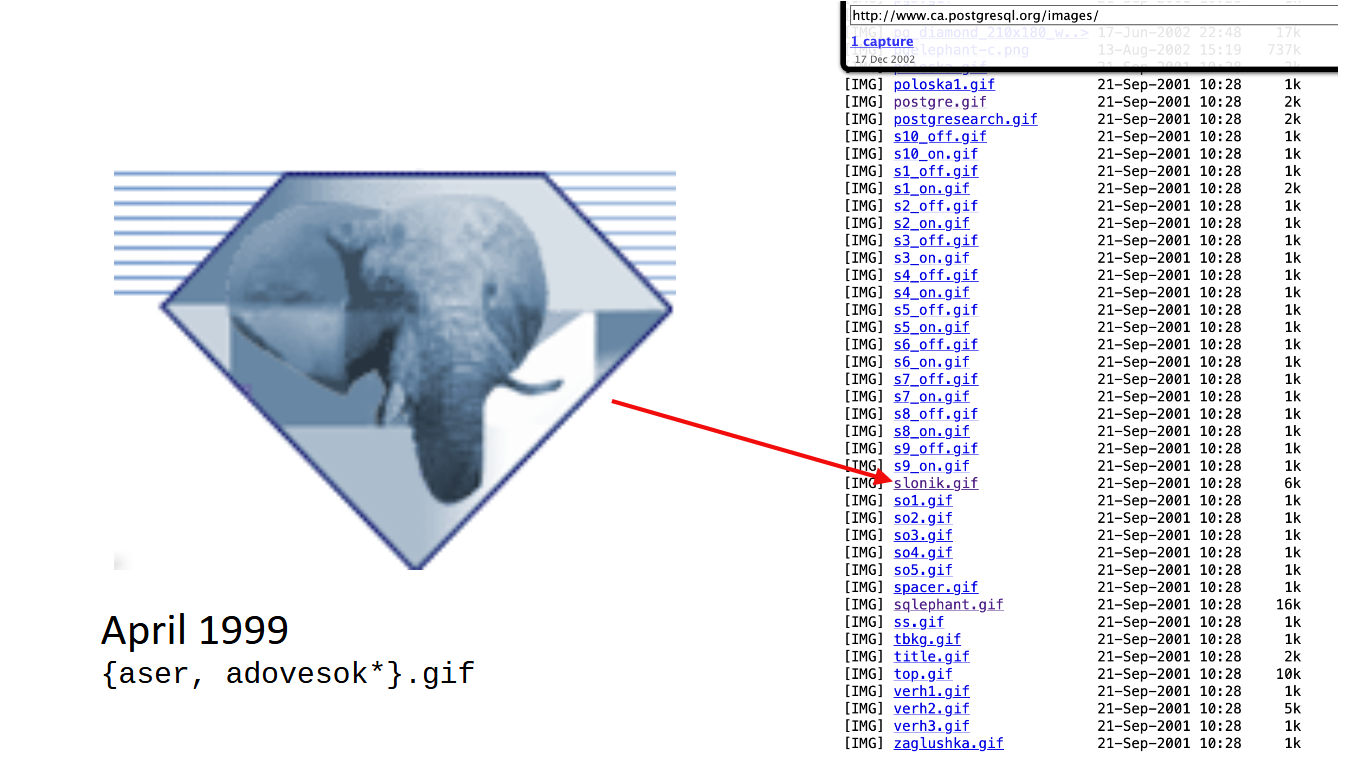
Screenshot of the image folder in the archived version of postgresql.org
These accidental Russian names instantly took hold in the international PostgreSQL community. Soon the elephant with the diamond became a recognizable symbol. And the simple, slightly naive name "slonik" stayed with us forever.
Evolution of Names and Logos
Dmitry and Ekaterina's sketch wasn't used in its entirety, but as Dmitry recalls, "certain individual elements, particularly this little elephant, were happily borrowed from it."

Archive of postgresql.org page
The further evolution of the logo is inseparably connected with the name of Daniel Lundin from Sweden. And his involvement began almost immediately after Dmitry's sketch appeared. Just 11 days after Samersov's email, on April 23, 1999, Daniel wrote in the same pgsql-hackers mailing list:
"I posted a first quick sketch of a high-contrast, hand-drawn, stylized elephant some time ago... I abandoned that idea when I saw Dmitry Samersov's proposal, which I thought was very well done. [...] The PostgreSQL logo and website design should be professionally redesigned before the 6.5 release. From my perspective, my clients don't take PostgreSQL seriously when I direct them to the web pages, and that's highly undesirable."
This letter shows that Daniel not only saw and highly valued the work of Dmitry and Ekaterina almost immediately, but already understood the importance of a professional visual identity for the project.
Later, I contacted Daniel myself to clarify details, and he confirmed in correspondence that when creating the final, vector version, he took the St. Petersburg "elephant in a diamond" logo as his basis. "IIRC used it for inspiration, then sketched up the vectorized one in Illustrator as best I could manage," Lundin wrote.
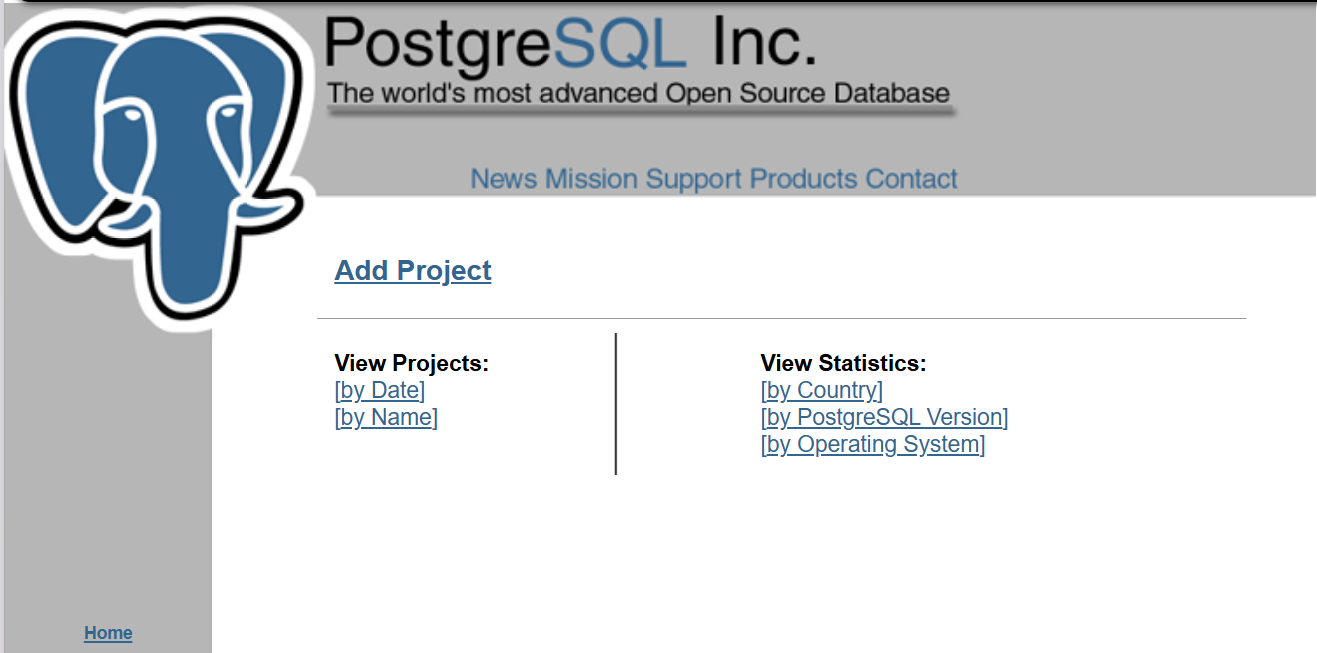
Archive of pgsql.com page
He removed the diamond faceting, made the image vector, more contrasty and stylized for web design needs of the time. It was this version, which appeared on pgsql.com (which, as seen from the 1999 correspondence, was being created specifically for PostgreSQL promotion and commercial support), that became the elephant we know today.
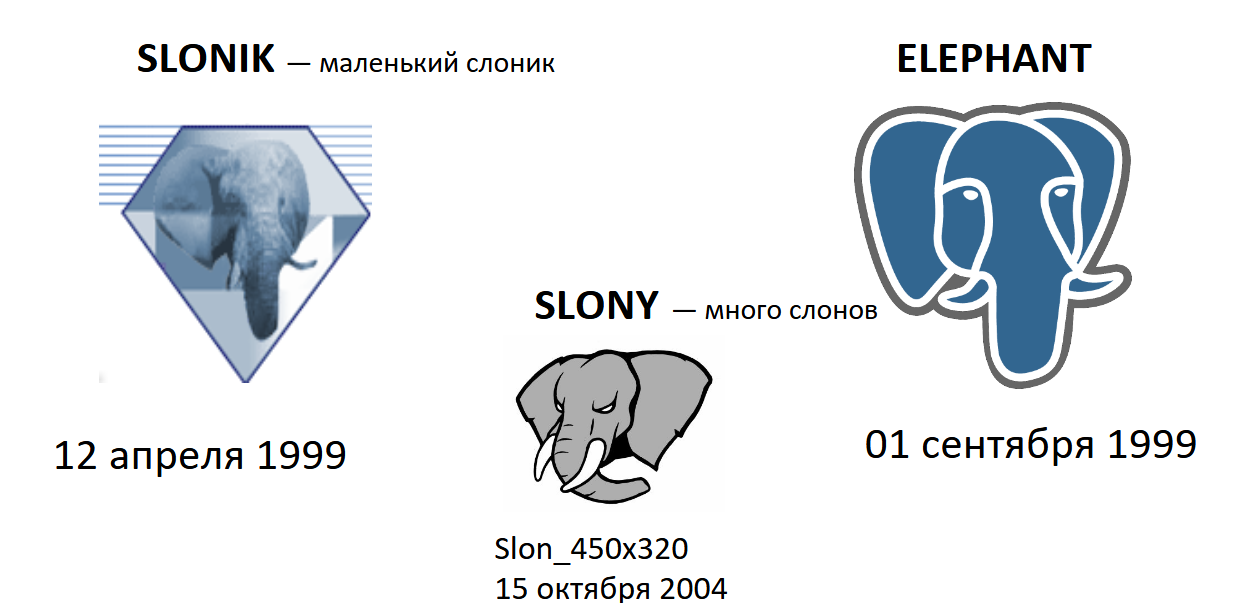
Evolution of the elephants
Slony-I and the Replication System
The name "slonik" meanwhile continued to live its own life. Jan Wieck, developing a logical replication system for PostgreSQL, was looking for a name for it. Seeing the slonik.gif file on the site, he became interested in its meaning. He asked me what it meant. I explained: "little elephant." Then he asked how you say "many elephants." I answered: "Slony" — and thus was born the name of the famous replication system Slony-I. Dmitry Samersov comments on this story: "I heard the legend about the name... I take a positive view of it. Beautiful legends, good name, convenient."
The Conflict with the PHP Logo
But the elephant's path wasn't without clouds. In the summer of 2004, a scandal erupted. A PHP logo appeared — a very similar blue elephant. Our community faced a choice: abandon our symbol or defend it. Josh Berkus conducted a thorough analysis, proving why the elephant was the perfect symbol for PostgreSQL: it doesn't just "remember," it's "reliable and faithful." Fortunately, we, the community, decided to keep the elephant.
At that very time, work was underway on updating our main website postgresql.org. I remember how in the web archive for that year there was even an amusing message from an anonymous vasya@mail.ru: "Events. The site is being slowly rewritten. Date: 2004-01-01 — 2004-12-31. The Postgres site is unhurriedly being rewritten. Coming soon." And indeed, by the end of 2004, the updated postgresql.org was launched, with Alexey Borzov working on the engine. It was on this updated site that our logo — that same elephant stylized by Daniel Lundin — was finally established.

The hardcore Russian slonik
The Russian-Speaking Community's Contribution
Speaking of the Russian-speaking community's activity in those years, it's worth mentioning our work on search. That very project www.pgsql.ru — a specialized search engine for PostgreSQL resources, which I announced in January 2004 and which was supported by RFBR and Delta-Soft — actually had a prehistory. Back around 2001, Fyodor Sigaev and I, with whom we later founded Postgres Professional, launched the first version of a search across all PostgreSQL mailing lists. Ivan Panchenko led the main engine development at the time. This early version can be found if you dig through the web archive. So our contribution to building community tools began even earlier, and it's pleasant to recall how we, the future co-founders of Postgres Professional, were already working together for the benefit of the PostgreSQL community.
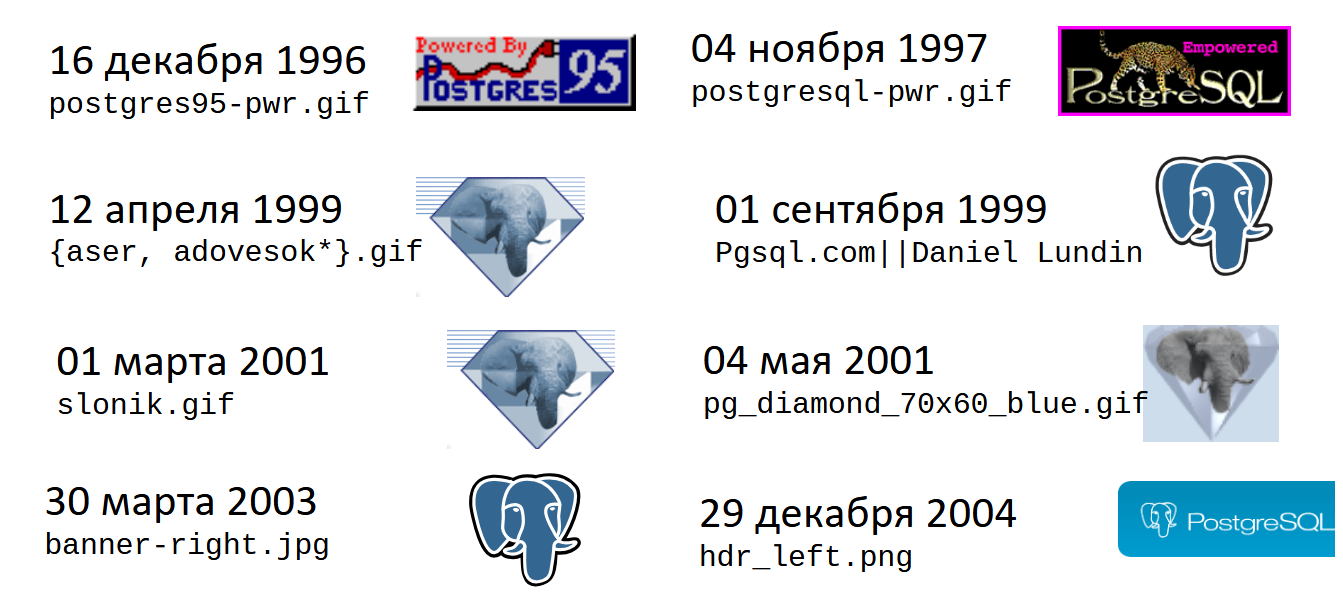
All PostgreSQL logos
Interestingly, Dmitry Samersov missed all this drama entirely: "All of that passed completely by me. Because in 2004, I was launching the company Assist, and there was no time for PostgreSQL."
Transferring Logo Rights to the Community
Years passed, and the elephant firmly established itself as the symbol of PostgreSQL. However, even Josh Berkus, who handled PR for the community, had an not entirely accurate understanding of authorship. He told the story that the first "elephant in a diamond" logo was developed by Jan Wieck, but the image looked terrible, so a designer was later hired to create the current elephant.
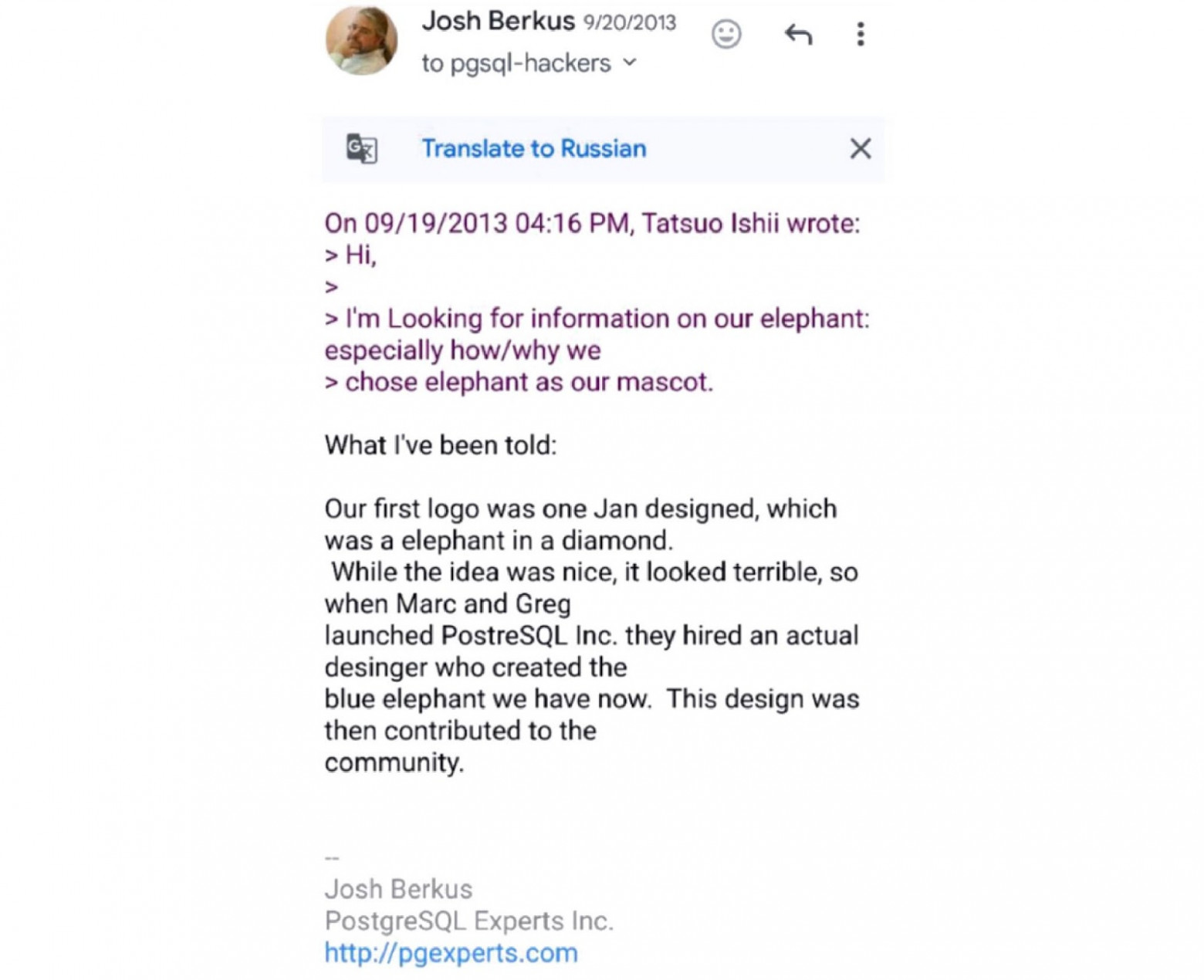
Example of a myth about the PostgreSQL logo origin
Legally, the authorship and usage rights for the "Russian slonik" remained in a gray area. I decided to rectify this situation and approached Dmitry Samersov with a request to formally transfer the rights to the original design to the community. Since the logo development was Dmitry's private initiative and his studio's, not some organization's, the rights transfer procedure was straightforward.

Transfer of PostgreSQL logo rights
Dmitry, who had no claims on the logo, agreed. With his characteristic humor, he recalls: "If they ask you to do some strange thing, then you should do that strange thing with all thoroughness and attention." In March 2025, Dmitry Samersov officially transferred the rights to the "slonik" design under a Creative Commons license to the entire PostgreSQL community.
Today, the official PostgreSQL wiki states: "The PostgreSQL elephant logo 'Slonik' is a copyrighted design..." The story reached its logical conclusion.
Slonik Forever
And so concludes this remarkable story of the PostgreSQL logo's creation. It began with an idea from an Agatha Christie detective novel, found visual embodiment thanks to the enthusiasm of St. Petersburg IT professionals and a designer, passed through the hands of a Swedish developer, nearly perished in battle with another "elephant," and was finally formally gifted to the global community by its creator.
What does Dmitry Samersov feel, standing at the origins of a symbol known to millions? "On one hand, it's nice that there's something that will remain after me, besides children. On the other hand, it's a bit funny that of everything done in this life, the most vivid impression remains such an accidental logo — slonik.gif."

Oleg with Dmitry — the true creator of the PostgreSQL logo
This story is a vivid reminder that great things are often born not from strategic plans, but from a sincere desire to share, coincidence, and the spirit of collaboration that has always been a strength of our PostgreSQL community. And looking at the blue elephant, we now know: it's not just an image, it's a piece of a remarkable story that found room for St. Petersburg, Agatha Christie, and one very aptly named file — slonik.gif.
FAQ
What is this article about in one sentence?
This article explains the core idea in practical terms and focuses on what you can apply in real work.
Who is this article for?
It is written for engineers, technical leaders, and curious readers who want a clear, implementation-focused explanation.
What should I read next?
Use the related articles below to continue with closely connected topics and concrete examples.