Office on a Deserted Island — A Reality
A group of freelance translators set up a month-long coworking office on an island in the Ladoga Skerries, solving connectivity and power supply challenges in the wild.
The Idea
This summer, four of us — freelance translators — decided to combine business with adventure. The plan was simple: rent an island in the Ladoga Skerries and work from there for a month. We needed to solve just two problems — internet connectivity and electricity. What follows is our account of how it all went.
Communication
This was our biggest headache. Our island is located about 8 kilometers from the nearest cell tower, with a 50-meter granite cliff standing 250 meters away, blocking the direct line of sight.
We used a Huawei E960 3G/Wi-Fi router (~9,000 rubles) with SIM cards from MTS and Megafon. Despite having external antennas, the main bottleneck turned out to be the cell tower capacity rather than signal quality. On average, the download speed hovered around 3–4 kilobytes per second during the day and up to 15 KB/s at night. Upload speed ranged from 1 to 10 KB/s. Ping was around 500 ms at night and about 1000 ms during the day.
We only had EDGE connectivity — not even 3G. The signal was just too weak and the tower too overloaded during summer tourist season. Still, it was enough for email, chat, and file transfers (if you were patient).
Interesting observation: signal quality varied dramatically depending on weather, time of day, and even which direction the wind was blowing. We tried various antenna positions and orientations, and eventually found a sweet spot on a rock about 30 meters above the water.
Electricity
Our power setup consisted of several components working together:
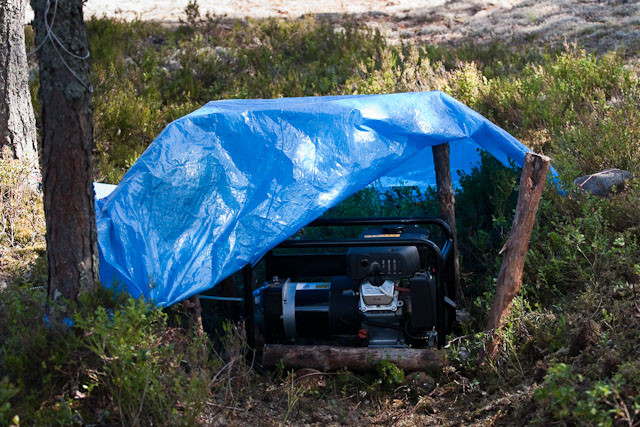
- Generator: Hitachi E24SB (2.1 kW, 37 kg, ~20,000 rubles). At a load of 150–200 W, it ran for 5 hours and 15 minutes on a single tank — much better than the rated 3 hours at 1 kW load. Over the entire month, we clocked about 250 engine hours and only needed one oil change.
- Batteries: A Kursk battery rated at 132 Ah and an Optima YellowTop 48 Ah (AGM) served as a buffer. This allowed us to work from the inverter without running the generator, eliminating the noise.
- Charger: Kulon 715d (15 A output) handled the charging process. It regulated the current and prevented overcharging.
- Inverter: MeanWell A301-600-F3 (600 W) converted 12V DC from the batteries to 220V AC for our laptops and other equipment.
The wiring used various gauges: 16 mm² for high-current connections from the batteries, 1.5 mm² for general distribution, and 1 mm² for lighter loads. All equipment was mounted on wooden pallets to keep it off the damp ground.
The typical cycle looked like this: run the generator for a few hours to charge the batteries, then switch to battery power for quiet working time. This gave us 3–4 hours of noise-free work between charging sessions.
The Office
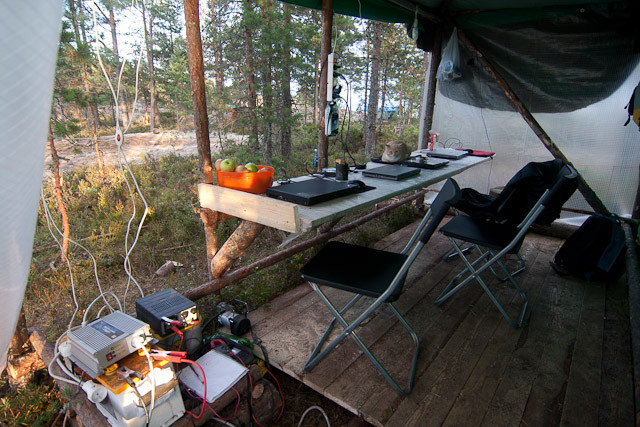
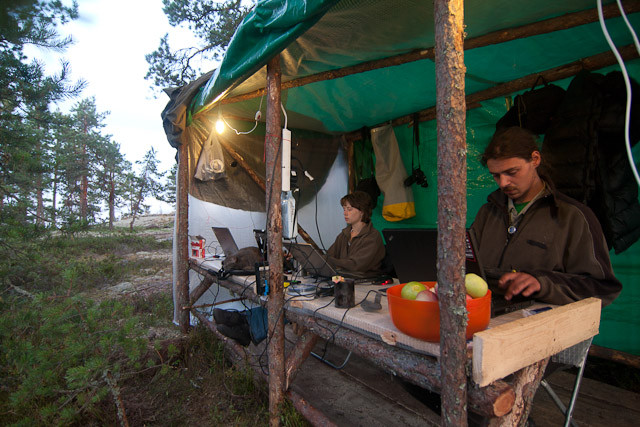
We built a proper workspace — a veranda with folding walls, constructed from tarps and lumber. The total weight of building materials was about 200 kg, all of which we brought to the island by boat.
The setup included a wooden work desk that seated four people comfortably, with enough space for laptops, external monitors, and peripherals. The folding walls could be raised in good weather for ventilation and a view of the lake, or closed during rain and wind.

Practical Tips
After a month of island office life, here's what we learned:
- Avoid glossy laptop screens. In outdoor conditions with variable lighting, glare from glossy displays makes work nearly impossible. Matte screens are a must.
- Invest in proper seating. We initially tried using tree stumps and logs. After two days, everyone's back was killing them. We ended up bringing proper folding chairs, which made a huge difference.
- Mount everything on pallets. The humidity on an island is relentless. Any electronics or equipment placed directly on the ground will eventually suffer from condensation. Wooden pallets solved this problem completely.
- Use energy-saving lamps. Every watt matters when you're running on generator fuel and batteries. CFL bulbs gave us adequate lighting at a fraction of the power consumption of incandescent bulbs.
- Night shifts for heavy transfers. Since bandwidth improved dramatically at night (when other tower users were asleep), we scheduled all large file uploads and downloads for nighttime.
- Bring backup everything. When the nearest electronics store is a three-hour boat ride away, you learn the value of spare cables, adapters, and components very quickly.
Results
Over the course of the month, we maintained nearly the same productivity as in a regular city office. The translation work got done, deadlines were met, and clients never even knew we were working from an island.
Total expenses for the "island office" infrastructure came to roughly 50,000–60,000 rubles (generator, batteries, inverter, router, building materials, and fuel). Not cheap, but split four ways and considering we also had a month-long vacation on a beautiful island — it was absolutely worth it.
The experience proved that remote work from literally anywhere is possible, as long as you're willing to solve the infrastructure problems. The technology exists — you just need some creativity and a willingness to experiment.