Is Our Universe a Simulation Based on a Giant Cellular Automaton?
An exploration of the hypothesis that our Universe operates as a giant cellular automaton, drawing on Stephen Wolfram's research to explain speed of light limits, quantum mechanics, dark matter, and other physical phenomena through simple computational rules.
I want to examine the hypothesis that our Universe functions as a giant cellular automaton. This concept builds on the research of Stephen Wolfram, who since the 1980s has been developing the idea that complex phenomena can emerge from simple computational rules.
Cellular Automata and the Game of Life
Let's start with mathematician John Conway's Game of Life — a system with simple rules where complex behavior emerges from primitive elements. It has been proven that such systems are Turing-complete, meaning they can perform any computation.
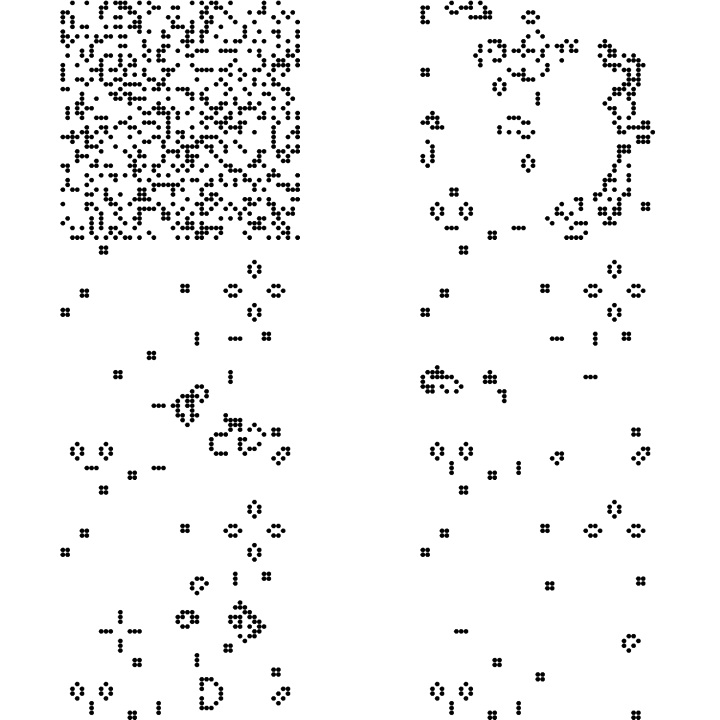
Conway's Game of Life operates on a two-dimensional grid where each cell is either alive or dead. The rules are deceptively simple: a living cell survives if it has 2 or 3 neighbors; a dead cell comes alive if it has exactly 3 neighbors. From these minimal rules, extraordinarily complex structures emerge — gliders, oscillators, and even structures capable of universal computation.
Stephen Wolfram and His Contribution
In 1983, Wolfram discovered Rule 30 — a one-dimensional automaton that "generates not repeating, but chaotic patterns from a single black cell." Based on this discovery, he developed the ambitious Wolfram Physics Project, where space is represented as a network of interacting points.

The key insight of Wolfram's work is that a very simple rule, applied repeatedly, can produce behavior of arbitrary complexity. This challenges the traditional physics assumption that complex phenomena require complex underlying laws.
Counter-Intuitive Physical Phenomena Explained
The Speed of Light Limit
Why can't objects exceed the speed of light? In a cellular automaton, "a cell is only influenced by the elements immediately surrounding it." This is a natural limitation of the system's architecture. Information can propagate at most one cell per time step — this maximum propagation speed is analogous to the speed of light in our universe.
Photons as Constructs
The strange properties of photons — zero rest mass, wave-particle duality — can be explained as "a self-replicating construct that travels at the maximum possible speed in the cellular automaton." A photon is not a thing sitting in a cell; it is a pattern that copies itself into adjacent cells at maximum speed. This naturally explains why it always moves at light speed and why it has no rest mass — it simply cannot exist in a stationary state.
The Quantized Nature of Reality
In a cellular automaton, "everything is quantized by definition." Energy levels, spin, and charge exist only in discrete portions, which corresponds to observations in quantum mechanics. There are no half-cells or fractional states — only whole discrete values. This is exactly what we observe in quantum physics, where energy, angular momentum, and charge all come in discrete packets.
The Mechanism of Interactions
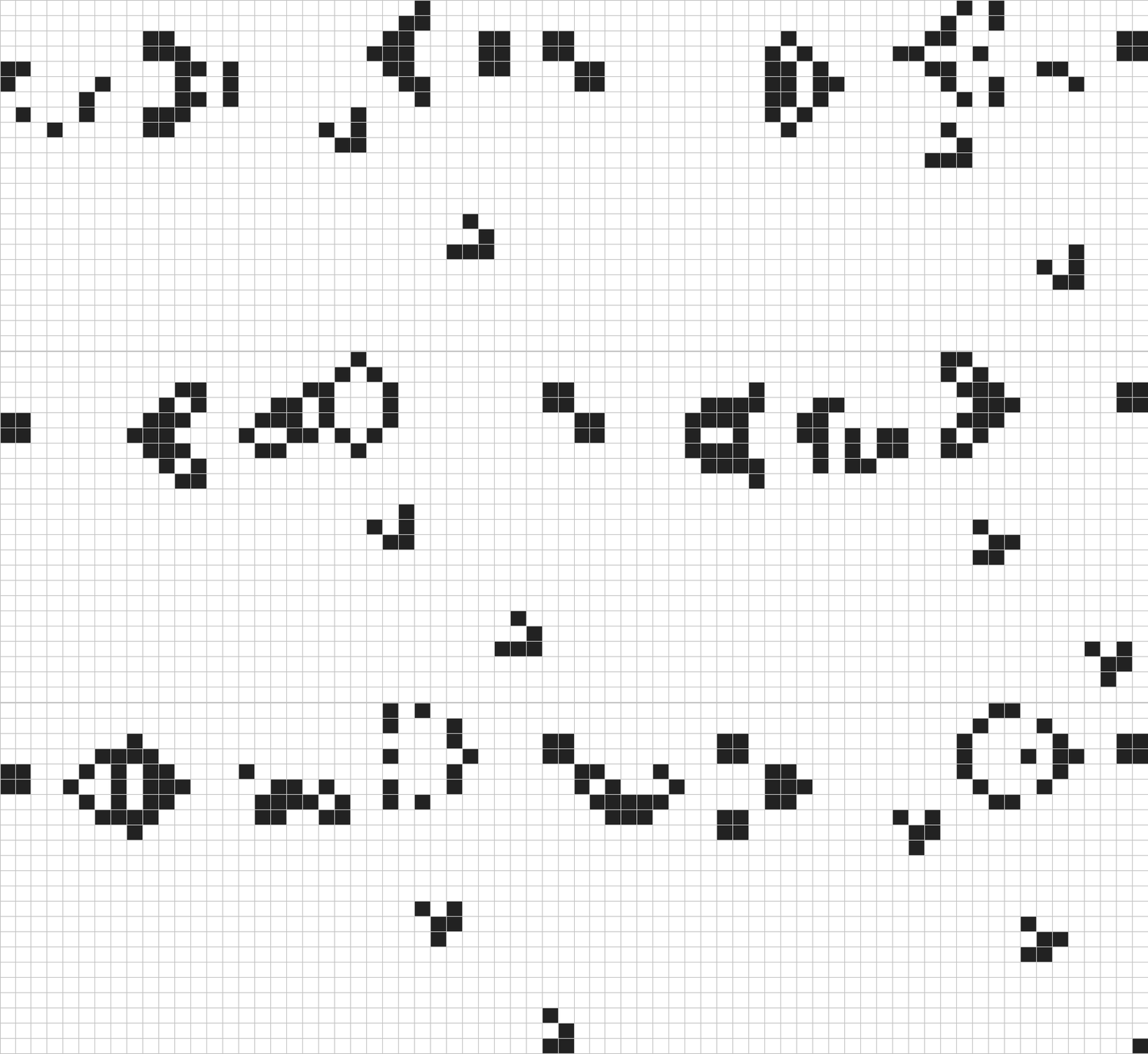
The Gosper Glider Gun pattern from the Game of Life is proposed as a model for force-carrying particles. Different types of "guns" emit constructs responsible for different forces: electromagnetic, strong nuclear, weak nuclear, and gravitational interactions.
The mechanism of attraction: if a graviton destroys a cell on the near side of an object, "part of the object has shifted toward the source of gravity." Repulsion works by the opposite principle — constructs add cells to the near side, pushing the object away.
Mass and Energy
Mass is interpreted as "the number of cells in a stable construct." The conversion of mass to energy occurs when a large construct breaks apart into pieces, including photons that "carry away cells from the parent structure." This provides an intuitive understanding of E=mc²: the energy contained in matter is simply the total number of cells, each capable of becoming a photon traveling at maximum speed.
Potential Energy
Gravitational potential energy is "the cumulative number of gravitons received by an object from another object before the moment of collision." Each graviton shifts the object slightly, and the total work done equals the total number of graviton interactions.
Relativistic Effects
Time dilation is explained as follows: when moving at the speed of light, "the object is copied into adjacent pixels at 1 pixel per tick." The more resources are spent on movement, the fewer possibilities remain for internal structural changes. This is why time slows down for fast-moving objects — their internal processes literally have fewer computational cycles available.
Dark Matter
In the Game of Life, there are stable structures that move only under the influence of external forces. By adding a "graviton gun" to such constructs, we get "dark matter" — particles that don't interact through electromagnetic or nuclear forces, only through gravity. They are simply constructs without the "guns" responsible for electromagnetic interaction.
Hawking Radiation
A black hole is "an enormous collection of diverse structures with graviton guns." Radiation occurs when individual structures "break away from the black hole and pass through the dense graviton bombardment." Some constructs at the edge manage to escape the intense gravitational field, carrying away mass-energy from the black hole.
Cosmological Consequences
The Expansion of the Universe
The accelerating expansion is explained by "the effects of movement in quantized space." Even with perfect geometry, photons "will lose their straight-line trajectory over large distances," which leads to a decrease in the observed brightness of distant objects. This offers an alternative explanation for what we attribute to dark energy.
The Universe as a Growing Bubble
The world can be represented as "the surface of an expanding sphere, an inflating balloon." With this representation, it can simultaneously be finite and have no boundaries — just as the surface of a sphere is finite but has no edges.
Architectural Questions
Spatial Isotropy
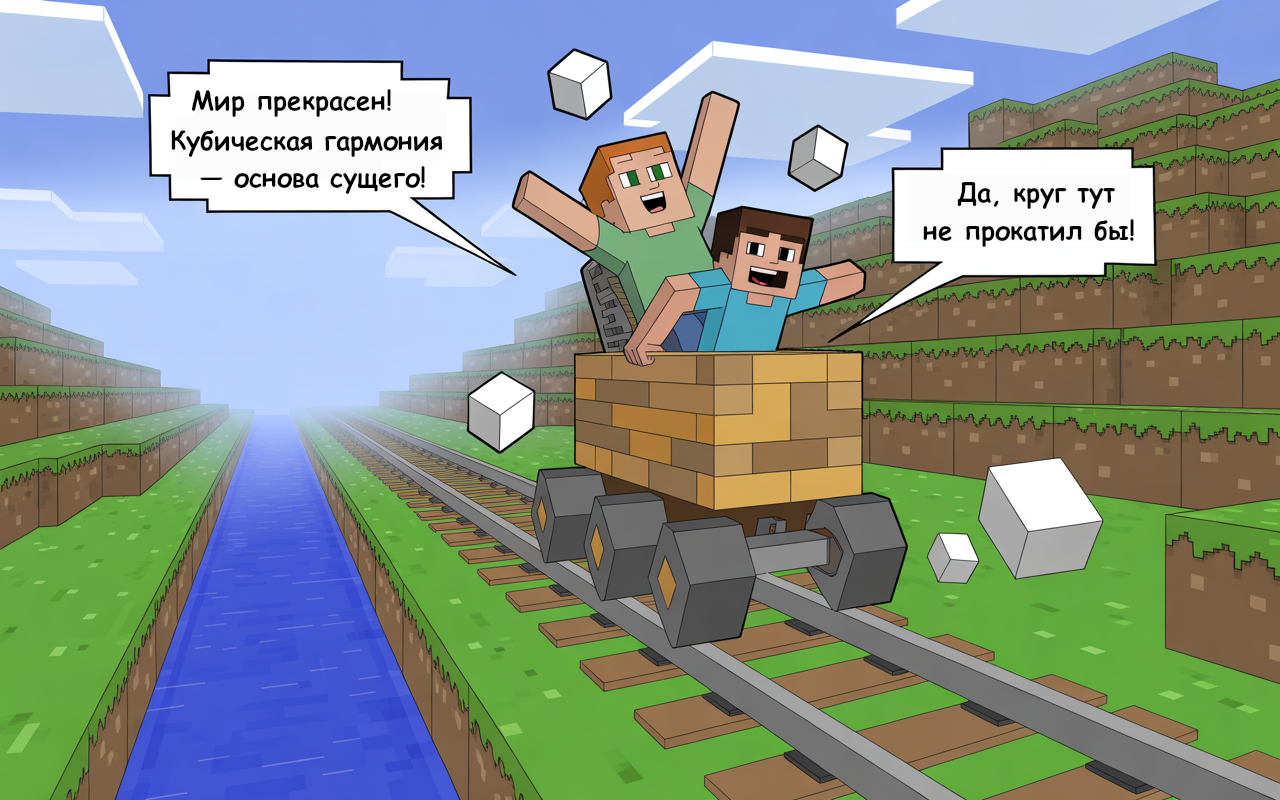
A cubic lattice leads to anisotropy (diagonal movement is faster). The solution is proposed in using parallelohedra — truncated octahedra, rhombic dodecahedra, and other shapes that tile space isotropically. These shapes allow equal-speed propagation in all directions, solving the grid anisotropy problem.
Computational Resources
The author notes that in a hypothetical simulation world, there may be no limitations on interaction speed. The power of such systems can be "practically" limitless. Whatever civilization created this simulation operates at a level of technology we cannot begin to comprehend.
Philosophical Reflections
The concept of simulation "does not contradict many religions at all." The idea of a Creator of the Universe is compatible with the cellular automaton theory. The author suggests that complex phenomena (miracles, resurrection) can be explained by the creator's ability to restore constructs through "backups."
For humanity, understanding the rules of the automaton could mean the ability to "call up the simulation's debug console" or discover ways to interact with its creator. However, the author admits that this "sounds quite like a fairy tale."
Conclusion
This article presents an ambitious speculation about the nature of reality, in which simple computational rules give rise to all the observed complexity of the Universe. Whether or not our universe truly is a cellular automaton, the framework provides surprisingly intuitive explanations for many of physics' deepest mysteries — from quantum mechanics to cosmology.