How We Created a Workplace Safety Product for Manufacturing
A team at LANIT turned a simple lighting automation task into Safety Alert — a computer-vision-based mobile device that detects safety violations on factory floors and warns workers in real time with voice alerts.
This story began with the simplest of tasks — turning off the lights when no one is in the room. An ordinary, boring task for industrial automation. We weren't planning any revolutions, startups, or accelerators. We were just doing our job.
But sometimes technology leads us where we never intended to go. And that's exactly what happened: a small feature turned into an idea, the idea into a prototype, and the prototype into a potential system that can actually save lives. Not in some grandiose, futuristic way — but right here and now.
Today's article on the LANIT blog is an attempt to tell how a mundane task gave birth to a product with social significance. How workplace safety, which is usually ignored, became the focus of technology. How a working tool emerged from a set of hypotheses, failures, rough MVPs, and conversations with factories.
It All Started with "Turn Off the Lights"
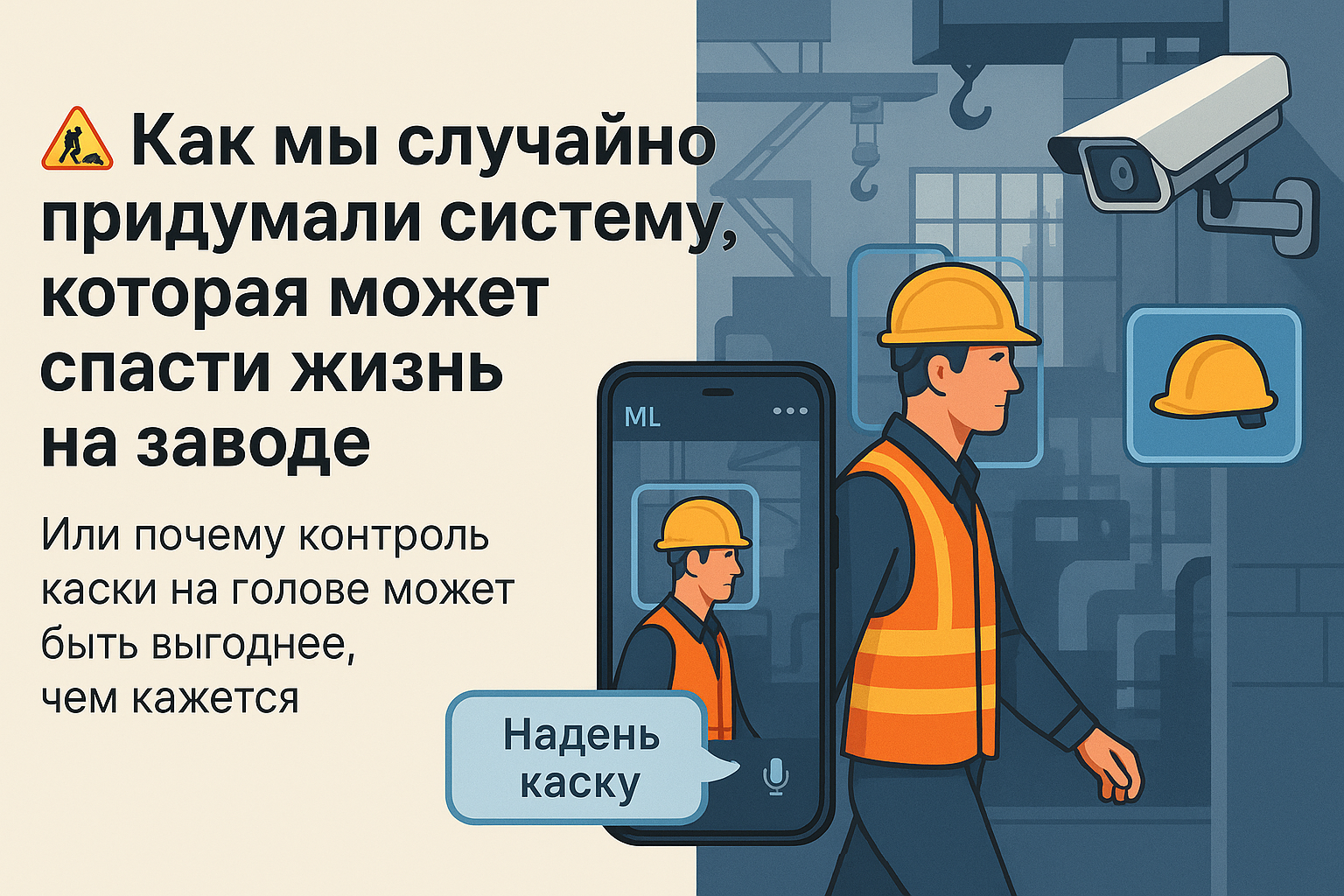
It all started with the task of "making the lights go off when nobody's around." This was a simple request from a Volga region factory — to optimize electricity consumption by automating the lighting. Back then, our Computer Vision Systems team didn't suspect that this MVP was our entry ticket into the world of occupational safety and... crash-testing business ideas in an accelerator.
We approached the task in the classic way: assembled sensors, a camera, and wrote the logic. But the client suddenly wanted more: "Can the system also determine whether a person is wearing a hard hat?" We didn't mind. How hard could it be? Object detection, a PPE (Personal Protective Equipment) database, a classifier based on a neural network, YOLO on a basic level. We collected data at the factory, built an MVP, and it worked.
We called the product CVS - Danger Control — the system recorded both people's behavior and their PPE usage. It was getting interesting. We were already thinking about a series of versions for different scenarios: cables, ladders, hard hats, vests. But then the client suddenly vanished. Their funding for digital projects was frozen indefinitely. The work was shelved.
And so we were left with an MVP, no contract, and the realization that we had an unrealized product on our hands. Sounds like a failure? No — like a beginning.
What to do with it? The answer came through the LANIT Product Manager accelerator.
The Accelerator: From Hypothesis to Realizing the Market Is Different
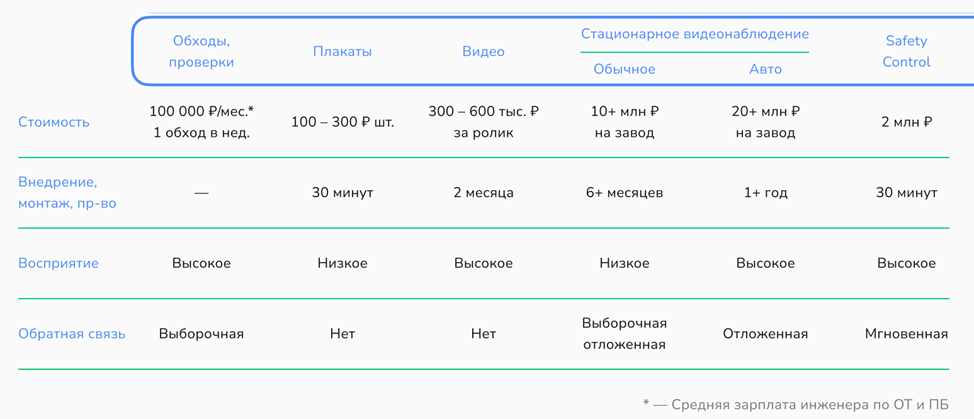
We brought this half-finished system to the LANIT Product Manager accelerator. The goal was simple — to understand who this system could be useful for. At the start, we honestly tried to find similar solutions. It turned out they exist and cost 20+ million rubles, with implementation timelines of a year or more. Even those who could offer such development didn't guarantee full delivery. In other words, the product was available only on a website — basically "made to order," which could mean a very long wait.
The market turned out to be less straightforward: stationary solutions were overloaded, inflexible, and offered no feedback. Video surveillance with analytics was essentially just a report that someone had to read. No live reaction. No help for the worker right here and now.
But what if the system could immediately say: "You're not holding the handrail — that's dangerous"?
That's how the idea for Safety Alert was born. We realized the value wasn't in "photographing" a violation. It was in immediately letting the person know what they were doing wrong. Right at the moment of the action.
And then Heinrich's Effect hit us: for every one fatal accident, there are 300 incidents without injuries. This is a direct dependency established by global practice. If you reduce the number of these "invisible" violations, it both decreases the number of fatalities and cuts the time and financial losses from incidents.
Production shutdowns, broken contracts, insurance payouts, compensation, damaged equipment — all of these are consequences of minor violations. They're easier to prevent than to clean up after.
The accelerator taught us that:
- An idea without target audience segmentation is just a fantasy;
- No ML will save you if nobody is willing to pay;
- Innovation doesn't have to be fancy — it needs to be timely.
And most importantly — sometimes a small change (like "please hold the handrail") can save millions and someone's life.
MVP Without a Budget: An Android Smartphone, Students, and No Magic
We had no investments. Only enthusiasm and a team of like-minded people. I gathered people I'd worked with before — engineers, developers, managers. We brought in students, and occasionally mid-level and senior specialists for a couple of days on specific tasks. Everything was done in one breath.
The result — a mobile prototype that can be installed on a regular Android smartphone. It can identify three basic violation scenarios, such as going up stairs without holding the handrail. If you violate the rule, the phone says in a voice: "Please hold the handrail." And it works.
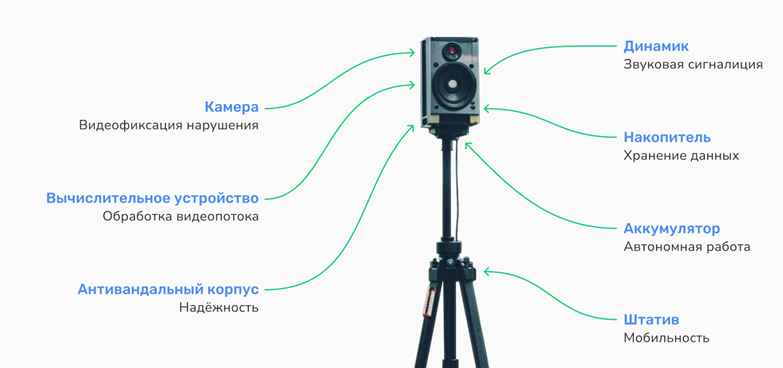
But there's a problem. It's a smartphone. You can't just place it in a factory; it's not designed for prolonged autonomous operation in industrial conditions. You need a ruggedized vandal-proof housing, a stand, power supply, a wide-angle camera, and protection from dust, water, temperature, and vibration. All of this is hardware that we currently have no budget for.
"We're Ready to Test. But You Do Everything First"
We came to the factories and said: "Let's test it, we'll show you the system works." The response: "Great. Only we won't fund anything. Bring us a finished solution — we'll test it, and if it works, we'll buy it."
At this stage it became clear: the B2B sector in Russia is very cautious. It's not ready to participate in development, even if it's interested in the result. Even if the product would help reduce fines and improve safety.
The device itself is a mobile autonomous video camera with feedback that:
- Monitors compliance with occupational health and fire safety requirements in automatic mode;
- Records violations as events (date, time, photo/video clip, violation name, violator identification via uniform number);
- Immediately alerts about violations through a speaker.
Key features of the solution — the ability to export a violation report for the last 24 hours, no network connection required, operates on battery (12+ hours of continuous operation), easy to install, easy to move around the factory floor, thereby reducing the habituation effect for workers and avoiding becoming background noise.
How does it work? The system uses cutting-edge computer vision technologies:
- Cameras capture events in real time.
- Machine learning (ML) algorithms analyze video and detect violations.
- Each violation is automatically logged in a database with the exact time, date, and description.
- The system recognizes identifiers on uniforms to record the responsible individual.
- Clear reports are generated from the collected data for oversight and analysis.
This is a fully automated process ensuring objectivity and prompt response.
We have a chance to test the solution at one of the food production facilities — work on another project of ours is already underway there. Perhaps we'll find a window for Safety Alert too. But for now, this story is in standby mode.
What's Next — Many Forks in the Road
When the MVP works, a dozen directions for scaling appear. We thought: what if we:
- Made a smart traffic light that says: "You're crossing on red!" (instead of just blinking);
- Added a scenario for daycare centers — if a child leaves the premises, the system immediately alerts the caregiver;
- Created cloud-based violation analytics, dashboards for management;
- Expanded the number of behavioral scenarios the system tracks.
But for now, we have a mobile MVP, a business plan, validated hypotheses, and dozens of hours of interviews with workplace safety and fire safety specialists.
What We Learned
Before the LANIT Product Manager accelerator, I was a purely technical person. A client would come — and I'd immediately think about how to solve the problem. After the accelerator, I understood that not everything a client wants needs to be built. And not everything that seems technically interesting makes business sense.
Now I always ask myself these questions:
- Is this actually a problem?
- Is this actually the client's problem?
- Does the client have the money to solve it?
This is a shift in thinking. It's not always pleasant — illusions crumble — but that's how mature products grow.