How to Recognize Mojibake?
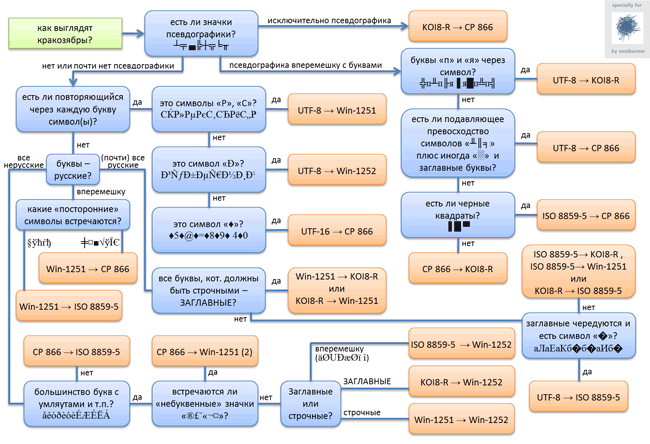
A flowchart for identifying garbled text (mojibake) — which encoding was the source and which one was it misinterpreted as.
Editor's Context
This article is an English adaptation with additional editorial framing for an international audience.
- Terminology and structure were localized for clarity.
- Examples were rewritten for practical readability.
- Technical claims were preserved with source attribution.
Source: the original publication
In the comments to the previous post about hieroglyphs, people said it would be great to have a similar flowchart for mojibake (garbled text caused by encoding mismatches).
So, voilà!
The source of information was the Wikipedia article on mojibake. In the flowchart, «UTF-16 → CP 866» means that the original encoding was «UTF-16», but it was recognized as «CP 866».
As always — clickable. Source in .docx format: here.
Why This Matters In Practice
Beyond the original publication, How to Recognize Mojibake? matters because teams need reusable decision patterns, not one-off anecdotes. A flowchart for identifying garbled text (mojibake) — which encoding was the source and which one was it misinterpreted as....
Operational Takeaways
- Separate core principles from context-specific details before implementation.
- Define measurable success criteria before adopting the approach.
- Validate assumptions on a small scope, then scale based on evidence.
Quick Applicability Checklist
- Can this be reproduced with your current team and constraints?
- Do you have observable signals to confirm improvement?
- What trade-off (speed, cost, complexity, risk) are you accepting?



