Guide to Juggling 5 Jobs: A Self-Destruction Manual
A satirical guide to the growing trend of secretly holding multiple remote IT jobs simultaneously, covering everything from time management and role-playing across companies to inevitable burnout and spectacular collapse.
Introduction to Multi-Employment: How We Got to Two (and More) Jobs
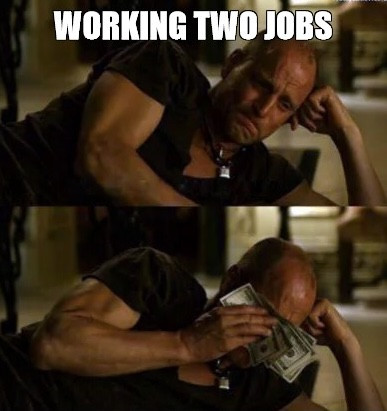
Juggling two jobs is not a new trend, but in recent years it has gotten a second wind. People used to moonlight evenings at a warehouse or driving a taxi; now they sit on two calls simultaneously, pretending their "mic is just glitching." The pandemic gave this a push: companies went remote, oversight weakened, and the desire to earn more only intensified.
The trend gained fame thanks to cases from the US, where IT workers got hired at two or even three large companies at once — pulling in $200,000–$300,000 a year from each. One of the most vivid examples is a programmer who became the hero of the Overemployed website. He simultaneously worked at five companies, swapping avatars and names in Slack to avoid getting caught.
Others picked up the idea: guides started appearing on Reddit and TikTok with time-management advice like "turn on your camera in one tab while deploying in a second and reply in a third chat via ChatGPT." People shared life hacks: from automatic "I'm on a call" statuses to full Trello boards for managing their multiple careers.
In the Russian-speaking segment, this topic was picked up by a well-known blogger. He is now banned on Habr.
Companies, of course, are not thrilled about any of this. Employment contracts started including clauses requiring you to work only at that company. But catching someone red-handed is tough: in the era of remote work, nobody can see that you're actually logging into your fifth consecutive daily standup.
So today, juggling two (or more) jobs is practically a subculture. Some do it for the money, some for the thrill. And some — because they simply can't say "no" at an interview. Seriously — I have a friend who started working two jobs because he felt bad turning down one of two offers.
Who Are You: Tri-Jobber, Tetra-Jobber... or Already a Penta-Grinder?
Before diving into the world of multitasking, it's important to honestly look in the mirror (if you're not already talking to it) and ask yourself: who am I in this career matrix?
- Mono-Jobber. The classic hard worker. Can focus on one job and is always available. These people still exist, but they're looked at with mild pity, like those who turn off the internet at night.
- Dual-Jobber. The first level of multitasker. Usually a combination of a full-time job and a freelance project "for the soul" (and money, of course). Dual-jobbers still believe they can maintain work-life balance. Cute.
- Tri-Jobber. This is where the gymnastics begin. One call interrupts another, and vacation is a myth. Tri-jobbers can set their status to "away" in a messenger faster than they blink. They often say phrases like "at our place" and don't know which company they're referring to.
- Tetra-Jobber. This is no longer work — it's a symphony of chaos. Four managers, four task trackers, four reasons to wake up at night in a cold sweat. Tetra-jobbers usually have four mugs on their desk and one question in their head: "How did I get here?"
- Penta-Grinder. The pinnacle. A person living outside of time and logic. Their day is a sequence of APIs, coffee, and brief blackouts. A Penta-Grinder is not just a role — it's a state of mind. If you're here — congratulations, you're either a genius or a myth we all invented so we don't feel tired.
Take a simple test: if you're reading this while simultaneously on two calls, writing code, and discussing tasks with a project manager — you're most likely already well beyond "tri-jobber" territory.
Crafting Your Personality Destruction Plan
The first step on the path to five jobs is choosing wisely. Ideally, all five should be in IT. That way you immediately eliminate the need to get off the couch and can simultaneously attend a daily standup, fix code, and order lunch. All projects should be "important" so that nobody suspects you work somewhere else. If work isn't urgent, it's easy to skip. But if everything is urgent and every deadline is now — that creates the perfect storm and a constant sense of significance.
Next comes the role-playing. At one job, you're a serious team lead, handing out tasks and creating the appearance of control. At the second, you're a junior who's "just learning," so you can stay silent for weeks. At the third, you're basically a Slack avatar: you drop emojis so people don't forget you're alive. The fourth you can take on the condition that "we won't load you up yet, just get familiar with the project." And at the fifth, you're "minimal support" — someone who fixes production once a week and gets paid for it.
It's important to distribute the workload correctly. If all five jobs require real engagement — you'll burn out in a week. But if you can be a person of mystery at each one, a master of invisible disappearance and king of "my mic isn't working" — you can hold out for a month, maybe even two.
That's the strategy: take on a lot, do little, stay confident. And set up a Google Calendar where your life isn't a life — it's a layered cake of calls, standups, and anxiety notifications.
Time Management (and the Illusion of Productivity)
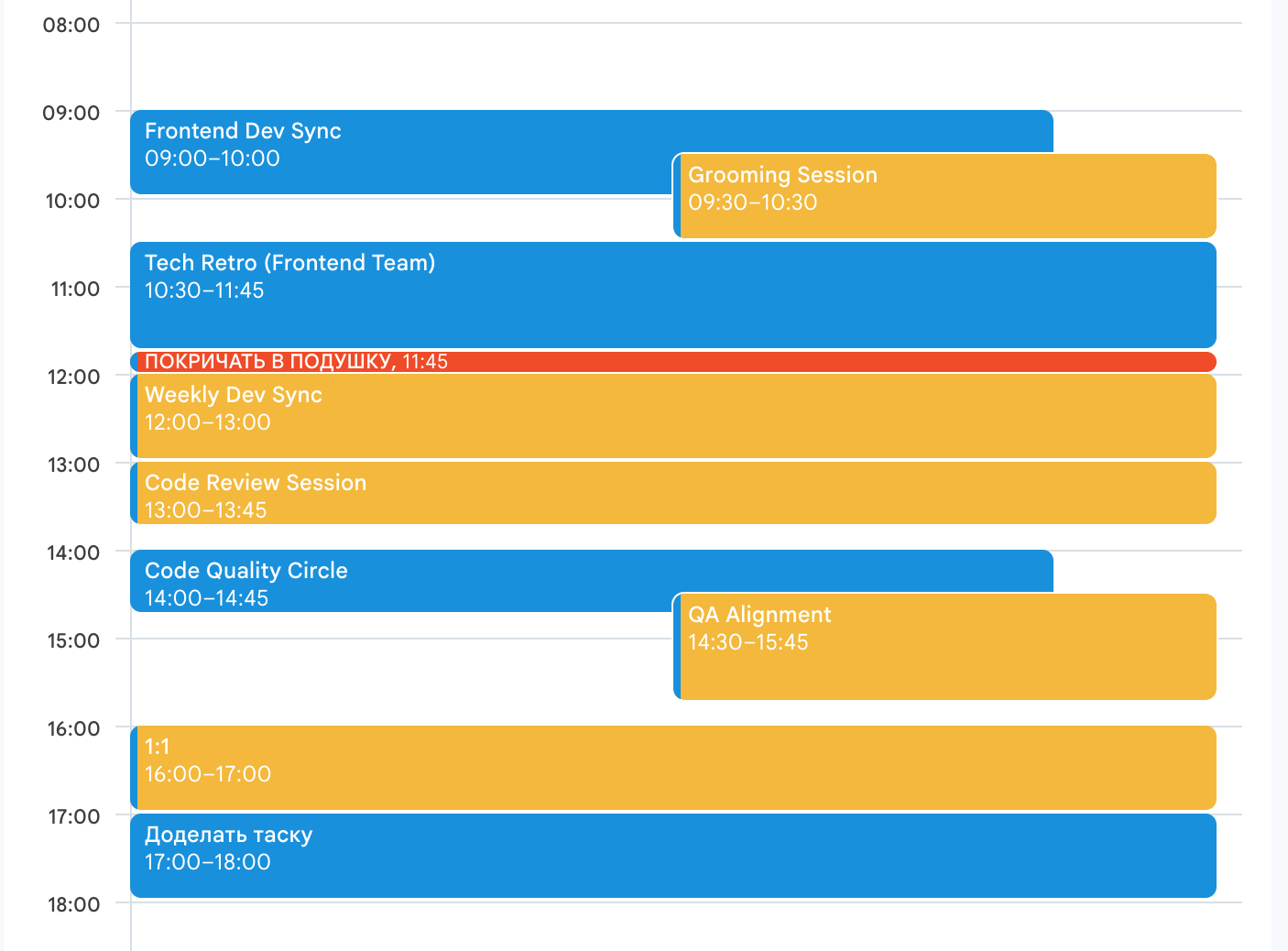
If you've decided to juggle five jobs, forget the word "spontaneity." Now you plan every breath. Your Google Calendar should resemble a motherboard that someone spilled colored stickers on. Every pixel of time is occupied. If there are 7 minutes between two calls — great, that's your lunch. Or shower. Or a brief session of philosophical despair — choose based on mood.
For survival, you need the Pomodoro method, adapted to reality: work 25 minutes — cry in the shower for 5. Preferably a cold shower to perk up before the next sprint. The main thing is not to mix them up: one day you might start crying in a Google Meet.
Sleep must now be strategic. Standing, sitting, in the coffee line, or during a meeting with product managers — the key is not to start snoring into the microphone.
Automate everything you can. Replies like "I'm on another call," auto-generated reports and standup notes, or better yet — hook up GPT to carry on conversations for you. But remember: everything can be automated except the suffering.
And don't forget: this isn't about productivity. It's about the illusion of productivity. You don't have to actually accomplish things — the main thing is that everyone thinks you're busy. Especially yourself.
Working with Burnout (and Ignoring Your Body's Signals)

At some point, you'll take vacation from three jobs just to work at the other two. That will be your rest.
Sooner or later you won't escape burnout, but you can cleverly integrate it into your schedule. For example, Mondays — anxious insomnia, Wednesdays — morning existential crisis, Fridays — apathy and tears into your pillow.
If you've started talking to the mirror — don't panic. It's not a breakdown — it's early access to a new version of yourself.
Helpful supplements — the classics. Coffee by the liter, energy drinks paired with magnesium for balance, and sometimes you just need to go out on the balcony and shout loudly into the sky: "Who even am I?!" This replaces yoga and expensive self-regulation coaches.
And if it all becomes too hard, if you feel like you can't cope — there's a proven solution. Get a sixth job. They say that's where enlightenment begins. There's no more pain, no more anxiety — just a clean schedule and a warm, conscious emptiness inside.
Damage Control: How It Will All Collapse (and When)

Every empire falls eventually. Even one built on Google Meets, Trello, and auto-generated standups. You'll probably ignore the first warning signs. Sure, it happens — you open a task tracker and see tickets with logos you don't recognize. No big deal. Or you accidentally message the wrong colleagues in Slack because "all these TypeScript frontends blur into one face."
The real warning sign is when you start mixing up employers. At one place you call the CTO by the name of someone from another company; at another, you accidentally send a meme that was meant for the "inner circle" chat. If you've ever said on a call, "well at our other... I mean, in this project..." — congratulations, you're on the brink of collapse.
Conclusion
And so you stand amid the ruins. Behind you — five projects, three laptops, one nervous tic, and a heightened ability to distinguish morning calls from evening ones only by the intensity of anxiety.
Was it worth it? Of course. You proved to yourself and the world: a human is not a fragile creature, but an adaptive processor capable of juggling dozens of tasks. And yes, the burnout threshold has not been reached — you've simply learned to live right at the edge.
P.S. By the way, I wrote all of this during a break between my third and fourth jobs.
If you liked it — subscribe to my Telegram channel — that is my fifth job.