The '5 Monkeys' Experiment Was Never Conducted
The famous story about five monkeys, a ladder, and a banana is entirely fabricated. The real reference study by Gordon Stephenson showed the opposite results -- monkeys adapted rather than blindly enforcing tradition.
The famous story about an experiment with five monkeys, a ladder, and a banana is widely spread in motivational trainings and popular culture. However, the truth is: no, it was completely made up, even though there is a reference study.
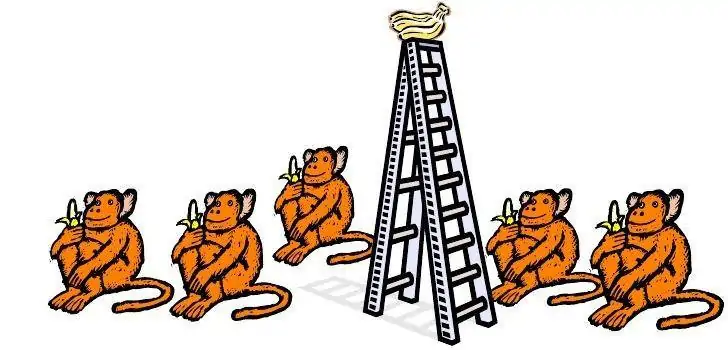
The Fictional Experiment
According to the legendary version, researchers place five monkeys in a room with a ladder and a banana at the top. Whenever any monkey tries to reach the banana, the scientist sprays all of them with ice-cold water. Gradually, the monkeys refuse to go for the banana.
Then one "wet" monkey is replaced with a "dry" newcomer. When the newcomer tries to reach the banana, the other four beat it, preventing it from touching the ladder. This process is repeated until only "dry" monkeys remain in the room -- yet they still don't touch the banana.
The moral typically drawn from this tale is that groups blindly enforce rules even when no one remembers the original reason.
The Real Experiment by Gordon Stephenson
In 1966, researcher Gordon Stephenson from the Max Planck Institute of Psychiatry conducted an actual study titled "Cultural Acquisition of a Specific Learned Response Among Rhesus Monkeys."
Methodology of the Real Study
Instead of bananas and ladders, Stephenson used a different approach: he placed monkeys in a cage with an object and made them fear it by directing jets of air at them.
Results -- The Opposite of the Myth
The results of the real experiment were radically different from the legend:
- When a naive monkey tried to touch the object, the frightened monkey pulled it away only once
- In the remaining three cases, the frightened monkeys merely "cast frightened glances toward the naive monkeys"
- In two cases, the frightened monkeys lost their fear and joined the newcomers
The Irony of Using Fabricated Experiments
The author notes a paradox: the fictional experiment tries to convince people of the need for change by claiming that "our basic human behavior is to reject change." However, the real research shows the opposite -- monkeys demonstrated the ability to adapt and learn, rather than blindly following tradition.
The fictional story implies that groups are inherently conservative and will enforce meaningless rules through aggression. But Stephenson's actual data showed that the conditioned fear was fragile: it barely transmitted to newcomers, and in many cases, the presence of a fearless newcomer actually helped the conditioned monkeys overcome their own fear.
Conclusion
And perhaps we simply shouldn't invent scientific experiments and pass them off as truth just to encourage different behavior at work?
Motivational stories should not be based on fake scientific facts, especially when the real research provides more positive and convincing evidence. The actual study demonstrates that social learning in primates is far more nuanced than the simplistic narrative suggests -- and that conformity is not nearly as automatic or deeply ingrained as the myth would have us believe.