The Economy of Seconds: How Airlines Earn Millions by Saving 30 Seconds per Flight
Modern airlines save millions of dollars annually by optimizing every phase of flight, from takeoff to taxiing, shaving seconds off each operation. A pilot explains the engineering and economics behind these micro-optimizations.
In the late 1960s, passengers flew without rush, jet fuel was cheap, and speed symbolized progress. Today the situation has fundamentally changed. Aviation fuel is getting more expensive, competition is tightening, and every second of flight has a monetary value.
Here's an example of economic efficiency: JetBlue added two minutes to every flight and saved $13.6 million a year on fuel. Southwest Airlines saved $42 million by extending flight times by 1-3 minutes. When you have thousands of flights, even seconds become gold.
The Price of Time and Fuel: Finding Balance
Airlines face a dilemma: fly faster (burning more fuel) or save on fuel (losing time). The solution is the Cost Index, a coefficient in the flight management computer that determines the economically optimal flight speed.
A high CI prioritizes speed (save time, burn more fuel), while a low CI prioritizes fuel savings. For a Boeing 777, the optimal value is 30, meaning a 1% speed increase raises fuel consumption by 0.3%.
Takeoff and Climb
The ideal profile is a continuous climb without level-off segments. Level flight during climb is inefficient: the engines work to maintain altitude instead of climbing.
Continuous Climb Operations (CCO) eliminates step climbs, reducing fuel consumption and emissions. The technique involves optimizing vertical speed while accounting for wind conditions to gain a few extra seconds.
Cruise Flight
At this phase, savings come from several strategies:
- Optimal altitude: As fuel burns off, the aircraft gets lighter and can climb higher where air resistance is lower. For example, a transatlantic flight might start at 31,000 feet and end at 39,000 feet.
- Route optimization: Controllers often allow direct routing instead of zigzagging along airways, saving 1-5 minutes.
- Speed management: With headwinds you can slow down (the wind carries you anyway); with tailwinds you can accelerate. United Airlines implemented software that suggests optimal speeds and saved $20 million annually.
- Weight minimization: Carrying excess fuel is inefficient; only the precisely calculated amount is loaded. Cabins are lightened with lightweight seats and minimal water.
The paradox: sometimes an aircraft deliberately flies slower to save money. Southwest reduced speed by adding 1-3 minutes and saved $42 million a year on fuel.
Descent with Savings
The old method was a stepped descent with level segments requiring added thrust. The new approach is Continuous Descent Approach (CDA): continuous gliding at minimum thrust from cruise altitude to the glide slope.
The benefits:
- Boeing 737 and Airbus A320 save 30-70 kg of fuel per descent
- Wide-body aircraft save over 250 kg
- An airline with 20 aircraft making 6 flights per day saves over 2 million kg of fuel annually — millions of dollars
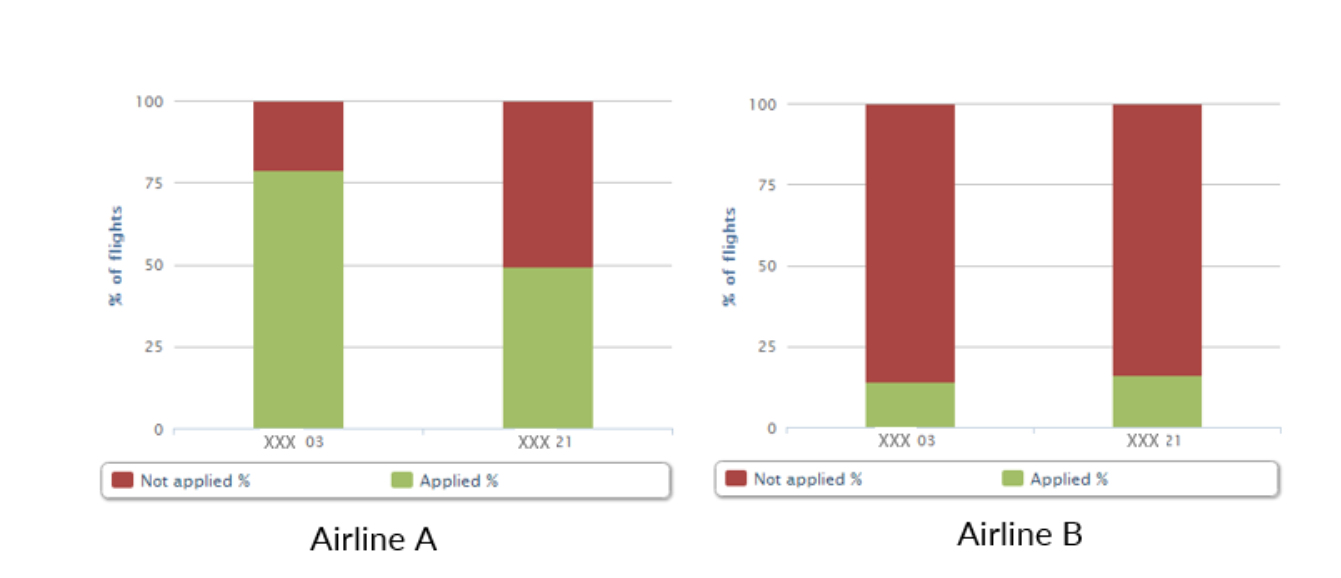
The challenge: this requires coordination with air traffic controllers. At one French airport, one airline performed 50-75% of approaches using CDA, while a competitor managed less than 10% under identical conditions. The difference was pilot training and initiative.
Delayed deployment of mechanisms: Keeping the landing gear and flaps retracted as long as possible reduces drag. Deployment happens only just before landing, saving fuel and reducing noise.
Landing and Rollout
Touchdown point: A precise landing in the first 300-600 meters of the runway ensures a long remaining distance for braking and early use of the nearest exit.
Aggressive braking: Spoilers, thrust reversers, and wheel brakes are armed in advance, providing intensive deceleration immediately after touchdown.
Scaling up: 30 seconds x 10,000 landings = 300,000 seconds, or 83 hours of savings per year. This allows the airport to handle more operations and reduce delays.
After Landing
Single Engine Taxi: A narrow-body aircraft on one engine consumes 10-20 kg of fuel over 10 minutes instead of the normal consumption with both engines running. Even 45 seconds saves about 3 kg. With 30,000 flights per year: 100,000 kg in savings. A Boeing 777 saves 65 kg over 5 minutes of single-engine taxiing.
APU (Auxiliary Power Unit): Burns 100-300 kg of fuel per hour. The alternative is connecting to airport ground power units (GPU) and air conditioning (1-2 liters of diesel per hour). An A320's APU consumes about 126 kg/hour versus less than 20 kg for GPU — a 5-6x difference. An airline with 50 aircraft and 10,000 flights per month running APU at full capacity burns over 10,000 tons of fuel annually just at gates.
Conclusion
There is no single magic solution; the gains come from many small victories. Aviation demands technology and precision. A culture of savings permeates the entire process — from planning to crew to technicians. The result: quieter, greener flights that remain comfortable, with changes invisible to passengers. Safety always remains the top priority — all these techniques are applied only under normal conditions.