Comments are our everything! Online comment history
« Too bad coders can’t be like rock stars and get their money for nothing and their chicks for free » (« It's a pity that coders can't be like rock stars and get their money for nothing and their chicks for free »). This is one of first comments in the form we are familiar with,
Editor's Context
This article is an English adaptation with additional editorial framing for an international audience.
- Terminology and structure were localized for clarity.
- Examples were rewritten for practical readability.
- Technical claims were preserved with source attribution.
Source: original publication
«Too bad coders can’t be like rock stars and get their money for nothing and their chicks for free» («It's a pity that coders can't be like rock stars and get their money for nothing and their chicks for free»).
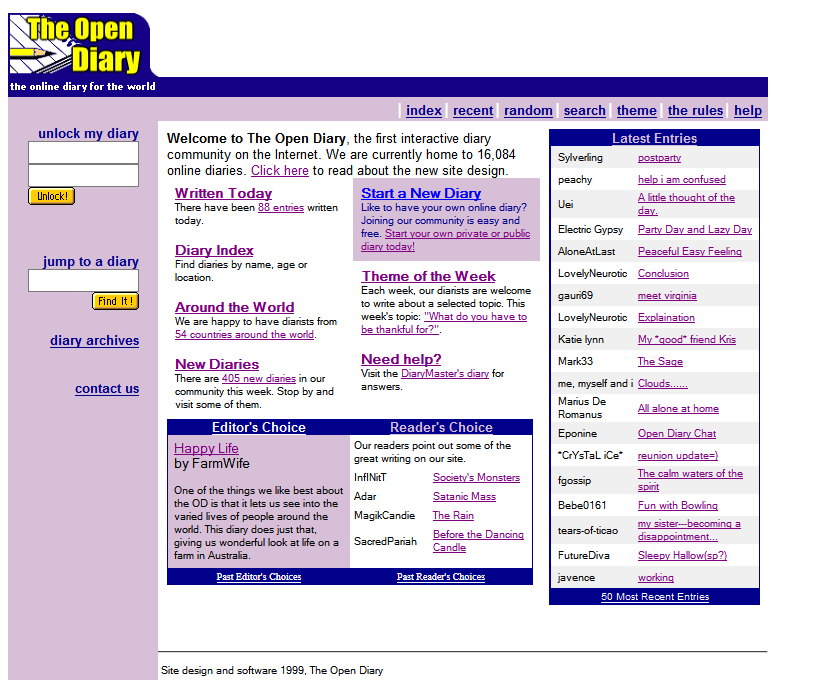
This is one of first comments in the form we are familiar with, appearing on the Internet. It was written by software development pioneers Dave Wiener. On October 5, 1998, Wiener created a discussion board with a comment function. Around the same time, another programming veteran, Bruce Ableson, created an online magazine Open Diary, which allowed diarists to respond to each other's entries using comments. This is how the comments section we know today came to be.
As the Internet has evolved, the typical web page has become a hierarchy, with an article/post/video/image at the top and comments at the bottom. Now they seem as natural as the sidewalks on both sides of the street.
But the concept of comments is actually one of the fundamental functions of the Internet. The very early Internet was just a huge comment section. And this article is devoted to their history of appearance and development.
❯ "First"
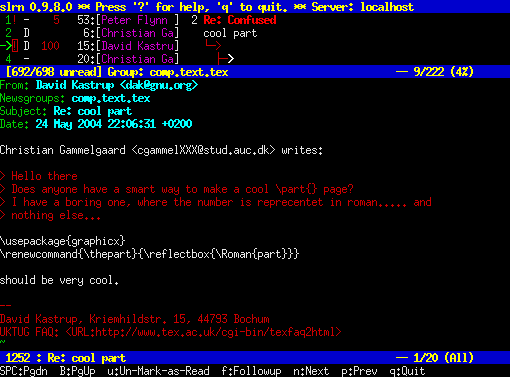
To AOL (AIM), emails and chats were Usenet And Telnet. These programs were the early drivers of what later became the Internet as we know it, and they were essentially just platforms for creating and reading comments. They allowed people to communicate and form online communities. With only a fraction of the computing power of modern smartphones, people created complex digital quests, organized forums on Dungeons & Dragons and discussed scientific theory.
Usenet
Comments - lines of text superimposed on each other in chronological order - are direct descendants of bulletin board systems, or BBS, which date back to the 1970s; users could connect via modem and contribute to discussion forums. The computer code that determined the order in which text appeared on the BBS also provided the basic architecture of the comment thread. This code, or script, became the basis for an early commenting function called guest book: A simple text entry area where any visitor could type a note. Guest books were attached to the website as a whole and not to any specific content on it. This created confusion as to what capabilities the guest book provided.
Even then, these early communities were not without trolls, but this dark force was balanced by high technological barriers to entry. Early adopters had to have sufficient knowledge and skill to use the terminal window and command line interface. Essentially, you had to be some kind of hacker.
Fray.com, a popular website launched in 1996, was one of the first to harness the power of the guest book. Users' questions and answers were published in real time. The website was essentially a collection of guest books.
The primacy of the invention of comments, as we now know them, is difficult to give to one specific person or site. But a possible contender for the championship is the interactive book “Travels with Samantha", which allowed readers to submit comments via a form (much like modern comments). The book won an award Best of the Web for the best document design in 1994. In the same year that the World Wide Web Consortium created W3 Interactive Talk for discussing technical issues - a system in which discussion points were submitted using a form that made them part of a topic page.
The desire to interact with others online has always been there, but the opportunities and reach have expanded gradually. The invention of the web browser, social media and the mobile web has removed the technical barriers to joining the online world.
The first blog prototype was created in 1994, but the term weblog was not used until 1997 (and then simply blog since 1999).
The modern blog evolved from the online diary. Users posted about their personal lives, usually for themselves, but open to anyone who was interested. One of the good things about blogs, besides providing regularly updated content that was attractive to both readers and search engines, was that they allowed readers to post messages.
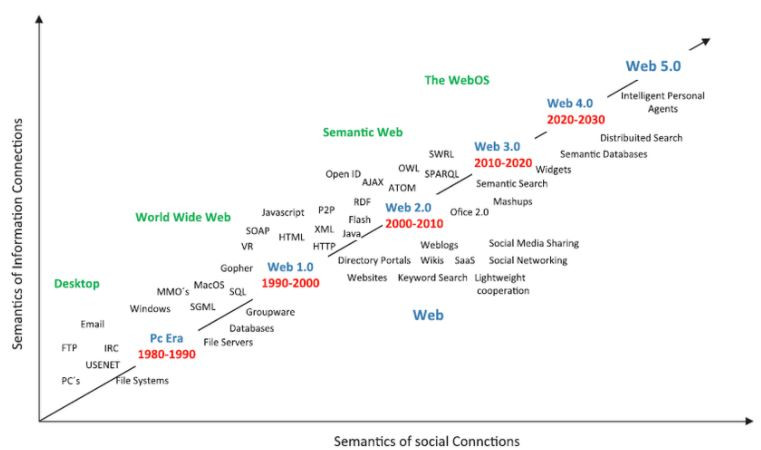
The evolution of blog commenting began with the Open Diary website, which has offered a separate comments section for its readers since 1998. Before this, no reader could directly leave feedback to the author of a post in this way. This was the birth of Web 2.0.
Evolution of the Web
❯ Blogs, spam and moderation
The best form of commenting on a blog was to continue a conversation already started in a blog post. The topic had to be relevant, and the comment had to improve on the original post as an active continuation of it.
Because there is a delay due to moderation, a blog comment should be thoughtful, well-structured, at least three sentences long, and have a recognizable beginning, middle, and end. The participant had to fully think through what he was going to say before he began.
Of course, each blog's comment area could be supplemented with responses from the author. This not only doubled the number of comments, but also added content and made the comments more interesting to other readers passing by.

In the late 90s, early bloggers expected the level of discourse to be high. Intelligent commenting was seen as a way to gain respect in the blogging community. In early 1999, there were only about two dozen blogs (which were mostly lists of interesting websites), but as their numbers exploded, it became increasingly difficult for bloggers to follow the fragmented conversations.
In 2000, a blog service Blogger introduced permalinks that allowed each blog post to have its own URL, and in 2002 Movable Type implemented the function TrackBack, which automatically notified the author that a post (URL) from his blog had been posted elsewhere. TrackBack was intended, at least in part, to blur the lines between commenters and authors. In theory it was great. But the technology couldn't support what real conversations required.
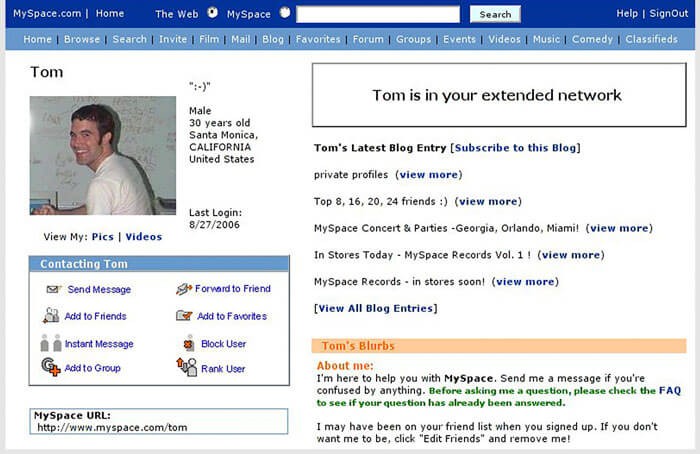
The first recognizable social networking site in the format we know today was Six Degrees. Created in 1997, this platform allowed users to set up a profile and become friends with other users. A little later, social networks began to widely develop and spread in the early 2000s, starting with MySpace.
MySpace
Social media had an advantage over blogs in terms of commenting. The ability to be in real time, that is, where you can get an immediate response to your comment and you can continue the conversation in the same way. This is not possible on blogs due to the need for moderation.
And this need for moderation killed openness in early blogging culture. A hurricane of link spam hit blogs in the mid-2000s. Clearing spam from comment sections has become a bigger headache for bloggers than controlling trolls. Many of them have permanently disabled comments.
The spam invasion exposed problems with early blog moderation, which grew out of a culture shaped by tools inherited from the BBS era. It took site owners years to realize that they weren't just providing platforms and platforms, but were building communities out of lines of text, which required a more nuanced approach. Almost all popular web forums depend on a 24/7 team of moderators.
However, high-traffic sites continue to leave comments unmoderated or use imperfect automatic moderation. Few have tried user moderation systems like the one the creator developed Slashdot Rob Malda. Founded in 1997, Slashdot quickly began to suffer from "signal-to-noise ratio problems” when tens of thousands of users appeared. Instead of embracing chaos (which was the hallmark of Usenet) or having everything blocked by moderators, Malda came up with a way for users to moderate each other. Moderation has become similar to jury duty. Moderation allows the author to evaluate whether a comment is suitable for publication. Special plugins and applications for blogs can check whether a comment is spam.
But moderation means delaying the publication of a comment. And this resulting delay could not compete with real-time commenting on social networks. Since blogs no longer allowed any comments, people had to go elsewhere to engage in discussions, and they moved to social media. And they found that social media was much preferable because of the real-time element that allowed for instant responses.
Initially, social media was unmoderated, which meant that anyone could make any comments and no one could remove anything that was obscene, harmful, or just plain awful. The lack of moderation meant that people could contribute whatever they wanted without any barriers. This has contributed to the rise of hatred, sensationalism, conspiracy theories and fake news. Commenting has become purely reactionary.
Unlike comments on blogs, the nature of commenting on social networks has changed. It became shorter and harsher, there was no depth, there was no pre-thought, it was easier to get off topic and it didn't necessarily require good writing skills. It was no longer necessary to think too much before responding because it was so easy to write a comment, regardless of the consequences.
The rapid expansion of social media platforms has revolutionized the way people communicate, fundamentally changing the landscape of human interaction. These platforms have become an integral part of everyday life as major sources of information, entertainment and personal communication.
The world's languages have begun to adapt to changes in culture, society and technology, leading to the emergence of new language forms such as acronyms, phonetic spellings, neologisms and multimedia elements such as hashtags and emojis.

And comment sections have become the ultimate expression of this phenomenon.
❯ Endless commenting
People always commented. If primitive people could write, then the walls under the rock paintings would be covered with comments about how the artist implausibly depicted the hunt for mammoths.
Even before the Internet, people wrote in the margins of books about their experiences, wrote letters to newspapers about their thoughts about the news they read. Now we do the same only through smartphones and computers. Today, if you go online every day, you leave at least one comment on some site. And you certainly read dozens, or even hundreds of comments a day. Online comments can be informative, funny, misleading or maddening. Some comments are off topic or even nonsensical. Some are not worth reading at all. But they can tell us a lot about human nature and social behavior.
Comments can inform us (through reviews), improve us (through feedback), manipulate us (through fake news), alienate us (through hate speech), shape us (through social comparison), and confuse us.
Comments affect our self-esteem and well-being. Short and asynchronous, these messages can be casual, confusing, funny, inspiring and weird. They can lose context as they move through the Web over time, prompting readers to add their comments to the queue.
And no matter how technology changes in the future, people will always have a need to speak out and discuss with others on any topic: for the sake of interest, out of principle, out of wounded pride, just to provoke a reaction from their interlocutor or to laugh outright. But nevertheless, there is room for improvement, namely we can improve the culture of commenting.
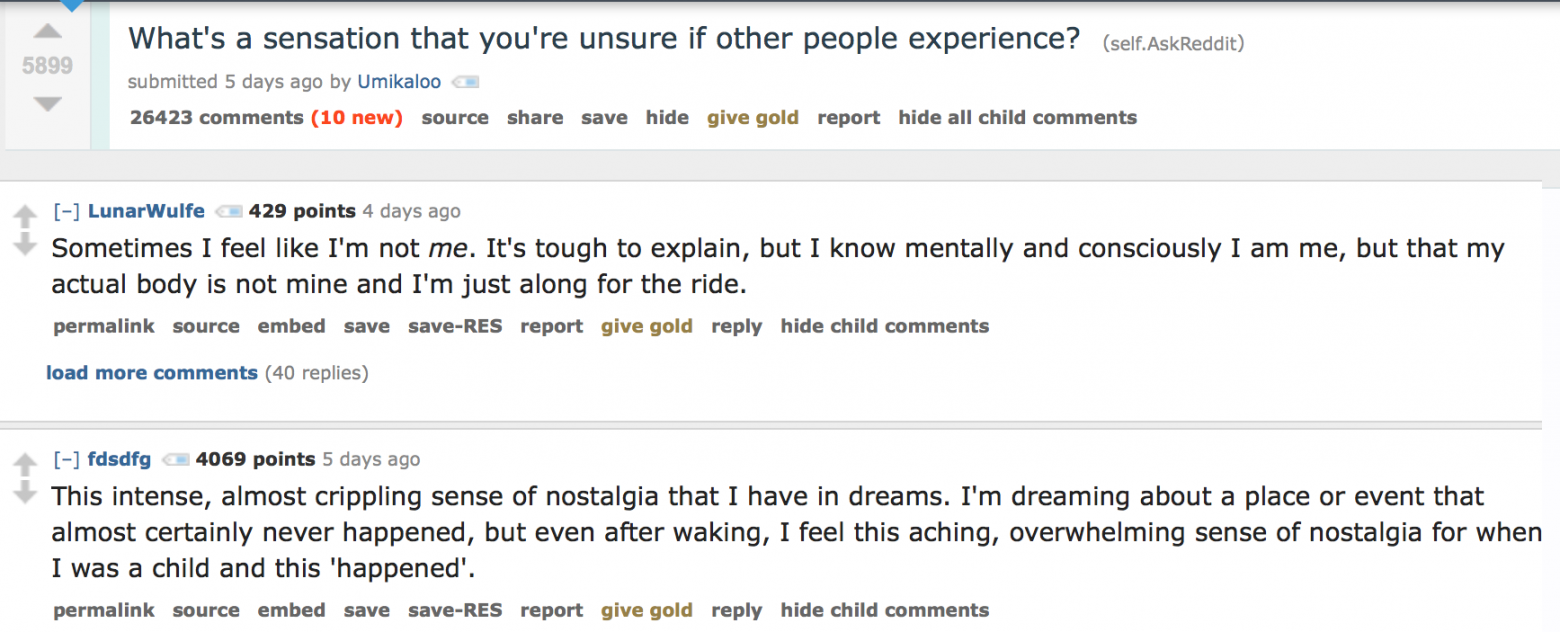
There's no better example than Reddit, which itself is practically one huge comment section. Anyone who uses Reddit knows that the real gold of Reddit is the comments. Users have developed their own community standards, which each member actively supports. If someone violates these standards, they will either be reported, or people will simply not like those comments (and therefore their comments will never get any attention).
You can watch dozens of videos on YouTube about a topic that interests you, but only in the comments will you find the information you need. The comments section can be the nastiest place on the Internet, the wild places where people share their dark thoughts. But this is where people share their unique experiences, experiences, and thoughts.
The real Internet is in the comments.
News, product reviews and competitions from the Timeweb.Cloud team - in our Telegram channel ↩

Read also:
- ➤ Setting up alerts from Zabbix to Telegram
- ➤ How to create your own web framework in Python
- ➤ Not (loneliness online) NOW
- ➤ On the birthday of the emoticon: millions of dollars, many years of trials, Nabokov - the history of the appearance and popularity of the emoticon
- ➤ What does my mom play while I sleep?
Why This Matters In Practice
Beyond the original publication, Comments are our everything! Online comment history matters because teams need reusable decision patterns, not one-off anecdotes. « Too bad coders can’t be like rock stars and get their money for nothing and their chicks for free » (« It's a pity that coders can't be li...
Operational Takeaways
- Separate core principles from context-specific details before implementation.
- Define measurable success criteria before adopting the approach.
- Validate assumptions on a small scope, then scale based on evidence.
Quick Applicability Checklist
- Can this be reproduced with your current team and constraints?
- Do you have observable signals to confirm improvement?
- What trade-off (speed, cost, complexity, risk) are you accepting?
FAQ
What is this article about in one sentence?
This article explains the core idea in practical terms and focuses on what you can apply in real work.
Who is this article for?
It is written for engineers, technical leaders, and curious readers who want a clear, implementation-focused explanation.
What should I read next?
Use the related articles below to continue with closely connected topics and concrete examples.