City of childhood: what will happen if you continue playing SimCity 2000 after 25 years
I have warm feelings not only for old computers, but also for the retro games that I ran on them. Perhaps my main love is SimCity 2000, the second in the famous line of city planning simulators from Maxis. It was with him that my acquaintance with the series began in the mid-90s.
Editor's Context
This article is an English adaptation with additional editorial framing for an international audience.
- Terminology and structure were localized for clarity.
- Examples were rewritten for practical readability.
- Technical claims were preserved with source attribution.
Source: original publication
How excited I was for this game can be evidenced by the fact that in the summer, when my family and I were moving to the dacha (“what kind of computer do you need, you need to walk in the fresh air!”), I exhausted stacks of paper, reproducing the game interface from memory and drawing the cities that I dreamed of building upon returning home. At some point, I even glued together a kind of monitor from cardboard boxes, depicted a city from SimCity 2000 on the “screen” and created an “animation” by pulling a thin ribbon with a drawn train through the slots...
❯ Somewhere there is a city, quiet as a dream...
Most of the games that I was fond of as a child left traces only in the form of pleasant memories. And only in the case of SimCity 2000, the present me and the past me are connected by a completely material bridge. Thanks to an amazing coincidence, I still have a floppy disk on which, back in 1999, I recorded a file called ALEXTOWN.SC2.
I was 9 years old, I immodestly named another virtual town after myself and for some reason decided that this time it was so successful that I definitely needed to brag about it to my friends in computer science class. I don’t remember at all whether the idea was a success (most likely not), but that doesn’t matter. The main thing is that thanks to her (and my habit of not throwing anything away), a city in which time stood still in the 1945 game year has survived to this day.
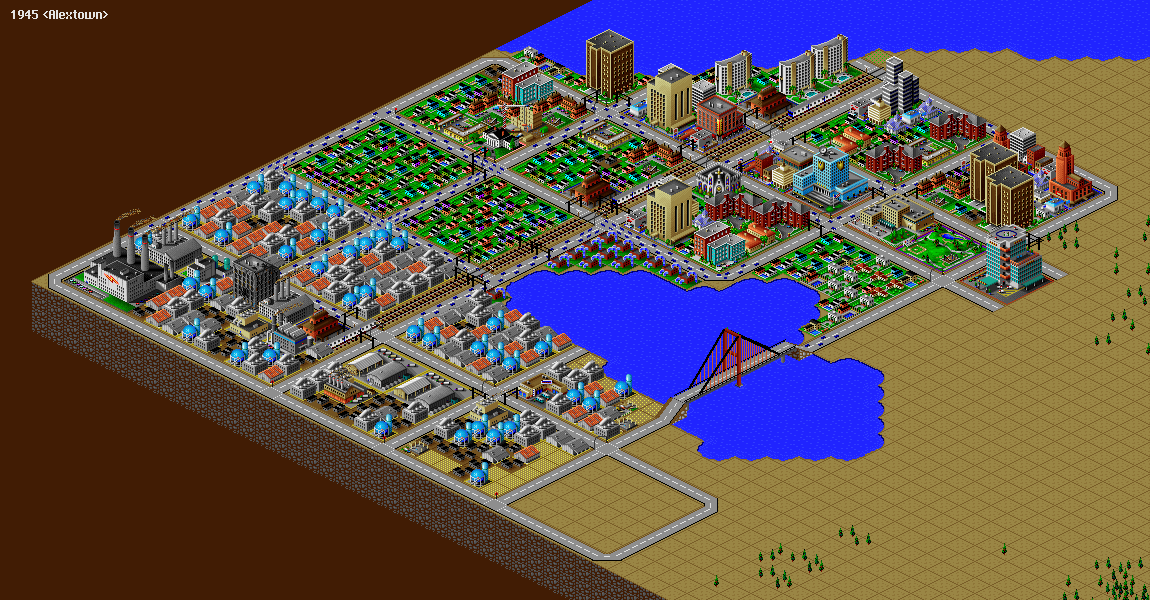
Seven thousand virtual residents waited patiently for their young mayor to grow up, finish school, then college, and finally awaken them from many years of sleep. And again the pixelated cars began to drive, white and blue locomotives ran along the rails, and the chimneys of tiny power plants and factories began to smoke. Residents of the digital “snuffbox town” hurried about their business, obeying lines of program code unknown to them and reading local newspaper news along the way, generated by a randomizer from a standard set of photographs, stories and toponyms...
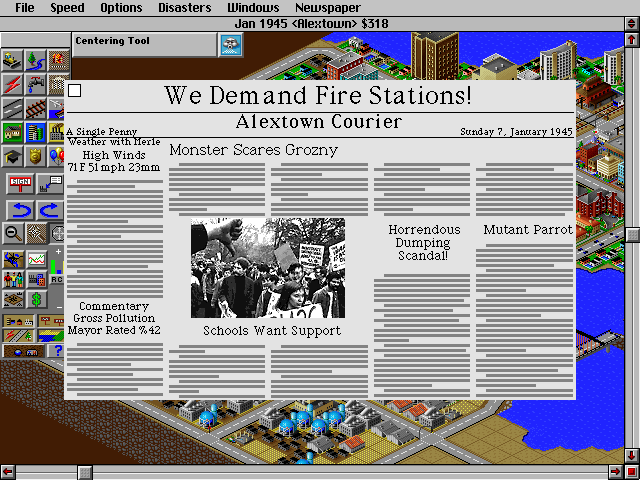
... sometimes in a rather funny way.
There are no wars or revolutions in SimCity 2000, and the connection with real history is limited to a rather conditional observance of the dates on which this or that technology becomes available. But this does not mean that in the awakened Alextown everything was calm and complacent: the townspeople did not have enough public transport, they were often sick and did not receive sufficient education, and the only power plant supplying the city with energy was to die today or tomorrow (in the world of the game this looks extremely clear: on the day of its 51st anniversary, the station simply explodes).
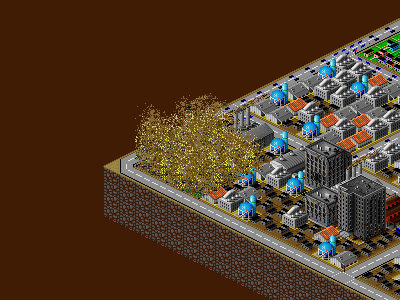
However, it cannot be said that Alextown was designed extremely poorly. Thermal power plants and factories are located at the edge of the map so that most of the smoke goes beyond its borders. The town has a school, a hospital and even a police station, and the grid of streets and avenues is laid out with an optimal 6x6 spacing (Sims are not willing to walk more than three squares, and if the area is further from the road, it will remain undeveloped). And on the outskirts there is a beautiful, albeit very short bridge, clearly inspired by the famous Golden Gate.
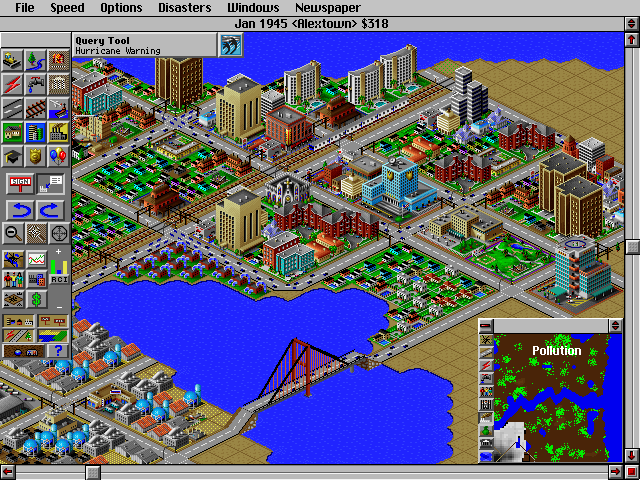
❯ Time, go!
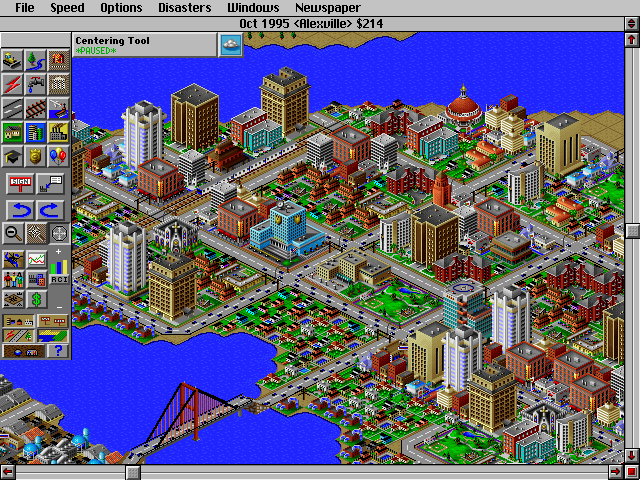
I made my first attempt to complete my Alextown (renamed by that time to the more harmonious Alexville) ten years ago. By in-game year 1995, the city's population had nearly doubled. Residents now have the opportunity to go to a museum or sail on a yacht.
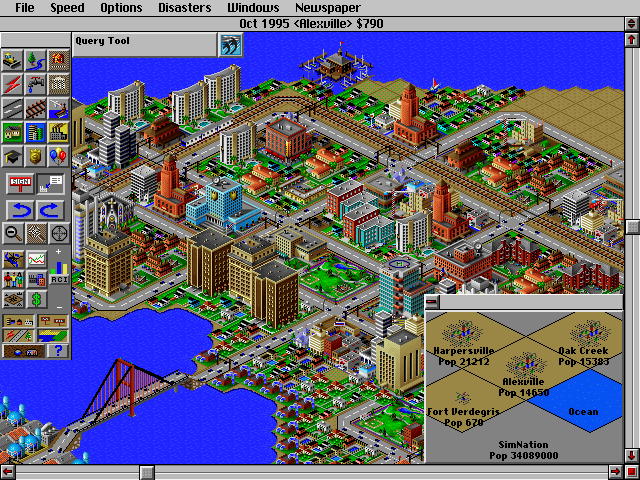
The increased energy needs were met by several new power plants, including two solar ones. The railroad covered half the city with the clear prospect of soon closing into the Alexville Central Circle.
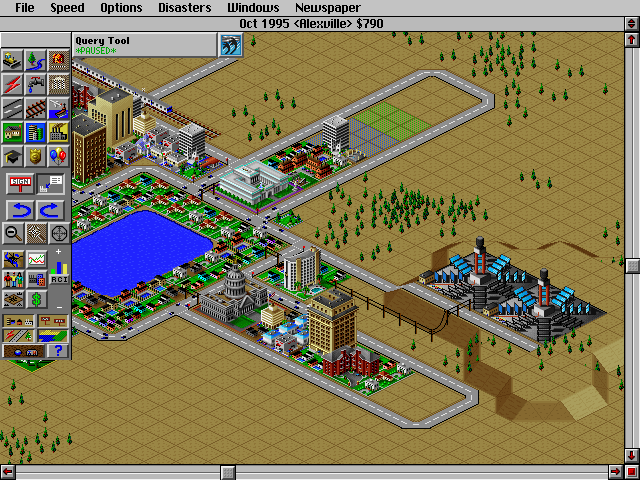
But the city has not escaped its growing pains. The load on the road network was increasing all the time, and car exhaust, as well as constant noise, reduced the value of land.
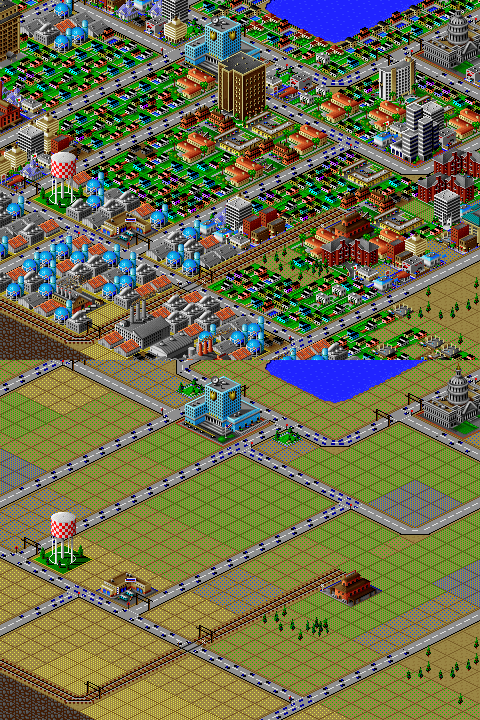
SimCopter One reporting heavy traffic!
Naturally, I used the mechanisms provided in the game to combat this: I built bus depots and new railway stations, and laid alternate routes for especially busy roads.
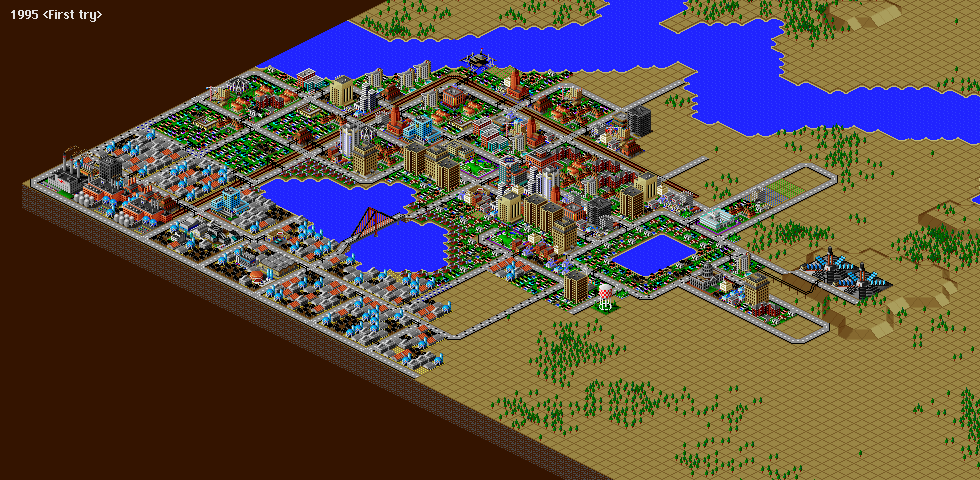
General view of the city in 1995
For a generally casual game, SimCity 2000 has very advanced monitoring and analysis capabilities. There are 18 types of charts available, allowing you to track road traffic, the quality of electricity and water supplies, population growth by area, crime rates and police strength, land values, the location of key municipal buildings and much more.
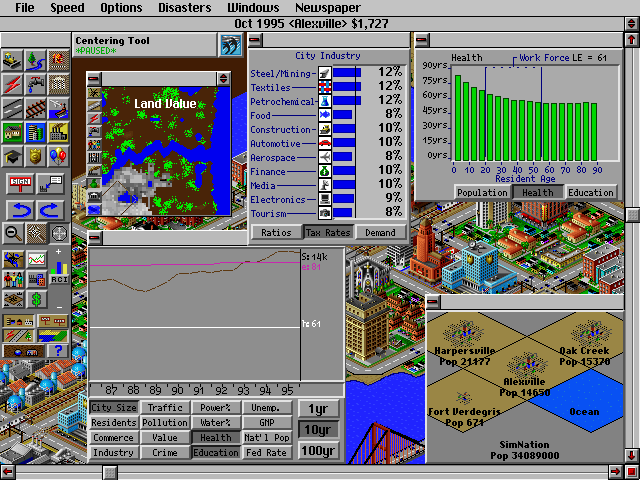
Moreover, you can either view small diagrams in the window or overlay them in the form of a color gradient directly on top of the main map. This is how, for example, traffic is reduced if you demolish some of the buildings inside the block and build an additional road:
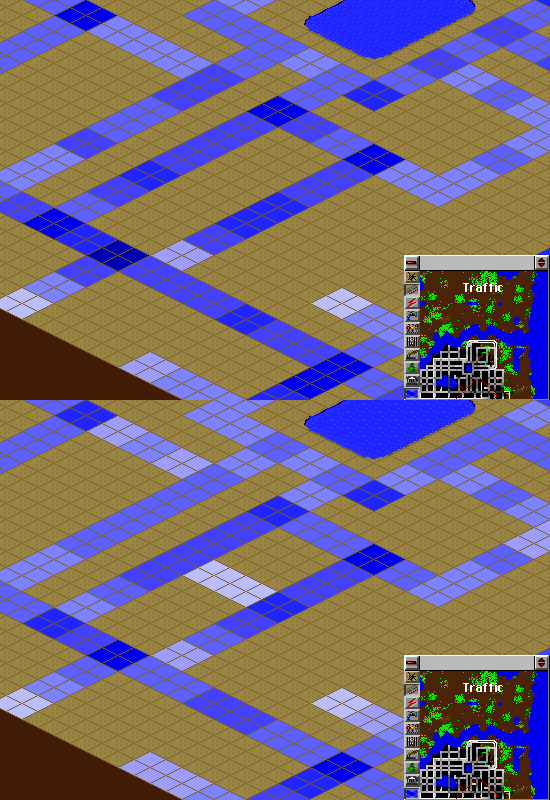
The darker the color, the denser the movement
In the City Industry window you can see the demand for different industries and the degree of their development in the city, and also set the tax level separately for each.
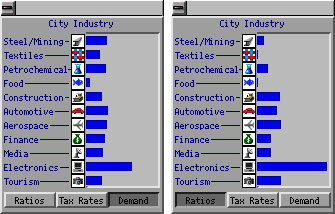
Desires and possibilities
The graphs can show population, levels of education, health care, crime, unemployment and many other indicators (16 options in total) for 1 year, 10 or 100 years. All in all, a paradise for a hyper-controlling mayor.
Another half century flew by unnoticed by me:
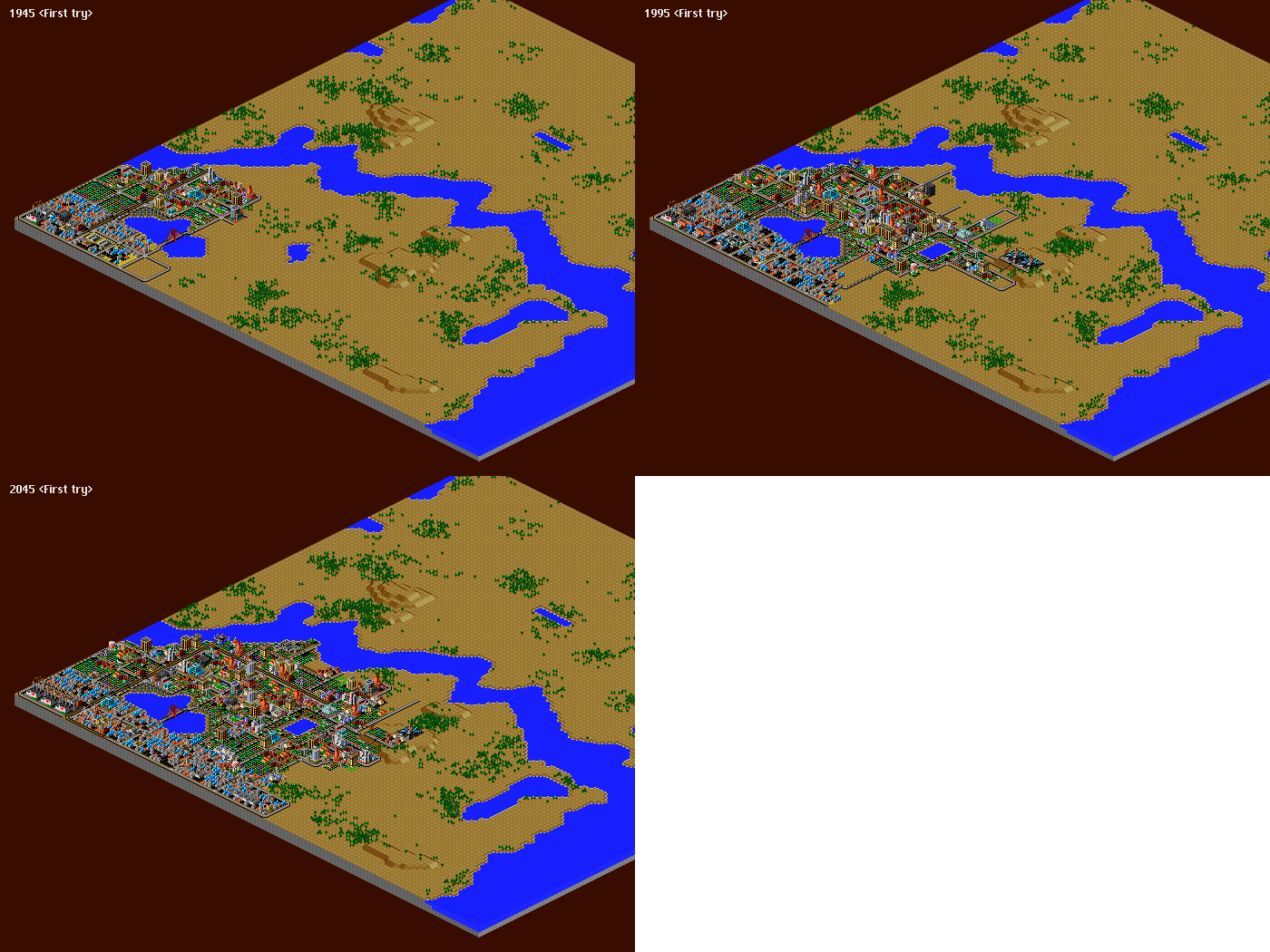
Only thanks to this animation I noticed that new trees were growing on the map by themselves
During the game, I really liked how my Alexville developed, but then, after carefully analyzing the indicators, I realized that everything was far from so rosy. Most residents have a low level of education; peripheral areas suffer from power outages all the time, but I can’t save enough money to even build a nuclear power plant (and there are also all sorts of futuristic ones there). In the middle of the 21st century, the sky of Alexville is still covered with clouds of smoke from coal-fired power plants.
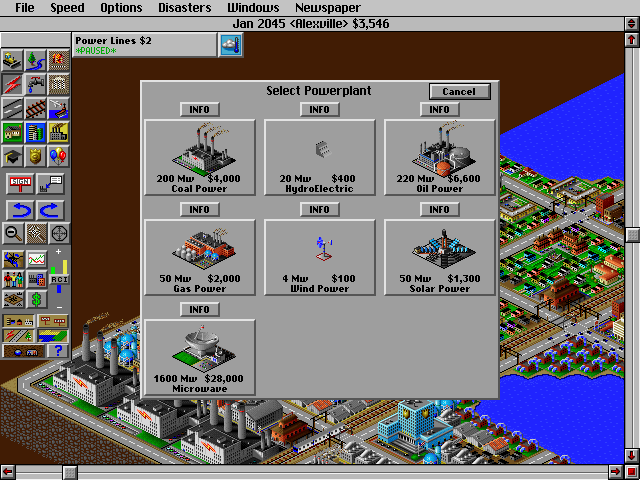
The brave new world we deserve
In order to somehow attract new residents to the city, I had to reduce taxes, but this automatically meant a drop in income and, as a consequence, a lack of funds for development. In short, a vicious circle that cannot be escaped, only broken.
❯ Second approach to the projectile
Five years later, in 2019, I tried again to start from the same point, taking into account the mistakes I had made. I wrote about this on LiveJournal and on Pikabu, so some points from previous posts may be repeated in this article - I hope you will forgive me for this.
The second time it turned out much better:
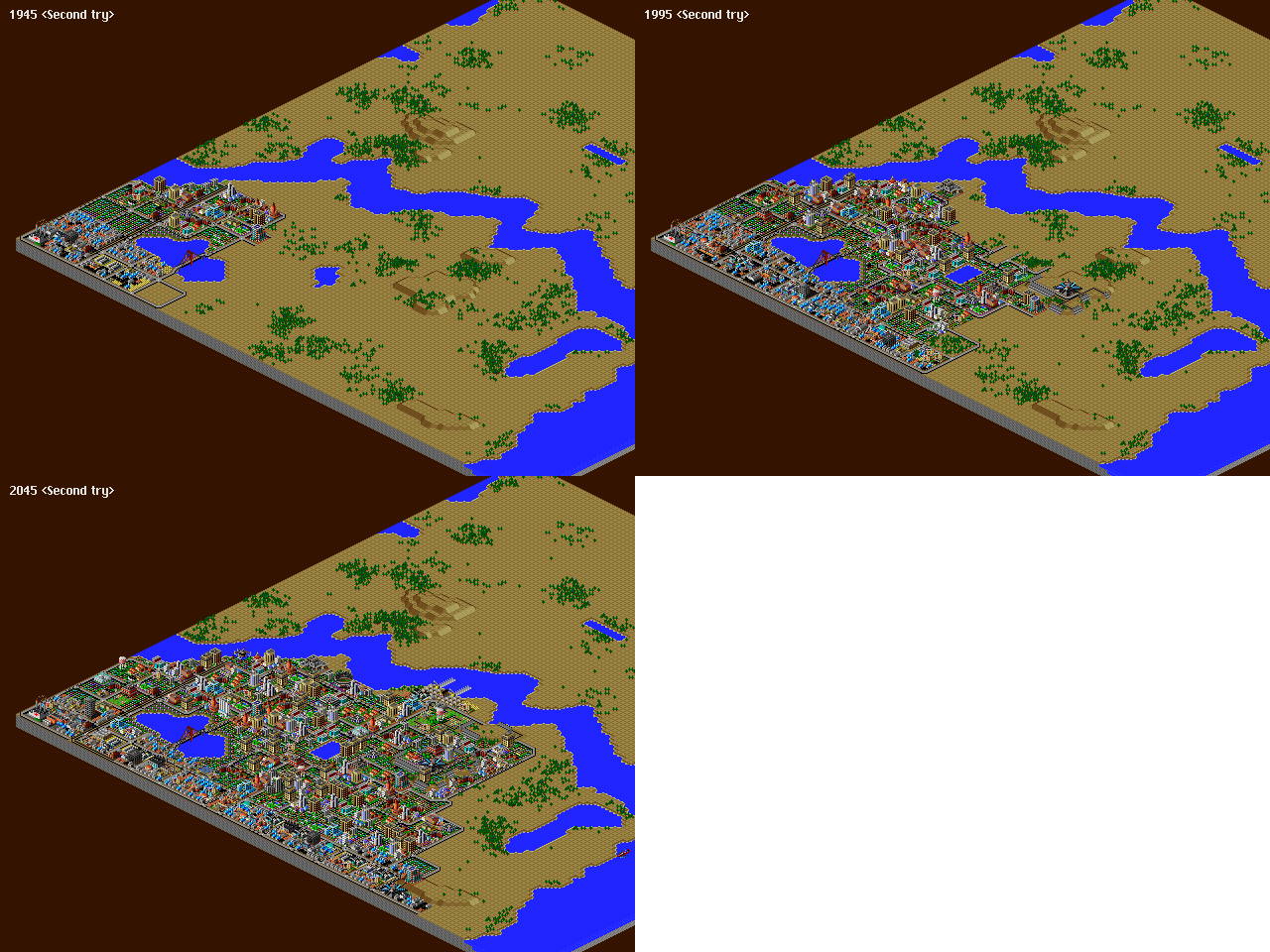
Full size view of the city - by link.
The population was almost 40 thousand people against the previous 22. A seaport and a stadium appeared in the city; many 3x3 tile buildings were built, requiring very high land costs. The city's energy is mainly provided by gas, solar and hydroelectric power plants, with the last coal-fired power plant completing its life and scheduled for final demolition in 2052.
Compared to the previous attempt, the numbers are as follows:
Population: 22,390 → 39 620
Health level: 64 → 65
Education level: 85 → 96
Annual profit: $732 → 1727 $
If anything, to get large screenshots I use the Windows version of SimCity 2000:
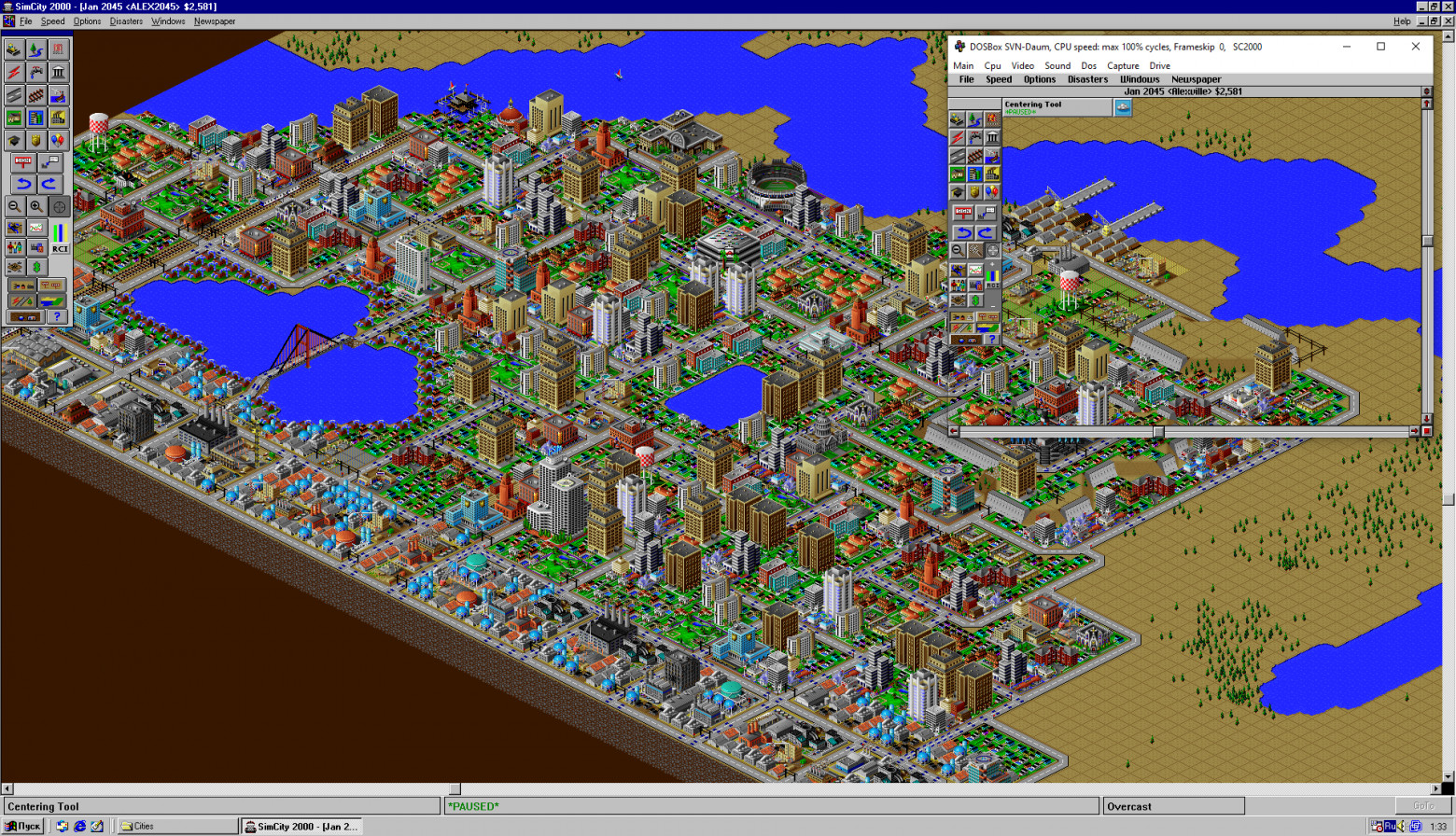
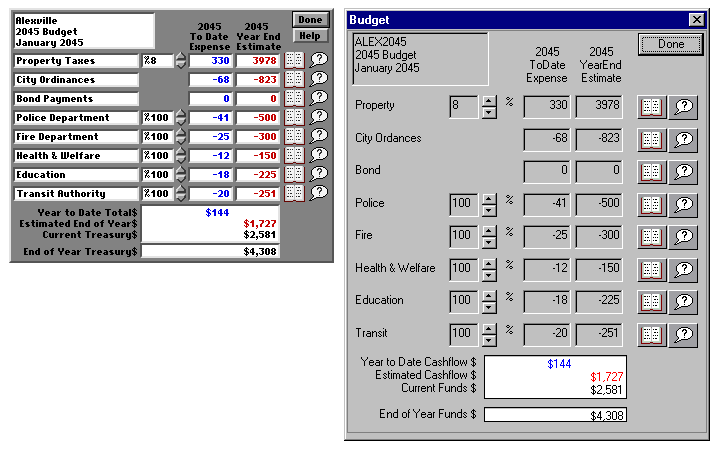
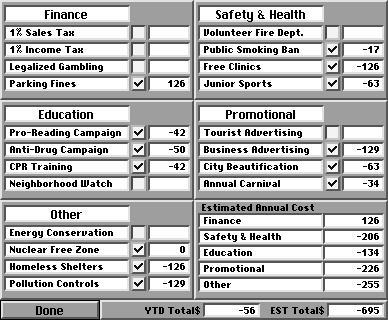
But for the game I still prefer the original for DOS - not only for nostalgic, but also for aesthetic reasons. In my opinion, the transition to standard Windows window forms greatly spoils the game interface. Just look at the budget window - how much more compact and at the same time more readable it is in the DOS version:
❯ Understanding the game mechanics
As you can imagine, this post would not have appeared if I had stopped there five years ago. I was very interested in checking how true the initial hypotheses were? How would my Alexville have developed if I had chosen a different road network, or a different type of power plant, or an alternative approach to taxation?
Complete reconstruction of a city with certain changes is a long process, so in this part we will mainly conduct experiments on simple models.
❯ Where have you, path, led me?
First of all, I wanted to check if the information from some game guides is correct that Sims are willing to walk 3 squares and drive a car 20 squares. The first figure does not raise any questions - I myself have seen many times that if a zone is located at a greater distance from the road, it simply will not develop. And for some reason, Sims do not agree to walk between different zones. That is, even if you mark residential and industrial zones adjacent to each other, Sims will not get from one to the other until you build a road.
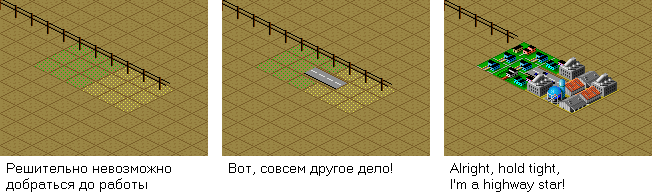
But with the maximum duration of trips it turned out to be more interesting. I created a town with a power plant, water pumps and two small zones - residential and industrial, each 3x3 cells in size. They were located in increments of 20 cells, which, taking into account the width of the zones, gives 18 cells of free space between them.
Everything worked perfectly, the zones were populated and existed indefinitely. Next, I increased the free space to 21 cells. The situation has not changed! And only when the zones were separated by 23 empty cells, a very characteristic pattern was formed: only those areas that were as close to each other as possible, namely at a distance, remained “alive” 24 cells, if you count along the way.
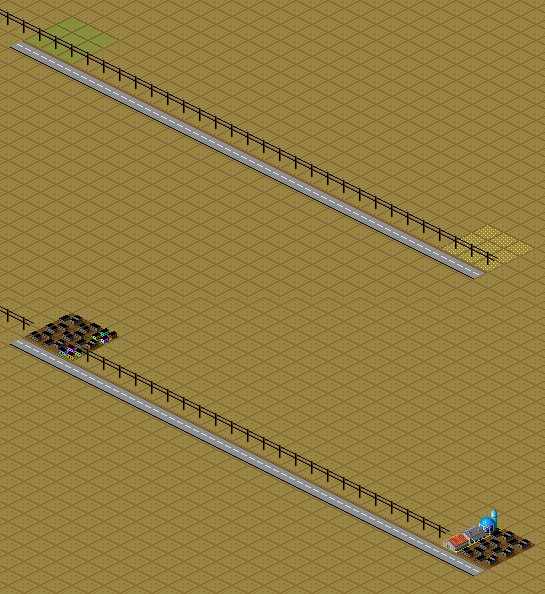
It seems that virtual residents only take the shortest route to the nearest highway. If, after traveling 24 cells, the Sim still does not reach the goal, the trip is considered unsuccessful, and the enterprise is left without an employee, and the employee is left without a salary. As a result, both the residential and industrial zones “die.” Although, if at the beginning the Sim was ready to walk a little further in order to get into the car one or two cells closer to work, then everything would have worked out. Amazing realism, if you remember how many people are ready to park on top of each other, just to avoid walking the extra 100 meters to the entrance.
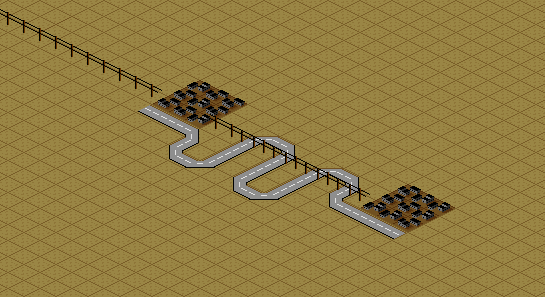
Looking at the previous animation, you might think that the issue is the linear distance of the zones from each other. But no, it is the length of the route along the highway that is decisive. If you bend the road like a snake, exceeding the 24 tile limit, the zones will die - even though they have become geographically closer to each other:
❯ I'll get off at the farthest station
The next series of experiments was related to railways. Here I have not found information anywhere about how far residents are willing to travel with their help, except for an assessment of what is further than on the highway. Okay, let’s build our own Trans-Sim railway, mark it with trees into 10-cell sections and start moving zones along it.
Here the result turned out to be more interesting. There is no clear limit after which Sims become desperate and pull the stop valve. The maximum travel range is in the range 54–64 cells. Zones that are no more than 54 tiles away are actively being built up and are rarely abandoned. At a distance of 60 cells, they build up, but slowly die and then barely stay warm. Only about 10% of the most patient passengers are willing to travel such a distance every day. And finally, with a trip length of 64 zone cells are built up, but are guaranteed to die within 5 years. At greater distances they usually do not even begin to be built up.
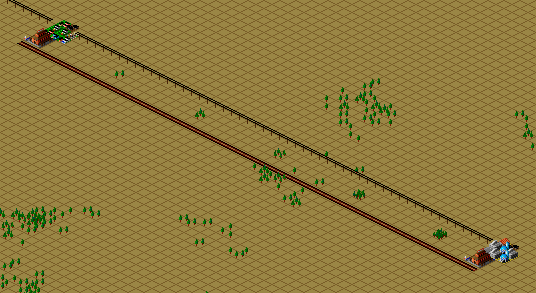
Here it is necessary to dwell separately on the fact that for the operation of the railway we need... stations. I wouldn’t bring up this truism if things weren’t different in the previous version of the game. The railroads from the original SimCity were a kind of legal cheat: they worked just like highways, without the need for stations, and they didn't produce pollution. In SimCity 2000, the developers still added realism by introducing stations, but, in my opinion, they overdid it a little. The stations are 2x2 squares in size and cost a hefty $500—twice as much as a school, or as much as three large parks and two small ones combined.
At the same time, Sims still agree to move no more than three cells away from the station. I checked this again on the model town:
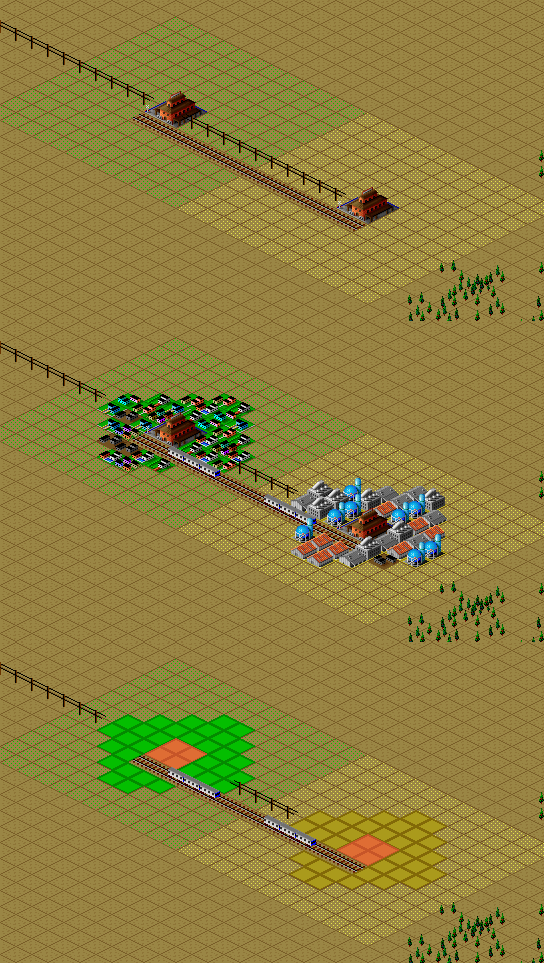
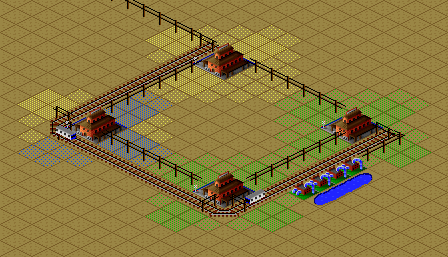
Not that this completely buries the idea of a railway city-paradise without cars, but planning will have to be done. If you place “oases of life” on a rectangular grid close to each other, you get large empty spaces in the center:
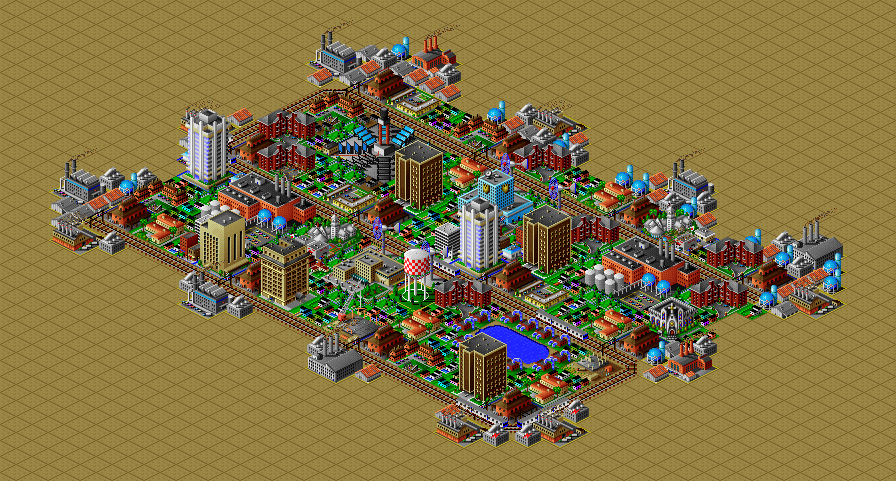
It makes sense to locate power plants, police stations, hospitals and other municipal buildings in them, which in the game model do not need access to transport. I tried to create a viable town solely with railways, within the starting 20,000 simoleons. It turned out quite well:
- Grandfather, is it good to live near the railway?
- Yes, yes, yes, yes. Yes, yes, yes, yes.
The city is completely self-sufficient and generates income. But, naturally, if I used regular roads, it would be much larger and more efficient. About 36% of the area is purely railway infrastructure.
As for the metro, I have not yet conducted such experiments with it. But I know that the subway in the game also allows you to create a city without roads. As proof - the absolutely crazy Moleville (“Moleville”), which I found on the Internet.
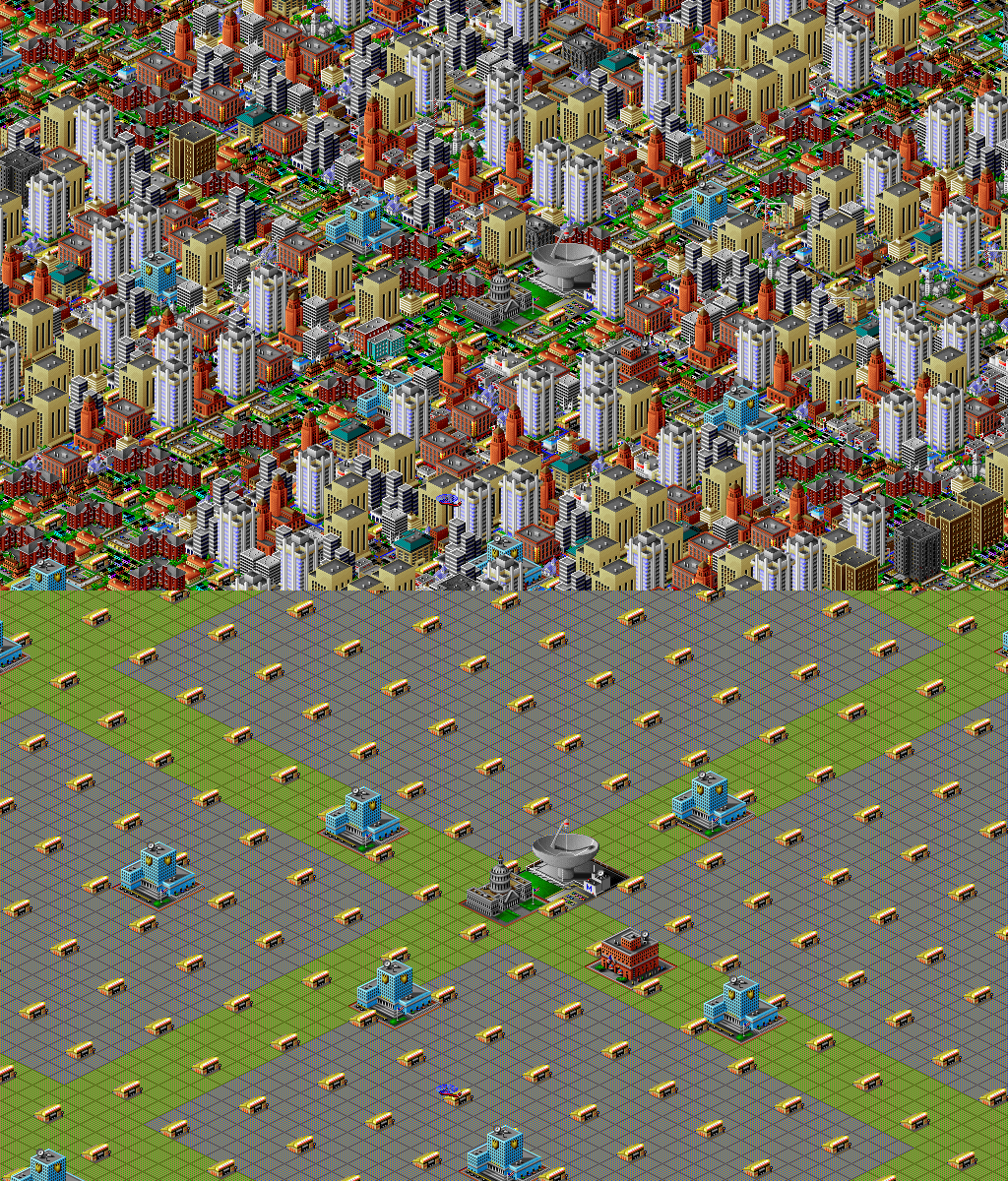
Would you like to live in such an urban paradise?
❯ I’ll walk along Abrikosovaya, turn onto Vinogradnaya
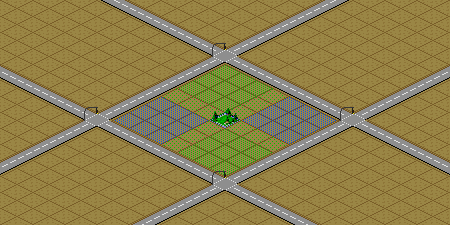
Another thing that needs to be studied is the optimal street spacing. Strictly speaking, the fact that Sims only walk three squares does not automatically mean that they need to build a city out of 6x6 squares. You already know that in addition to the three types of zones that residents must populate on their own, the game has a lot of municipal buildings and engineering facilities that the player is free to place as he chooses. And which, according to game mechanics, do not require roads to operate. Therefore, you can spread the streets apart, mark out zones with an indentation of three cells, and stick something useful into the empty middle.
In the case of a 7x7 block, this could be a small park, a metro station or a tiny body of water:
In the center of an 8x8 block you can place a library, a mayor's house (one per city) or a water tower:
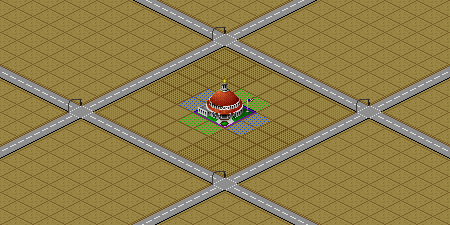
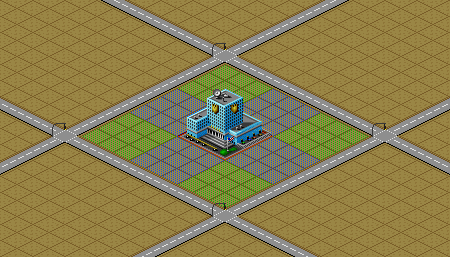
In a 9x9 block in the center, a police station, school, museum or other public building of the most common size of 3x3 cells will fit perfectly:
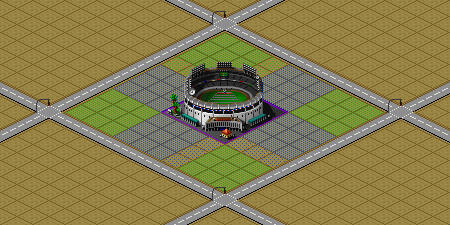
And finally, an entire microdistrict of 10x10 cells can be built around a stadium, a zoo or a university - and what the hell, a power plant. There are no buildings larger than 4x4 in SimCity 2000.
To find out how the spacing of streets influences the development of a city, you cannot limit yourself to one model microdistrict—the effect can only be noticeable on a large scale. So we will check this in the second part.
❯ Oddities of our town
It would be strange to make the same demands on realism for a game from 1993 as for modern city-planning simulators. Some things are well thought out - for example, energy production from solar power plants depends on the weather, and average household energy consumption increases significantly from the 1930s to the 1970s. On the other hand, some moments seem clearly unfinished.
One striking example is hydroelectric power plants. I definitely remember that as a child I did not use them in my cities because I thought it would be very difficult. Hydroelectric power stations are the only power plants in the game that cannot simply be taken and built on a flat area of suitable size. I loved leafing through encyclopedias and had a rough idea of what real hydroelectric power plants looked like - a tall dam holding a huge volume of water, and a building with generators below. Therefore, in the game, as I thought, it is necessary to create something similar - a large difference in heights in the area with the river, in this spirit:
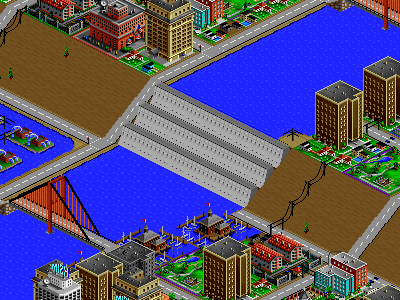
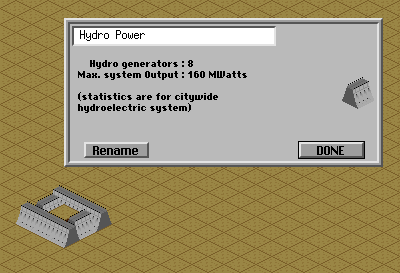
I didn’t even undertake their construction, wondering how much the necessary earthwork would cost me. But in reality everything turned out to be ridiculously simple. No reservoirs or dams are needed. You can simply make a small mound in an open field, drop some water in the improvement mode - and voila, you will get a 1x1 tile waterfall, cascading from nowhere to nowhere. There may not even be water at the top of the hill! And on such a slope one “cog” of a hydroelectric power station is calmly placed, which immediately begins to work. If you wish, you can assemble a whole wedding cake with a cherry in the shape of a wind generator:
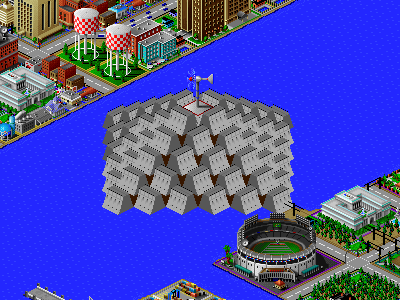
In short, hydroelectric power plants in SimCity 2000 are absolutely cheating: they have the same unit energy cost as coal plants, but they take up 37.5% less space, they are easy to expand as needed, and they also do not produce pollution and do not wear out over time. That is, when choosing a hydroelectric power station, you completely eliminate the problem of small towns, such as the need to find several thousand simoleons every 50 years to replace the power plant. In addition, hydroelectric power stations occupy cells with a difference in height, on which no other buildings can be built.
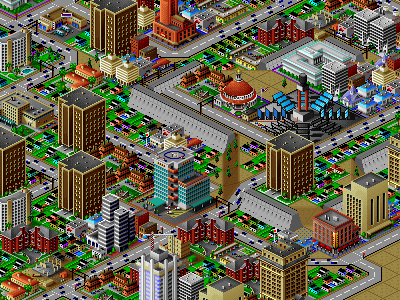
- Mom, let's go see the hydroelectric power station!
— We already have a hydroelectric power station at home.
I think that the developers simply decided not to bother with the complex mechanics of preparing the landscape, but in general, such preferences towards hydroelectric power plants reflect the overall “green” agenda of the game. It pays a lot of attention to the environment: citizens are very happy about the presence of bodies of water and trees and protest when they are destroyed, high levels of education correlate with work in environmentally friendly industries, and air pollution is one of the main reasons for residents to leave the city.
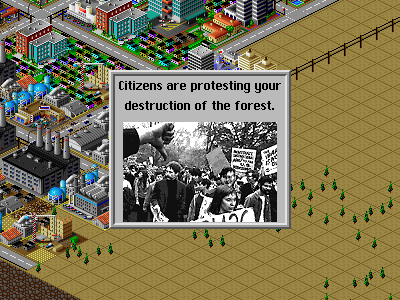
Let's defend the Simkinsky forest!
Even the alien monster from the cover of the game, having attacked the city, not only destroys buildings, but partially replaces them with windmills.
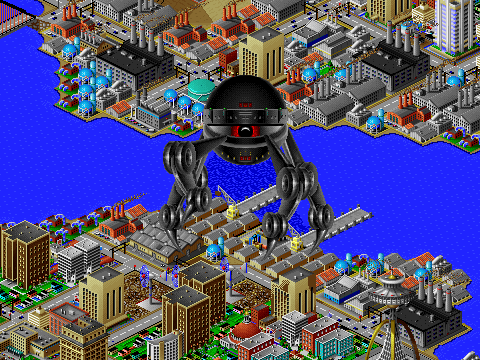
WE COME IN PEACE. AND WIND GENERATORS
The developers also did not escape the radiophobia characteristic of the early 1990s: nuclear power plants in the game were literally created in order to periodically explode and make everything around them uninhabitable. What to do, the memories of Chernobyl were still fresh in the mass consciousness.
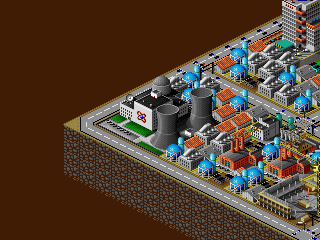
Somewhere out there, Homer Simpson is about to drop a uranium rod...
In general, it is difficult to name a single reason not to use hydroelectric power plants if you want to build a truly efficient and environmentally friendly city. Perhaps there is aesthetic displeasure when looking at gray concrete blocks generating energy from nothing in the middle of the desert.
In SimCity 2000 there is no garbage problem (it will appear only in the next part), and accordingly, there are no zones or facilities associated with waste recycling. There is only air pollution from industrial enterprises. Here's how it's described in the manual: “Around industrial zones there is an area with a radius of 3 to 5 cells in which environmental pollution keeps people away. Do not place residential or commercial zones in this area, otherwise they will develop poorly and residents will complain to the city hall about the pollution.”
It is also curious that according to game mechanics, industrial areas are the main sources of not only pollution, but also crime. “Guys from the working-class outskirts” do not let the police get bored with nothing to do - however, they agree to fool around less if they have parks or reservoirs near their home factories. And for some reason the biggest breeding ground for crime is power plants.
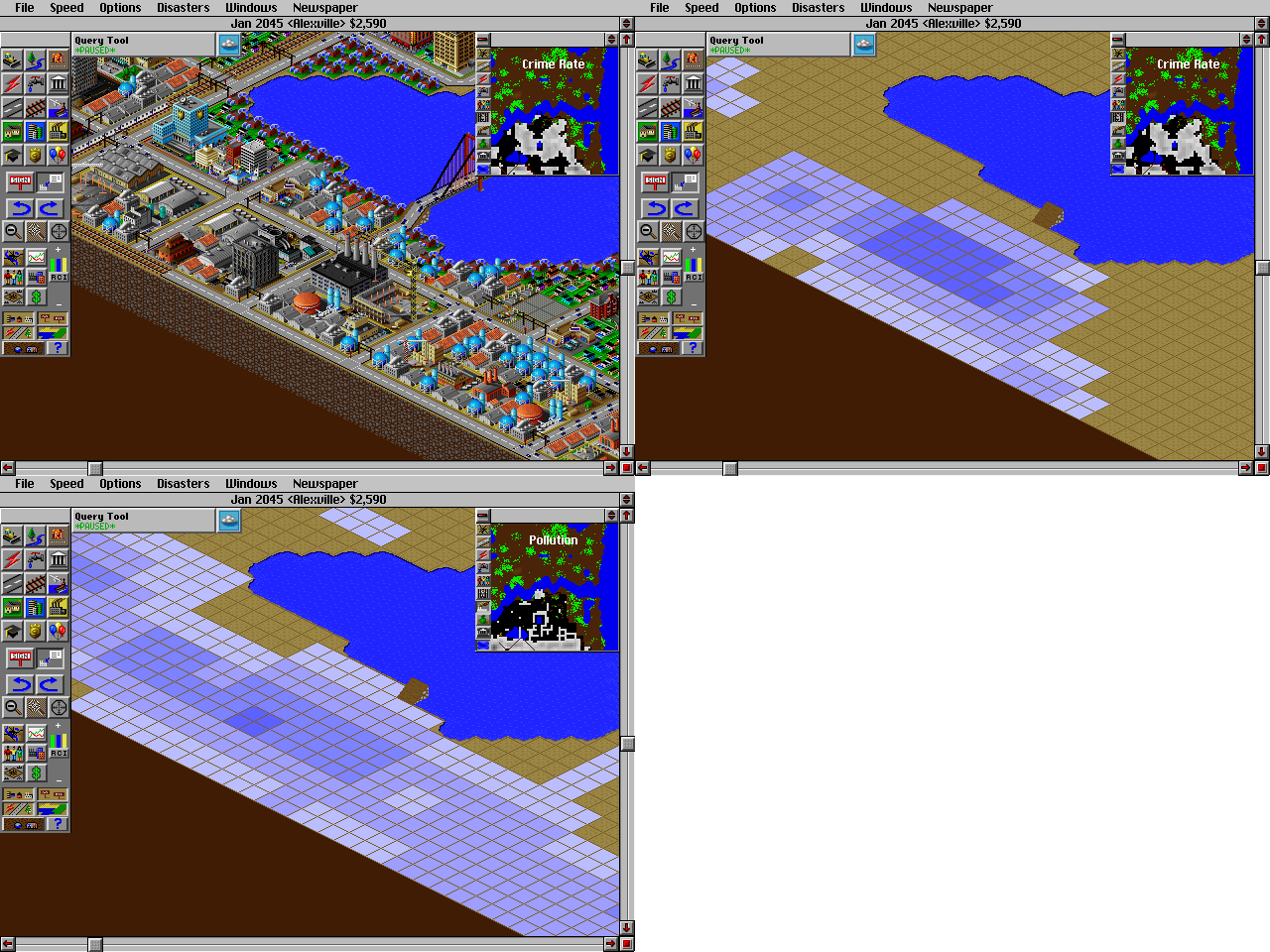
Two eternal friends - both dirt and crime - cannot live without the other...
But, on the contrary, here is an example of good development - the behavior of aircraft in the game. Once you build an airport, tiny airliners will appear in the sky. They serve only for beauty, enlivening your town, but at the same time they quite believably circle over the runway, approach and land with a characteristic sound.
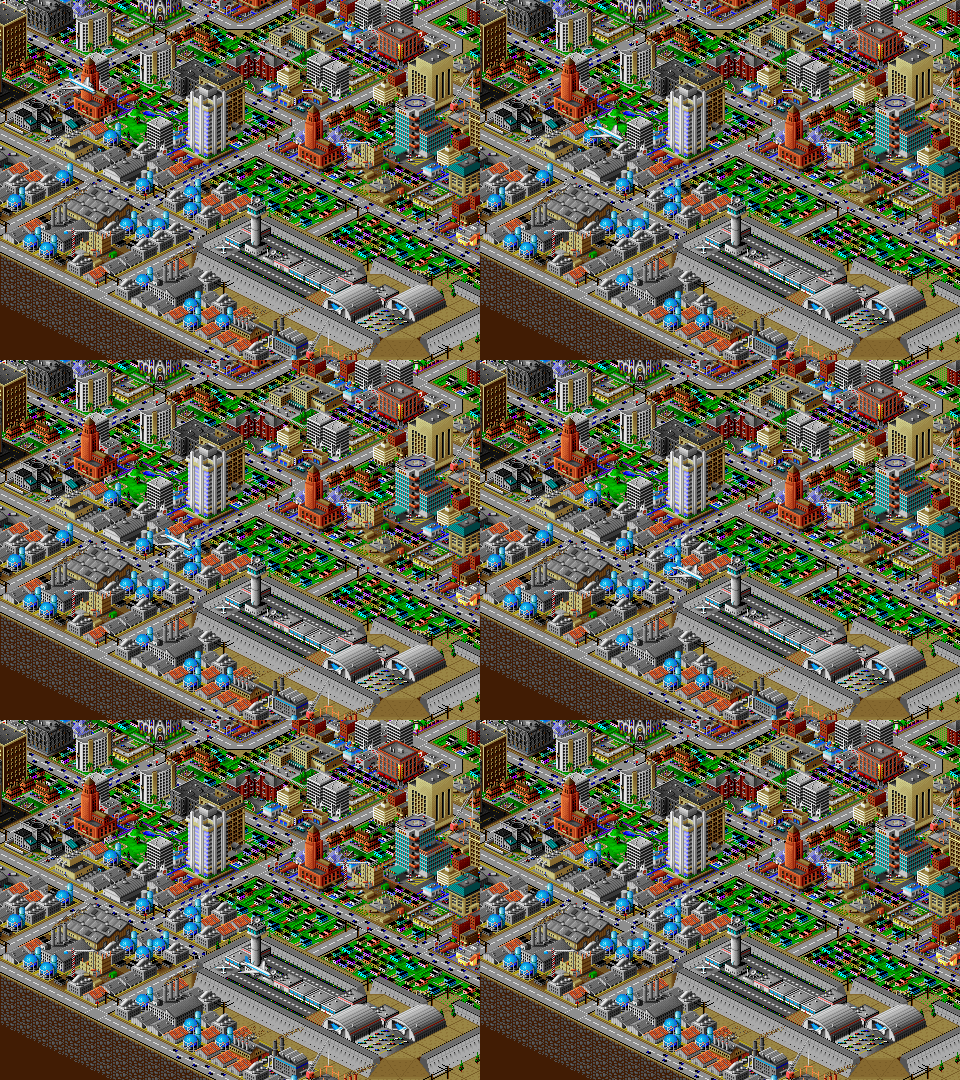
But if there is a high-rise building under the glide path, the plane may crash into it, and then a fire will start:
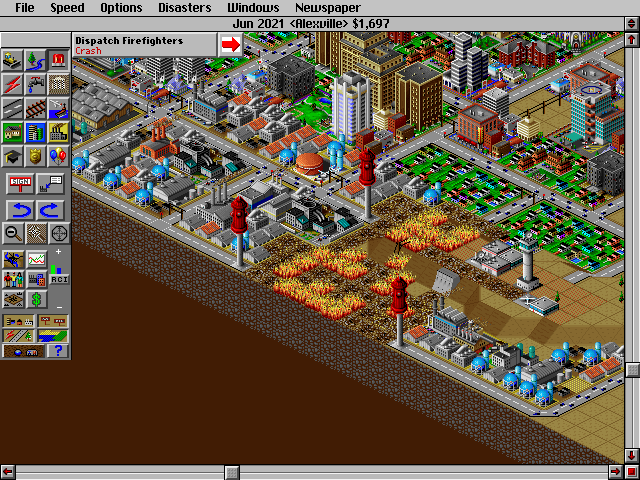
Keep this in mind when zoning areas around airports. In my case, I made my task easier by building the airport on a hill.
❯ City of Tomorrow's Happiness
So, it's time to sum up the interim results. I'm going to build a new version of Alexville on the same landscape, but start from scratch in 1900. Here's what I plan to change from my last attempt:
- Don't build railroads early in the game. In the town from my childhood, a small network of three stations cost $2,375 - a lot of money, considering that the initial budget for the development of the city was $20,000. Such expenses greatly slowed down development in the first decades, when ordinary roads would have handled traffic just fine.
- Actively build hydroelectric power stations in order to stop burning coal by the beginning of the 21st century.
- Increase the number of schools and ensure that the quality of education in them does not fall below A−. This is achieved when the school is no more than half its maximum capacity and is sufficiently funded. A similar principle works with hospitals.
- Use the minimum required number of water pipes (only at street intersections), but, on the contrary, lay more power lines in newly designated areas so that Sims can start building up without waiting for their neighbors.
- Designate high-density zones based on 2×2 or 3×3 building sizes. When zones are completely “filled,” small pieces often remain where only “single-cell” buildings can appear. That's an extra 5 simoleons per cell - even this small savings can make a difference early on.
- Adopt additional City Ordinances as early as possible to improve education and reduce pollution and crime.
Looking ahead, I will say that the effect of these seemingly insignificant changes turned out to be much greater than I expected. Let's say, the level of population and income that was in old Alextown in 1945, I managed to achieve by 1920. But all the details - next time! In the meantime, a small spoiler:
And a bonus for the most curious:
❯ Interesting facts about SimCity 2000
- There are 156 buildings and objects in the game.
- The actual size of the map from SimCity 2000 is approximately 8x8 km (5x5 miles). Accordingly, one cell is approximately 60x60 m.
- Although the player only sees the months change, the game actually takes days into account (this can be found in save files). True, for some reason each month has 25 days.
- SimCity 2000 is one of the few games that had a WinG compatible version. This is an API for games under Windows 3.1, which was not widely used and was soon replaced by DirectX.
- Only legally, 4,230,000 copies of SimCity 2000 were sold - not counting the countless pirated copies, in the distribution of which, I confess, I also took part.
- There is a little-known online version of the game. In SimCity 2000 Network Edition, two or three mayors co-govern a city. Before constructing buildings, you must first buy a plot of land. Decisions regarding city programs are made by vote, and the simulation speed must be chosen once and for all when creating the map.
- Sometimes, if the mayor cannot cope with a disaster, Captain Hero - a superhero in a pink tights and green cape - flies into the city. He is also often mentioned in local newspapers.
- One of the main conventions of all versions of SimCity is a very small area devoted to car parking. According to the developers, if they had depicted this realistically, the game would have been called SimParkingLot rather than SimCity.
- The author of the wonderful musical accompaniment for SimCity 2000 is Sue Kasper. The sound of melodies varies significantly depending on the MIDI synthesizer of the audio card, so I recommend trying different options.
- SimCity creator Will Wright lists Go as one of his favorite board games. “It has a simple set of rules, but the strategies are so varied and complex.”
News, product reviews and competitions from the Timeweb.Cloud team - in our Telegram channel ↩

Why This Matters In Practice
Beyond the original publication, City of childhood: what will happen if you continue playing SimCity 2000 after 25 years matters because teams need reusable decision patterns, not one-off anecdotes. I have warm feelings not only for old computers, but also for the retro games that I ran on them. Perhaps my main love is SimCity 2000, the...
Operational Takeaways
- Separate core principles from context-specific details before implementation.
- Define measurable success criteria before adopting the approach.
- Validate assumptions on a small scope, then scale based on evidence.
Quick Applicability Checklist
- Can this be reproduced with your current team and constraints?
- Do you have observable signals to confirm improvement?
- What trade-off (speed, cost, complexity, risk) are you accepting?
FAQ
What is this article about in one sentence?
This article explains the core idea in practical terms and focuses on what you can apply in real work.
Who is this article for?
It is written for engineers, technical leaders, and curious readers who want a clear, implementation-focused explanation.
What should I read next?
Use the related articles below to continue with closely connected topics and concrete examples.