Censorship Is Growing in IT and We Don't Notice — You're Only Allowed to Smile and Stay Silent
Corporate censorship in IT is a bigger threat to free speech than government censorship. PR departments ruthlessly sanitize interviews, NDAs silence employees, and tech monopolies control what stories the world gets to hear.
I have two interview articles with strange paragraphs like these.
One:
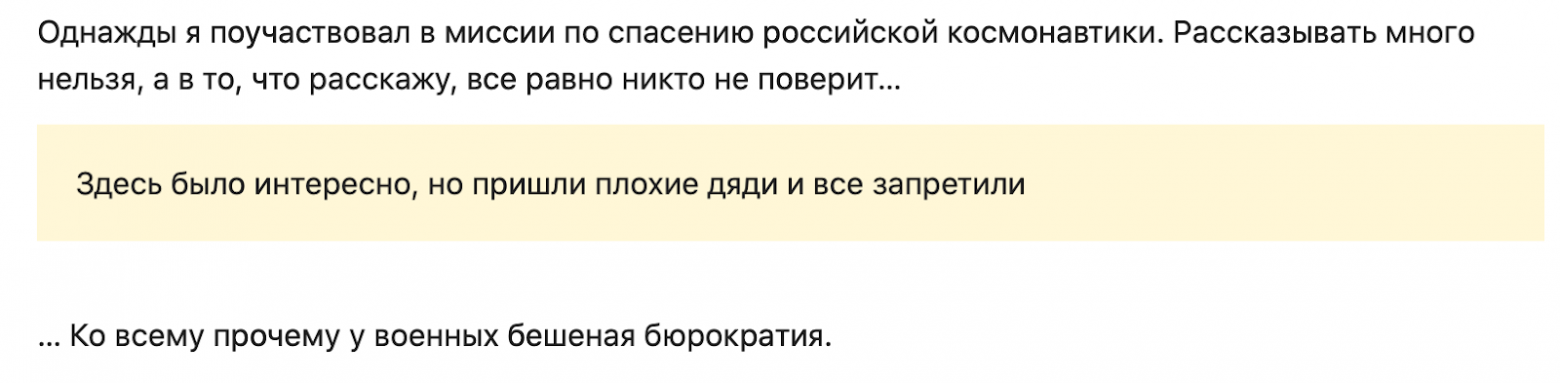
Two:

Behind both of them are unpleasant stories — for me and for the people I wrote about.
In the first one, a guy talked about working at a factory where they cobble together equipment for space rockets out of junk — the guy was threatened by the FSB. In the second, a pentester said he found a funny vulnerability on a galley's website, reported it, it was immediately fixed, but instead of thanks, they told him to get lost.
After the articles, we received various threats. I had to engage in moral bargaining with myself, remember what this work is actually for, and estimate — would the money from selling my parents' apartment and my clunker be enough to pay a lawyer if a two-billion-dollar company wasn't bluffing and really went to court to determine how much damage was done to its business reputation.
For me, both stories are equally disturbing. The people responsible for those paragraphs — I hate them equally, with every ounce of my strength. But when I come to whine about this crap to my friends, I discover that the stories affect them differently.
The first: "How horrible, the government has lost its mind, they've ruined and looted the space industry and are erasing any criticism! State censorship is a crime!" The second: "Well, it's a private company, it's protecting its interests, that's normal. Maybe it really was defamation."
But I hate all censorship. And when I say that modern corporations are a much bigger threat to free speech than the government, people tell me I'm going too far.
But I don't think so. Private censorship is almost never discussed now, nobody really attacks it, so companies aren't afraid to push the envelope and silence people when they have leverage. Various justice warriors are too focused on governments. I understand why — the government punishes more harshly for circumventing its censorship; it puts people in prison. That's certainly worse compared to losing your job, losing an absurd lawsuit, or being cancelled.
But if right now we somehow miraculously defeated dictatorships and there was no more state censorship — instead of celebration, bad news would await us. Because then we'd notice that every day in normal life we still can't say an enormous number of things, because companies have forbidden us from doing so.
Those two paragraphs at the beginning are the most egregious and exceptional cases in my entire career, which happened to leave visible scars in the articles. In reality, 90% of my articles could have been overflowing with paragraphs like that.
For about two years, I wrote on Habr about working at various companies, interviewing regular developers, CTOs, founders, and other folks. The work always went like this — we'd talk openly and well, I'd record it, assemble the text, prepare it for publication, then get a message: "Hey, everything's great, but our PR people also want to take a look." Which actually means "demand."
Then these PR people would arrive in my document in a whole army and shamelessly start crossing things out — even though this wasn't advertising, they didn't commission or pay for this text. They simply believe that if someone wants to talk about their company, only they have the right to decide how the story will sound.
They ruthlessly cut the life out of the text, turning interesting people into smoothed-out corporate puppets with no opinions. They want people to talk about burnout without mentioning the word "burnout" — or better yet, not talk about it at all. They want the article to not contain the word "stress," even if it's not in the company spokesperson's words but in my question. Tasks can't be "difficult" — they must be "interesting" or "challenging." Every technology a programmer works with — they love it and see absolutely no problems with it. And in general, "the question of framework choice shouldn't be touched, it's too controversial." Problems are bad. There are only challenges and their successful solutions.
Once I was talking to a CTO of a startup. He said their company offered better salaries and tasks than Yandex, but developers still didn't want to join them. I said — you really think so? He said — yes, it's actually true. I said — you know you'll ask me to cut this later. He looked at the startup founder sitting next to him, and the founder said — if that's what we actually think, then we won't cut it.
Two weeks later, a PR person enters the text and refuses to let the article go with that phrase.
I hate hypocritical PR people. These are people who studied journalism and maybe even worked as journalists. They themselves faced being unable to say what they wanted to tell. They all consider themselves incredibly intellectual and progressive, howling on social media every day that "the cannibalistic government is suffocating freedom," and then calmly come to work, sit down at their computer, and cross out from publications what-in-their-opinion-cannot-be-said.
I fight these edits for weeks, the text release gets delayed and sometimes cancelled entirely because I just tell the PR people to go to hell. At first, I spent a lot of energy on this, thought I could slay the dragon. But with every article, I started the war anew, only the PR people came fresh each time while I was the same. I burned out within a few months, noticed the texts were getting worse and worse because I had less and less energy to fight for them. Started writing much less often, then stopped writing entirely.
Every time in Russia they shut down another Vedomosti and the ousted editorial teams write pompous protest statements — I feel double the pain. Not only because the government does raids, but because a bunch of great journalists, finding themselves on the market, end up in the crosshairs of various Yandexes and Megafons. Their press offices will gladly offer cushy positions, and yesterday's fighter for free speech is now teaching stupid writers to replace "difficult" with "interesting."
We're outraged when state media says "a pop" instead of "an explosion." When companies force people to say "interesting" instead of "difficult" — nobody even notices. It's just little things. And then someone tells a story about childish idiocy at a two-billion-dollar company — and the company threatens to sue everyone to hell and back. The publication is pulled, but no Meduza writes a story: look at this outrageous company. They're too busy whining that an explosion was called a pop.
I have a friend who got a job at Facebook, moved to San Francisco, and now calls me on his way to Starbucks before work. He's a simple guy from a village, like me. I invited him on my podcast to talk about what it's like at his Facebook. He agreed, of course.
Two days later he writes — sorry, I can't. Turns out, after signing the contract with Facebook, he can't speak publicly about anything for several months, or he'll be quickly fired. And even after that — he might talk, but only after getting full topic approval from someone who handles the company's public image. So, formally, my friend can no longer discuss a huge part of his life if anyone else might hear us.
I don't understand why nobody is outraged by the fact that companies absolutely unpunished and uncontrolled impose their conditions and decide which stories the world will hear and which it won't.
Just imagine how many interesting things happen behind the scenes of the IT industry every day that you'll never hear about because someone has forbidden talking about it. No anonymous leak or source can reveal a story fully from all sides. Every tool, every product, every feature, deal, idea — all went through the sweat and blood of individual people. These stories circulate among insiders over a couple of drinks and go to the grave because the world will never record them.
All that remains on the surface are lousy vanilla success stories.
So Yandex buys Tinkoff, and all we get are nauseating platitudes about "we're happy about the partnership, this will be great synergy, a wonderful future awaits us all." Now we can only guess how many expletives were left behind the scenes, what hidden and personal motives shaped this deal for months, and what really stands behind it. And if any of the participants wants to talk about it, they can't — because private companies have been granted the right to censor, and they've invented a bunch of distracting terms for it. Tone of voice, brand values, image, NDA.
So all we get from companies instead of truth is silent puppets and polished presentations with rehearsed speeches that are creepy to listen to from an overdose of fake joy and falseness.
This censorship is defended with market economics. Supposedly — if you don't like one company, you go to another that doesn't do what you don't like. But that's just another diversionary tactic. There's actually no choice.
Recently, Andrey Sitnik came on our podcast, a well-known frontend developer who now lives in America and faces cancel culture daily. He voiced an interesting thought — the modern IT market doesn't work according to the market mechanisms described in old textbooks. Almost every IT business becomes a monopoly and by its very nature strives to become the only one in the niche it found. They succeed, but their PR people and lawyers set everything up so you can't technically call them out.
Every IT giant defends its monopoly in the name of "user safety and comfort."
If, for example, you don't like a social network — bad interface, laggy, or you just disagree with the company's policies — you don't actually have a choice, because a social network is the people you communicate with there. To move to another social network, you have to convince all your friends to switch too. If they don't want to, you either give up your social connections on the internet or stay with a product you don't like. And that's not a free and fair choice. That's coercion.
Real market choice is when we can use any social network we like and through its interface communicate with people on any other social network. If that were the case, Facebook would have died seven years ago. Nobody in their right mind would use that overloaded, laggy piece of crap. People are held there by social connections.
But nobody will allow real competition to emerge, and you get a strange, largely unstudied situation — the market has tons of companies, and all of them are monopolies. And as long as they're monopolies, they can control information about themselves however they want. How and with whom their employees will speak, what will become public knowledge. And all of this will be covered up with soulless corporate speeches about benefiting users.
I understand where this comes from. Companies want to control their image — because it's their money. If people speak badly about them, investors leave, and companies lose value. If they speak honestly about something, people get triggered, twist their words, and blow up scandals. I've seen it myself — Sberbank publishes a podcast where their developers talk about development in a super smoothed-out way, and angry psychopaths still flood the comments screaming: how can they not reissue a card for their 90-year-old grandmother but have time to record podcasts.
People inside see these comments, scandals, and stock price swings — they grow callous, bitter, and from their anger quickly cross over to the dark side. And now — yesterday they dreamed of doing good, today they've become dictators who forbid everything for everyone, because what if something goes wrong again.
I understand this, but for me it's not an excuse. It's cowardice and weakness. Just being hurt that someone doesn't like you, only blown up to gigantic industrial proportions. And censorship is a lousy solution to the problem.
I try to behave in a market-oriented way. If I don't like it, I leave. But I never found an alternative. I tell the PR people who forbid me from writing honestly to go to hell, I go write another article about another company, and I meet PR people there with exactly the same demands. In product companies, body shops, game dev, IT giants, small startups. Everyone forbids.
I don't want to sign an absurd NDA when I start a new job, I go to another — the same thing. I don't want to use a product because I don't like its policies, I go to another — same thing. All social networks ban the same things. Apple and Google say they're not monopolies — after all, they compete with each other, but that's nonsense. If I don't like iOS and switch to Android — nothing changes, their censorship is completely identical.
I find this disgusting, and I don't understand why we still aren't fighting. Government censorship will die out on its own soon enough, and we — having defeated it — will find ourselves in a world where nobody can be criticized for anything, truth equals toxicity, and only conversations about the weather exist.
Watch my podcast with Andrey Sitnik — about censorship and monopolies, among other things.