Breaking AvtoVAZ Under Andropov: The First Cybercrime in the USSR — And Why It Wasn't Really Hacking
The story of Murat Urtembayev, a Moscow State University graduate who in 1982 planted a logic bomb in the AvtoVAZ assembly line code — the first cybercrime in Soviet history — and why calling him a 'hacker' misses the point entirely.
November 24, 1982: The Assembly Line Stops
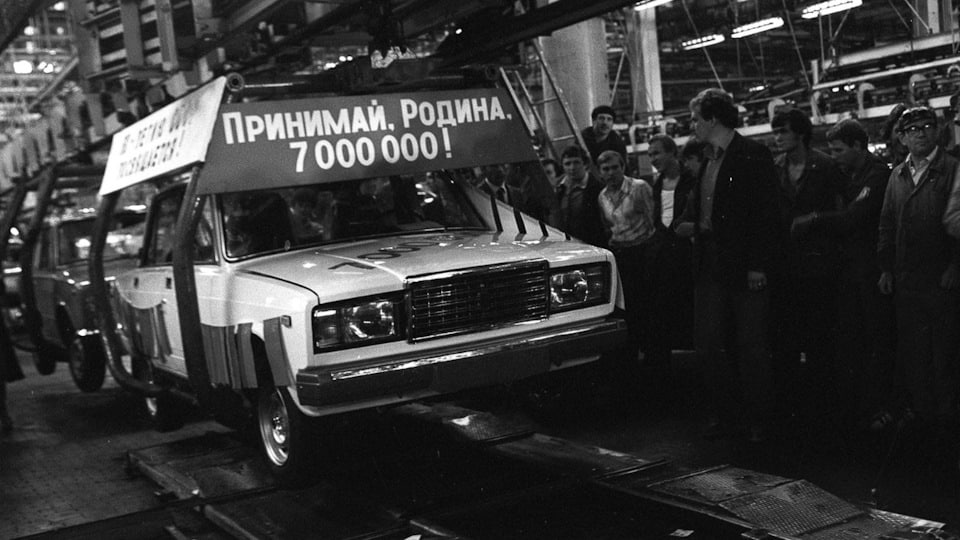
On November 24, 1982, the Volzhsky Automobile Plant (AvtoVAZ) in Togliatti experienced a catastrophic system failure. Yuri Andropov, the former KGB chief, had just come to power, and attention to discipline had intensified dramatically. The investigation would reveal that behind the failure was a deliberate logic bomb planted in the program code by engineer-programmer Murat Urtembayev, a graduate of Moscow State University.
The Biography of Murat Urtembayev
Murat Kamukhammetovich Urtembayev was born in May 1955 in Alma-Ata. He injured his hand in childhood but demonstrated extraordinary mathematical abilities. He won math olympiads at every level and was admitted to the elite Mechanics and Mathematics Faculty (Mekhmat) of Moscow State University.
During his studies, he married Selmira from MSU's Philology Faculty. Wanting to provide a decent standard of living for his family, he chose not to continue into graduate school. In 1978, through the Soviet job assignment system, he was sent to the Volzhsky Automobile Plant in Togliatti as an engineer-programmer.
Life at AvtoVAZ
His starting salary was 150 rubles — while a skilled factory worker earned around 300. He belonged to a small group of programmers that the plant management was eager to retain.
When his wife arrived a year later, finding her a job proved impossible despite the help of his superiors. Murat considered leaving the plant once his mandatory service period ended. His department head secured him a unique business trip to Norway in exchange for a promise to stay another 2–3 years, but Murat declined, citing family problems.
The Conflict
In July 1982, after a performance review, Urtembayev did not receive the promised promotion to senior engineer-programmer. He received no bonus and no honorary certificate. According to his wife, he came home crushed and kept repeating that he would "show them all."
Two versions of his motivation exist:
Version One (from defense attorney Vyacheslav Moskovsky): Murat had noticed that a group of programmers would organize system failures, heroically fix them, and then receive bonuses and business trips as rewards. He decided to do the same.
Version Two (from Valery Kabanov, department head): Murat learned that his colleague Vladimir Ponimansky had received a 10-ruble raise while he had not.
The Technical Execution
By the end of October 1982, Urtembayev had inserted a logic bomb into the code of the program controlling the mechanical assembly storage accumulator on the production line. According to Kabanov, it was something like "PETYA&VITYA*MASHA/KOLYA" — a hidden counter programmed to trigger a failure at a specific moment.
The plan: the logic bomb was supposed to activate on the first day of his return from vacation in Kazakhstan, so Murat could "heroically" fix the problem and earn recognition.
But he miscalculated: the failure occurred just a few hours after the code was inserted, while Murat was still in Togliatti and hadn't yet left for vacation.
The Events of November 22–24, 1982
According to Kabanov's testimony, the first failure occurred at 4:00 PM. After a reboot, the system crashed again at 7:00 PM, then at 8:00 PM. The frequency of failures kept increasing.
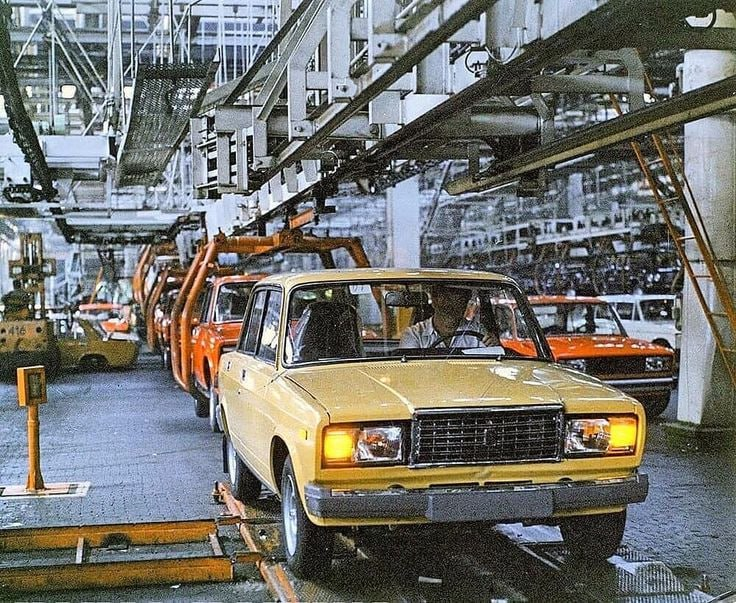
All three conveyor lines stopped. Workers were sent home. The programmers split into two teams: one physically moved a hundred component sets (rear axles, suspensions, drive shafts) to assembly stations by hand, while the other tried to identify the cause.
"The system seemed to go mad: the reboot frequency approached one minute."
By morning, the error had not been found. Only at 3:00 PM did Vladimir Ponimansky discover the hidden counter and the pattern of its activation. They decided to manually send a value greater than zero to the counter at regular intervals. The second shift was already working stably.
Unmasking the Saboteur
Within days, the programmers confirmed that the logic bomb was deliberate. They even found a previous version of the code where the modification had been done crudely, "in a lazy way."
Urtembayev's technical mistake: he had placed the counter in the recovery zone, so the first repeat failure occurred not after 28 days (as planned) but after just 4 hours, then after 20 minutes. With each crash, the interval shortened.
The damage: 460 automobiles failed to come off the assembly line. Direct losses exceeded 7,000 rubles.
The Investigation and Trial
KGB agents arrived at the plant. Andropov, having just taken power, had launched a campaign to enforce order and discipline.
A case was opened under the article for "Sabotage" — carrying a sentence of 8 years to the death penalty with confiscation of property. The threat of treason charges loomed on the horizon.
Murat was "completely crushed morally." He initially tried to argue that everything had happened by accident, but the KGB had already been briefed by the programmers and "quickly, professionally, and politely" brought him to a confession.
The charge was reclassified to Article 98 of the RSFSR Criminal Code: "Deliberate damage to state property causing damage to the state and other grave consequences." This happened because "there were absolutely no precedents for production sabotage via program code in the USSR."
The Verdict
A traveling court session took place in May 1983, held in the AvtoVAZ computing center in the presence of the national press.
Sentence: three years suspended, with the obligation to compensate damages of 7,176 rubles. The punishment: instead of working as an engineer-programmer, he was to work as an unranked locksmith in workshop 45/3 for two years.
An article in the newspaper Izvestia reported: "A system programmer at the Volzhsky Automobile Plant modified the software of the main conveyor's automated process control system, resulting in a three-day shutdown."
Defense attorney Vyacheslav Moskovsky attempted to appeal, arguing that Article 98 referred to material property, and that program code might not qualify. In response, he was hinted that the case could be reviewed "in an entirely different direction."
After the Trial
After completing his sentence, Murat immediately resigned from the plant and moved to the Kazakh SSR. After the collapse of the Soviet Union, he went into commerce. According to unconfirmed reports, he died in 2010 from a heart attack.
Some of his former colleagues later participated in the cleanup operations after the Chernobyl nuclear disaster.
Was He Really a Hacker?
Murat Urtembayev entered history as "the first Soviet hacker," but this label is not entirely accurate.
"Calling him a hacker isn't quite correct — neither in the original sense of an elegant and clever programming solution, nor in the 1980s sense of a network intruder. He didn't break into anything."
He simply modified the code of a program to which he had direct access, and "in the opinion of his colleagues, not particularly subtly."
Far more deserving of the hacker label, the author argues, is Nikolai Saukh from the Kurchatov Institute, who in late 1983 used a self-written utility to download the Unix source code for Soviet developers over a network connection from an Austrian institute.
FAQ
What is this article about in one sentence?
This article explains the core idea in practical terms and focuses on what you can apply in real work.
Who is this article for?
It is written for engineers, technical leaders, and curious readers who want a clear, implementation-focused explanation.
What should I read next?
Use the related articles below to continue with closely connected topics and concrete examples.