And Still They Turn
A deep dive into the history and engineering of railway turntables — from 18th-century mine tracks to Moscow's monorail depot, covering tramways, trolleybuses, and the unique technical artifacts that persist into the modern era.
One of the most recognizable attributes of an old railroad is the turntable. Semaphores and steam locomotives have mostly become museum rarities, yet turntables continue to mark time like hour hands on steel highways.
Behind the Scenes of Industry
Turntables predate steam locomotives, semaphores, and railroads themselves. In the 18th century, they appeared on cast-iron or wooden "wheelways" in mines and factories. Small wagons were pulled by ponies or workers, and turntables served as switches and curves. Their capacity was limited — only one wagon could fit, and it couldn't change direction while moving, requiring stops. Wooden structures couldn't support more weight.
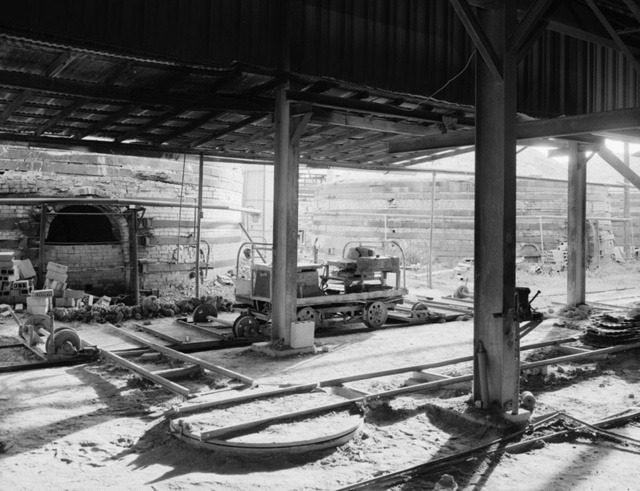
With steam locomotives capable of pulling multiple cars simultaneously, manual switching became impractical. In 1832, Englishman Charles Fox patented a modern-style switch mechanism. Turntables lost their primary role as switches but remained essential in factory workshops requiring compact operation.
Bigger Railway, Bigger Circle
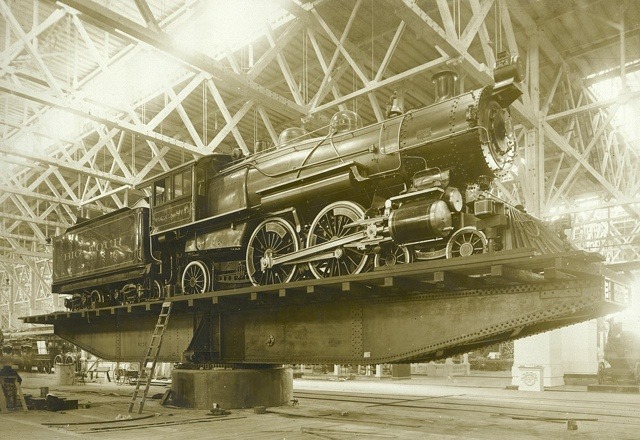
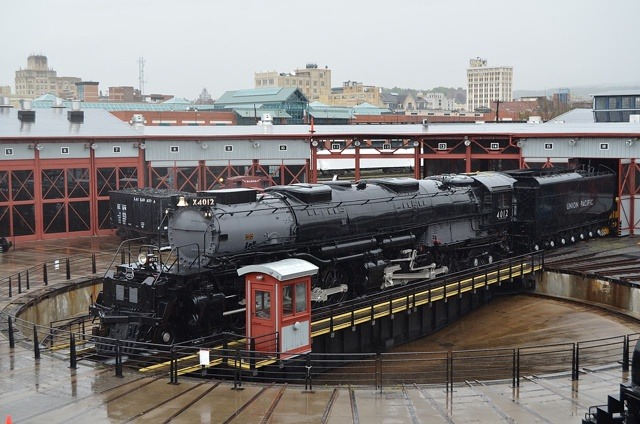
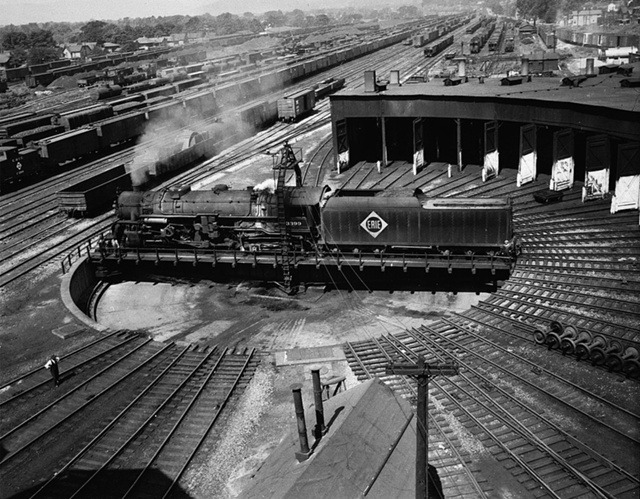
Steam locomotives typically operate in only one direction — forward with the boiler leading. They could reverse, but awkwardly. Turntables enabled their reversal at major stations and grew larger alongside locomotive development. Nazi Germany standardized turntable beams at 23 and 26 meters. American "Big Boy" locomotives stretched over 40 meters — only two turntables in the US can accommodate them now.
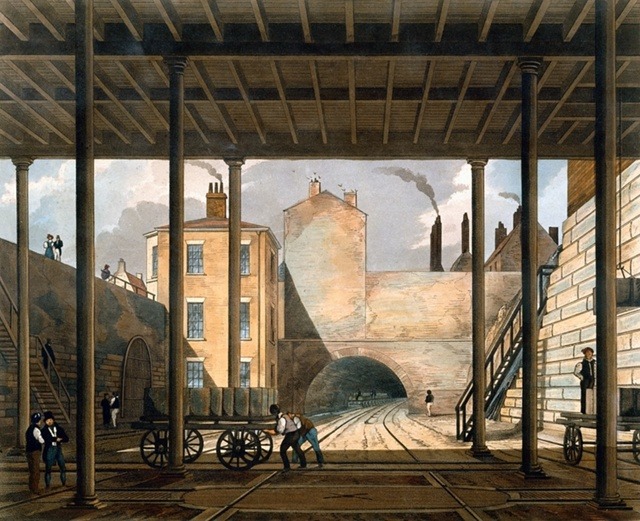
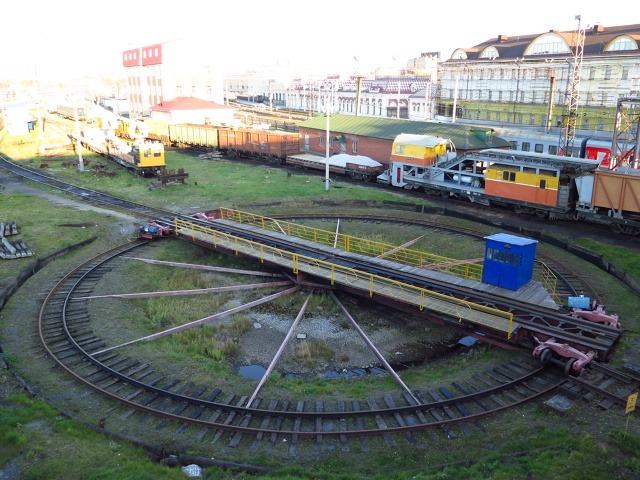
Alternative turning methods existed: loop tracks (like tramways) or three-point maneuvers using triangular track arrangements. However, these required enormous radii — at least 200 meters for mainline steam locomotives — consuming vast amounts of land. Turntables proved far more space-efficient.
Round House for Locomotives
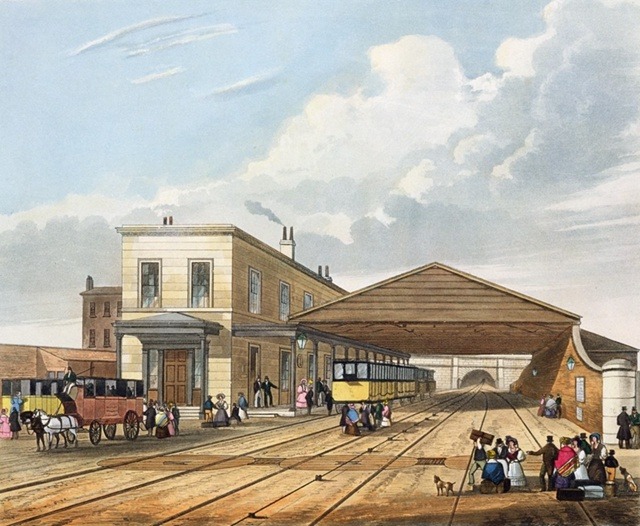
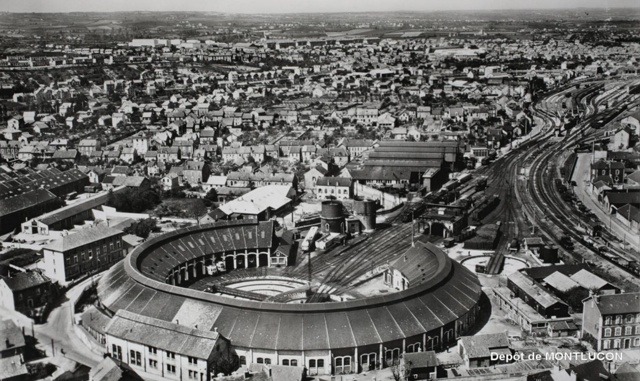
Turntables enabled multiple track directions from a single point, making them ideal for locomotive depot design. "Fan depots" featured radiating tracks from the turntable like flower petals, with locomotive stalls directly accessible. This configuration profoundly influenced industrial architecture.
Design characteristics:
- Rotating beam or truss structure around a vertical axis
- Located in a circular pit (minimum 1 meter deep)
- Early designs: balanced type — relied only on a central pivot pin
- Later designs: unbalanced type — supported by wheeled trolleys on a ring rail
Early balanced turntables required precise locomotive positioning (center of gravity through the pivot axis) but needed minimal manual effort. As locomotives grew heavier, unbalanced designs became necessary, requiring motorized operation — typically electric, occasionally pneumatic using the locomotive's own brake system air supply.
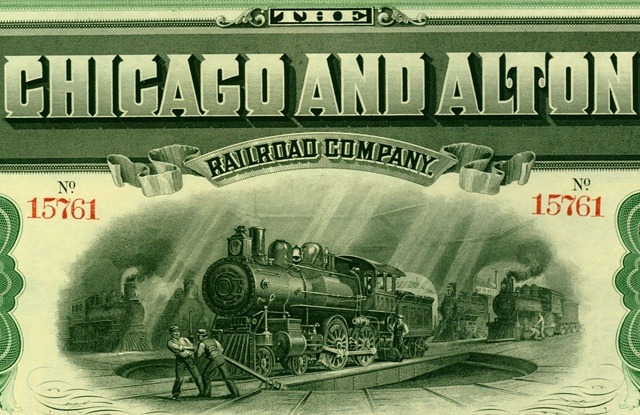
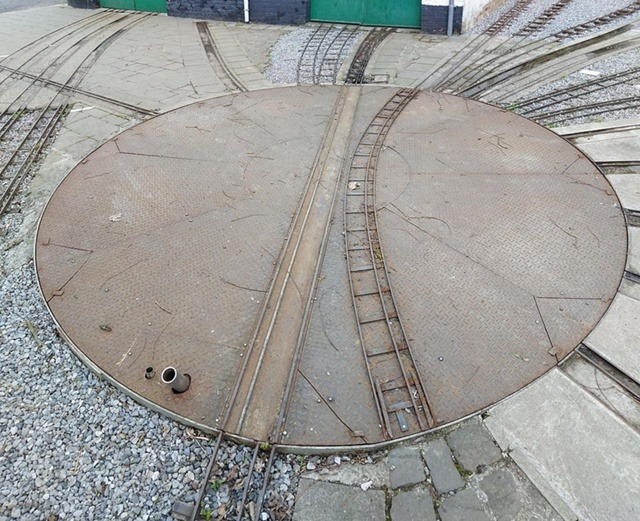
Some turntables rotated only partially (as sectors) due to space constraints. The French town of Montlucon features a circle-sector hybrid design. Some depots used two overlapping turntables.
Smaller Cousins: Tramway Turntables
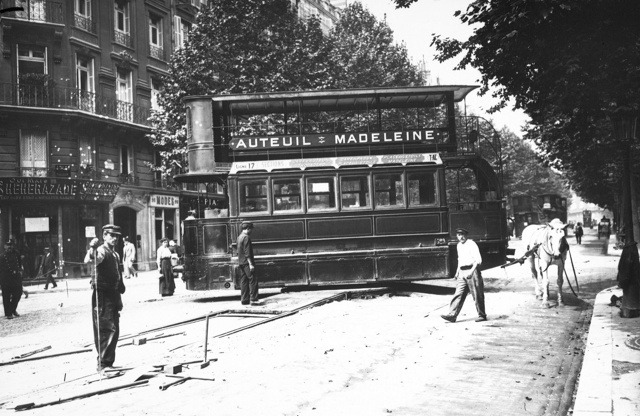
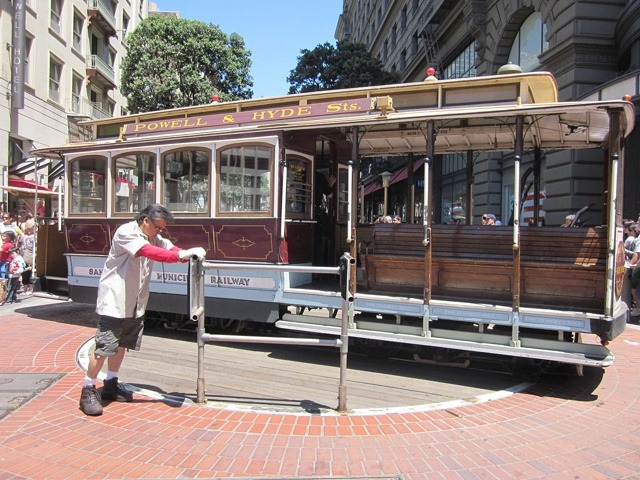
San Francisco's famous cable cars use manual turntables — drivers and conductors turn them by hand. The California Street line uses terminal turnouts, while the other two routes with shared terminals use circular turntables (four total including the depot).
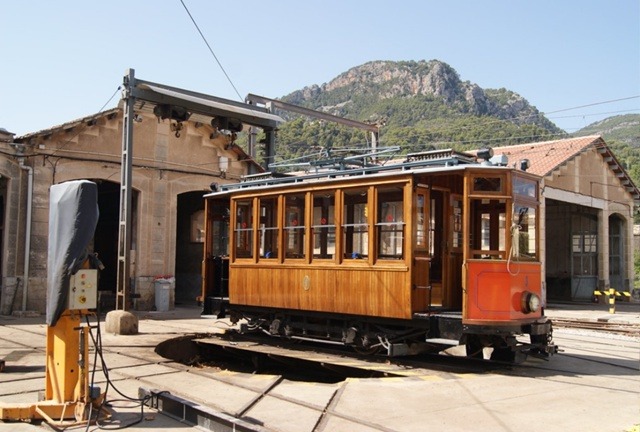
In Soller, Mallorca, Spain, a turntable serves both city trams and the Palma interurban railway, operating vintage vehicles dating from the 1890s to 1920s.
Trolleybus Turntables
In Solingen, Germany, a 7.5-meter-diameter turntable (expanded to 12 meters in 1985) served trolleybuses on routes constrained by cliffs and the Wupper River. Operators manually rotated the early versions; later, electric drives completed rotation in 45 seconds. After a 2009 route extension beyond the narrow area, only museum trolleybuses now use it.
In Guadalajara, Mexico, a subterranean turntable accommodated converted Chicago trolleybuses in the 1970s–1980s during tunnel construction for the unusual "metro-trolley" system.
Moscow's Strogino depot and other Russian facilities maintain small turntables for bogie rotation and maintenance.
The Kiev Anomaly
In 1960, when Kiev's Metro opened at the Dnipro station on an aqueduct near the Paton Bridge, a tram line served the left bank. Space constraints prevented normal depot construction, so engineers created an epic solution: a lift-rotating turntable combination. Wagons exited the distant depot, traveled under the Dnipro station estacode via the lift-turntable (rotating while ascending), then continued on bridge-adjacent tracks. This unique arrangement lasted until November 1965, when metro service expanded to the left bank.
Moscow's "Egg" (2000s–2013)
During the Luzhkov era, Moscow attempted to revive tramway turntables spectacularly. The concept: a 25x35-meter glass-clad structure (the "blue egg") near Sokolniki metro station would house a covered turntable with dual parallel chord tracks (instead of diametral), allowing simultaneous two-way rotation. However, the design proved insufficient for two-car Tatra trams, so a surrounding loop circuit was added — negating the innovation's entire purpose.

Construction halted during the 2008 financial crisis and Luzhkov's resignation. His successor Sobyanin completed the structure as a traffic control booth. The original tram route reopened with a conventional loop in 2013, leaving behind an architectural oddity.
Moscow Monorail Depot
Luzhkov's "innovative transport" obsession extended to the monorail. Its fully enclosed turntable was architecturally necessary (monorail switches are extremely bulky), but operationally problematic.
Design features:
- Standard monorail beam supported on central pivot and ring-rail trolleys
- Seven parallel maintenance tracks (not fan-configured) extending south
- Short auxiliary tracks for service vehicles
- Six-section monorail cars (no rear cabin)
- Rotation not used for turnout — trains entered one track and exited reversed via the other, avoiding the need for a third switch
Remote-controlled operation from handheld computers was attempted. On March 5, 2013, a train backing onto the turntable failed to stop and rammed through the depot wall. The system operated for over 20 years until closure on June 28, 2025, eliminating a unique technical artifact.
Circles Without Rails
Automotive turntables found applications in military fortifications and civilian settings alike — service stations, residential complexes, and large parking areas throughout Europe.
Current Status
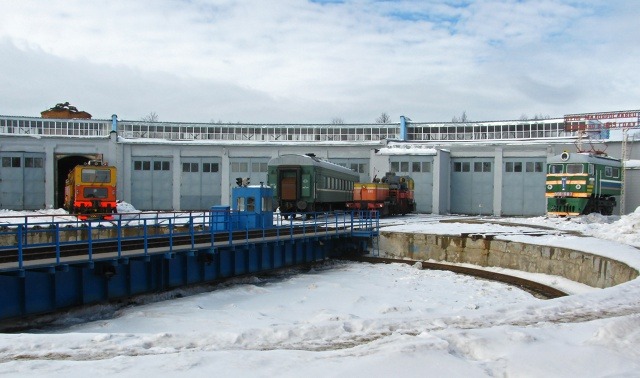
Modern mainline locomotives (electric and diesel) feature dual cabs, largely negating the need for turntables. However, they remain relevant for:
- Narrow-gauge trackside maintenance vehicles (often single-direction)
- Historical steam locomotive operations (though triangular turning has been favored since 2016 restoration programs began)
- Depot operations and heritage railways
Russian Railways continue limited production. The Kirov Factory manufactured a replacement KP25VA in 2019 for Moscow's Podmoskovnaya Museum Complex.
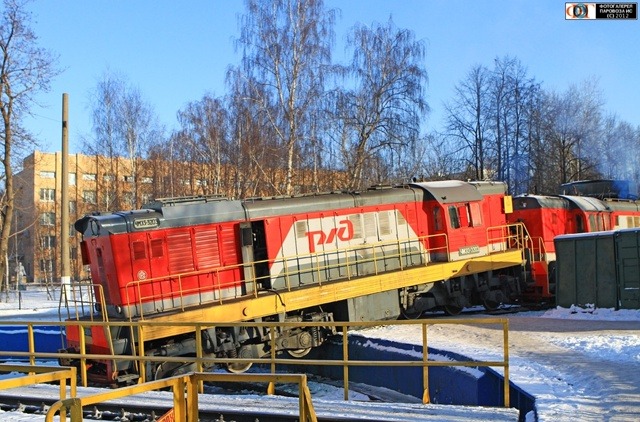
Active Russian turntables include:
- Lyublino depot (Kursk direction, two units)
- Moscow-Sortirovochnaya (Ryazan direction)
- Likhobory (Moscow Central Circle)
- Moscow-Kievskaya (near Studencheskaya metro)
- Depot imeni Ilyicha (Belarusian Station, restored in the 2010s)
Architectural Legacy

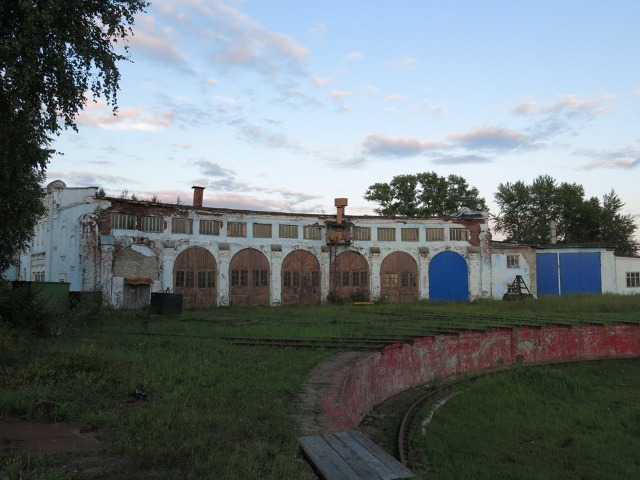
Fan depots remain striking industrial structures. The Circular Depot of the Nicholas Railway (Moscow, near Leningrad Station, built in the 1840s) sparked a major preservation controversy. Originally featuring a closed-ring stall arrangement with a central dome, it was damaged during "Sapsan" high-speed track expansion but eventually restored as a souvenir market with a reinstated dome.
The Railway Museum of Russia in St. Petersburg features a turntable as its primary exhibit and is architecturally styled as a fan depot. A major museum project in Yekaterinburg remains incomplete.
Conclusion
Turntables occupy a unique position in the history of technology. Most transportation innovations follow a predictable arc: invention, popularity, obsolescence, museum. Turntables, though severely diminished by the mid-20th century, cling to life in specific niches — track maintenance, heritage operations — becoming cultural artifacts for railroad enthusiasts and architectural historians alike.
And still they turn, persisting through technological change via specialization and nostalgia.