A Couple of Blunt Answers About Evolution
In school I loved biology, but evolution had an obvious problem: it's a greedy algorithm. How do you gradually grow half a wing? Why does a peacock have a useless tail? Here are the answers I wish I'd heard sooner.
In school I loved biology, but it had an obvious problem. Evolution is essentially a greedy algorithm that instantly rewards small improvements. Thousands of years of gradual improvements, and here before you is a platypus.
The problem is that it has an eye. And other complex organs. And birds have wings. And no greedy algorithm helps you understand how you can spend millennia growing half a wing. This thing doesn't just fail to help — it actively gets in the way.
A wing only works when it's complete. Half a wing doesn't get you off the ground.
There's a similar question about complex mutations. How can you change a couple of letters in code so that it suddenly becomes a polished library with something useful?
Or take the peacock's tail. How can you develop such a long useless thing that predators absolutely love? Shouldn't the surviving peacocks have become nimble and short-tailed?
I got my answers fairly late, but I remember how glad I was to hear them. And watching the ongoing flame war about Darwin's theory, I see many people asking the very same questions.
What Darwin Did
As a child he beat a puppy. Then he was tormented by guilt and loved animals. Every day.
Sorry.
Then he sailed to the Galapagos Islands and killed a certain number of birds. Carefully studying their beaks, he began seriously thinking about how species originate. I wrote about these islands here and encountered those very finches.
Today this sounds simple enough, but back then you couldn't just grab a couple of taxidermy specimens, show up at a meeting of the Royal Scientific Society and say: "See, the beaks are different? Yeah, so God doesn't exist!"
Skipping a couple of steps — he wrote a serious work On the Origin of Species, thereby laying the foundation for evolutionary theory, proposing the idea of human descent, and starting the fiercest flame war among primates.
His thinking was inspired by island isolates: on islands he and other researchers encountered only what existed in nearby sources, not the full diversity. A huge amount of data was collected for him by an equally epic character of the same historical period — a blind traveler. For the record, on the equivalent of a disability pension, while blind, he managed to travel nearly the entire known world.
The theory itself has long since become outdated several times over, because Darwin critically lacked data on heredity, epigenetics, complex systems, and so on. But the idea itself is brilliant at its core, and most importantly, it's excellently falsifiable. Meaning you can design experiments that confirm or refute the theory.
Darwin is incredibly cool.
Some of Darwin's ideas were refuted, but the main ones were confirmed. Darwin himself wrote that if a complete organ were found that could not have arisen through gradual changes, it would mean the theory needed revision.
"If it could be demonstrated that any complex organ existed, which could not possibly have been formed by numerous, successive, slight modifications, my theory would absolutely break down. But I can find no such case. No doubt many organs exist of which we do not know the transitional grades, more especially if we look to much-isolated species, round which, according to my theory, there has been much extinction. Or again, if we look at an organ common to all the members of a large class, for in this last case the organ must have been first formed at an extremely remote period, since which all the many members of the class have been developed; and in order to discover the early transitional grades through which the organ has passed, we should have to look to very ancient ancestral forms, long since become extinct."
But What About the Eye!
So the basic logic is simple: if you're developing something, it either gives an immediate advantage, or it gets filtered out by natural selection. At first glance, a wing seems to imply intelligent design — take a hedgehog, invest about 3,000 years in a useless organ, make it longer from generation to generation, and finally, take a running start and fly! Hooray hedgehogs, you're now birds!
In short, it turned out that things work a bit differently, and wings, Batman's cape on a flying squirrel, and other adaptations can indeed be obtained through sequential changes. For example, if half a wing or a quarter of a wing would let you jump from a tree a bit higher off the ground or glide an extra centimeter. Some creatures braked against the air with furry paws, some with thermal dissipation panels, some with gills (hello, arthropods) — and conditions formed where it became possible to develop a wing from a relatively small, non-aerodynamic growth on the body that was used for something else entirely.

To simplify, in one lineage it worked like this: first, thermal dissipation panels developed, which needed to be fairly large. Then those members of the species that had larger and more conveniently positioned panels survived better because they glided farther or landed more softly. Then, through mutations, the panels started changing in various ways, and those that turned out bigger, more parallel, more mobile, and generally even slightly more convenient for gliding gave a selection advantage. And from there we get wings.
When we got serious about genetics, all of this started looking much more logical, because genes that control wing development were found in wingless creatures. There, they were responsible for various other things.
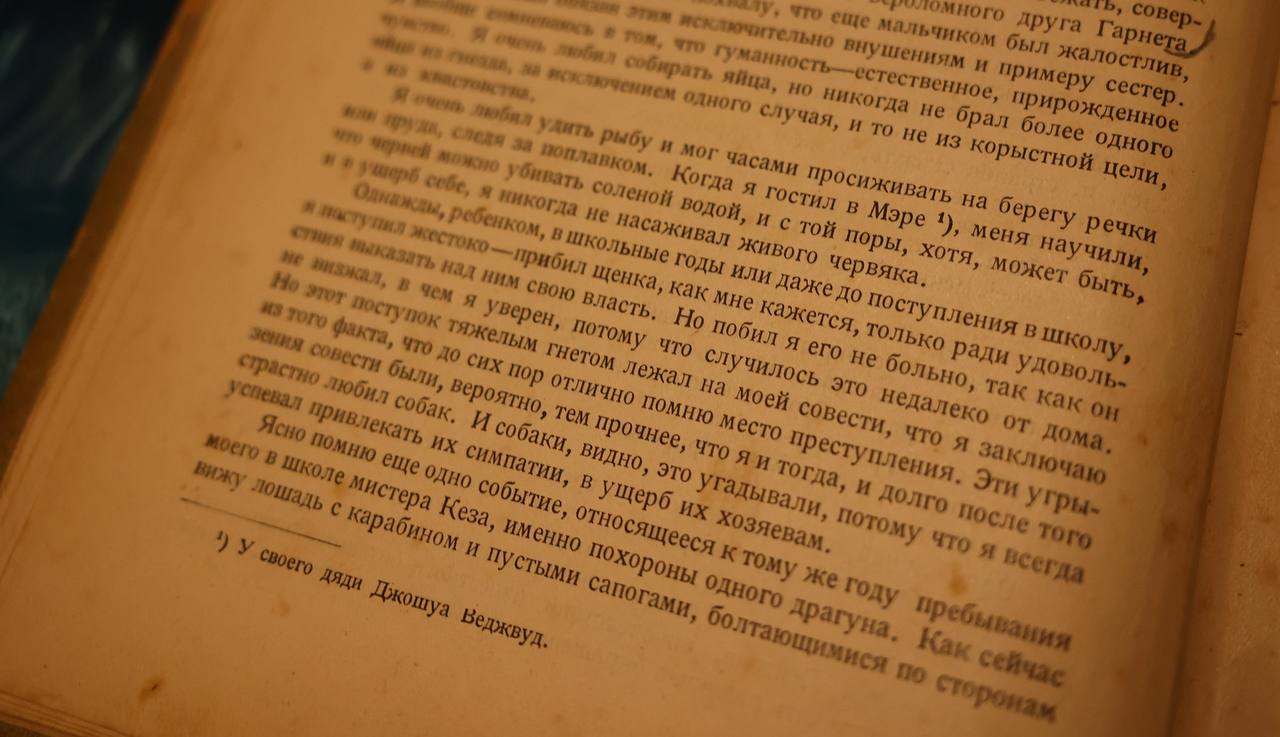
The eye evolved from a light-sensitive pixel to a modern system in roughly the same way. My favorite example is the distributed eye of the scallop — pixels along the edges of the shell. When something swims overhead, the shadow covers them one by one, and the scallop, like an old subway turnstile reading that sequence, understands it's time to close up.
There's an entire book about the eye by Dawkins — The Blind Watchmaker: Why the Evidence of Evolution Reveals a Universe without Design. In short — from individual photodiodes they progressed to recesses for determining direction, then to simple matrices, then a lens appeared, lens control, wavelength differentiation, and so on.
The examples of gene pre-adaptations are very interesting. At the molecular level, simplified: you have a piece of code. If there's only one copy in the DNA, don't touch it or you'll break everything. But if during assembly it accidentally gets duplicated, then the second copy isn't as critical — the organism survives without it. Think of it as a test environment and start recombining. For example, from the old default opsin you can make different opsins for different wavelengths and get color vision. From myoglobin, which attached oxygen to iron for storage in muscles, you can make a hemoglobin truck for transport through blood. Fish are even wilder: from a protein coding for the assembly of the digestive enzyme trypsinogen, the code duplicated many times, the copies drifted through mutations, and then suddenly this code started producing a protein that sticks to ice crystals instead of food. And you know what? The antifreeze protein allowed fluids in the fish to freeze at lower temperatures, so it now lives in Kamchatka and other regions where it's actually quite cold.
Nanomachines
When the problems with wings, eyes, and blood clotting were resolved by genetics, the question of the bacterial flagellum suddenly arose. This thing seemed unnatural because it has a rotating drive.
And Earth's biology isn't exactly rich in wheels and other freely rotating things.
To give you a sense of how strange this thing is, let me note a few things:
- It consists of a classic stator and rotor; the system has a diameter of about 50 nanometers
- It works exactly as a nano-electromotor should, at speeds up to 60,000 RPM. Efficiency up to 65%.
- It's powered by a proton gradient or sodium ion gradient (chemical electricity).
- Self-repair (it's a biological system, after all)
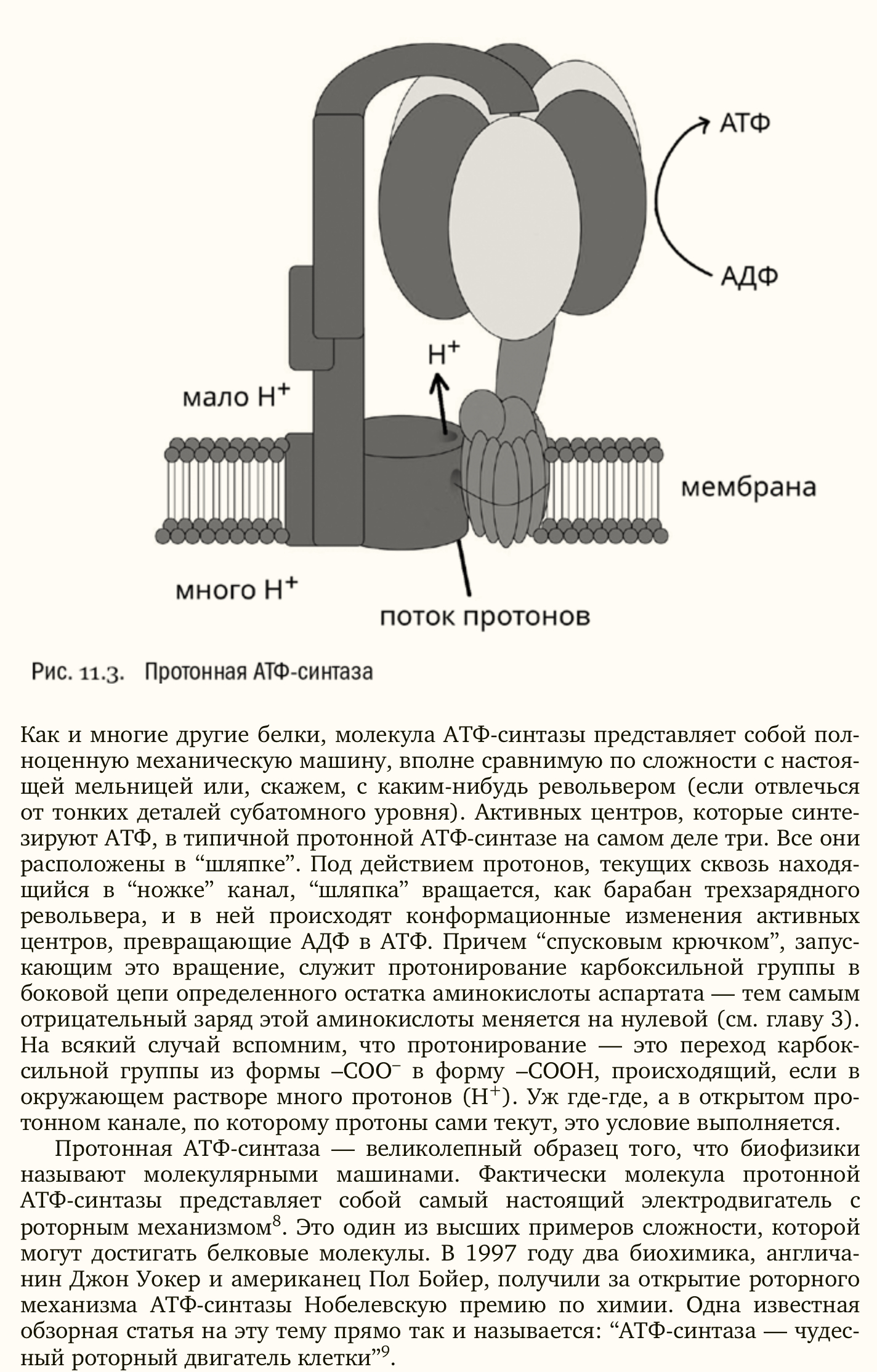
We actually know many nanomachines. What blew my mind was ATP synthase, which exists in your cells:
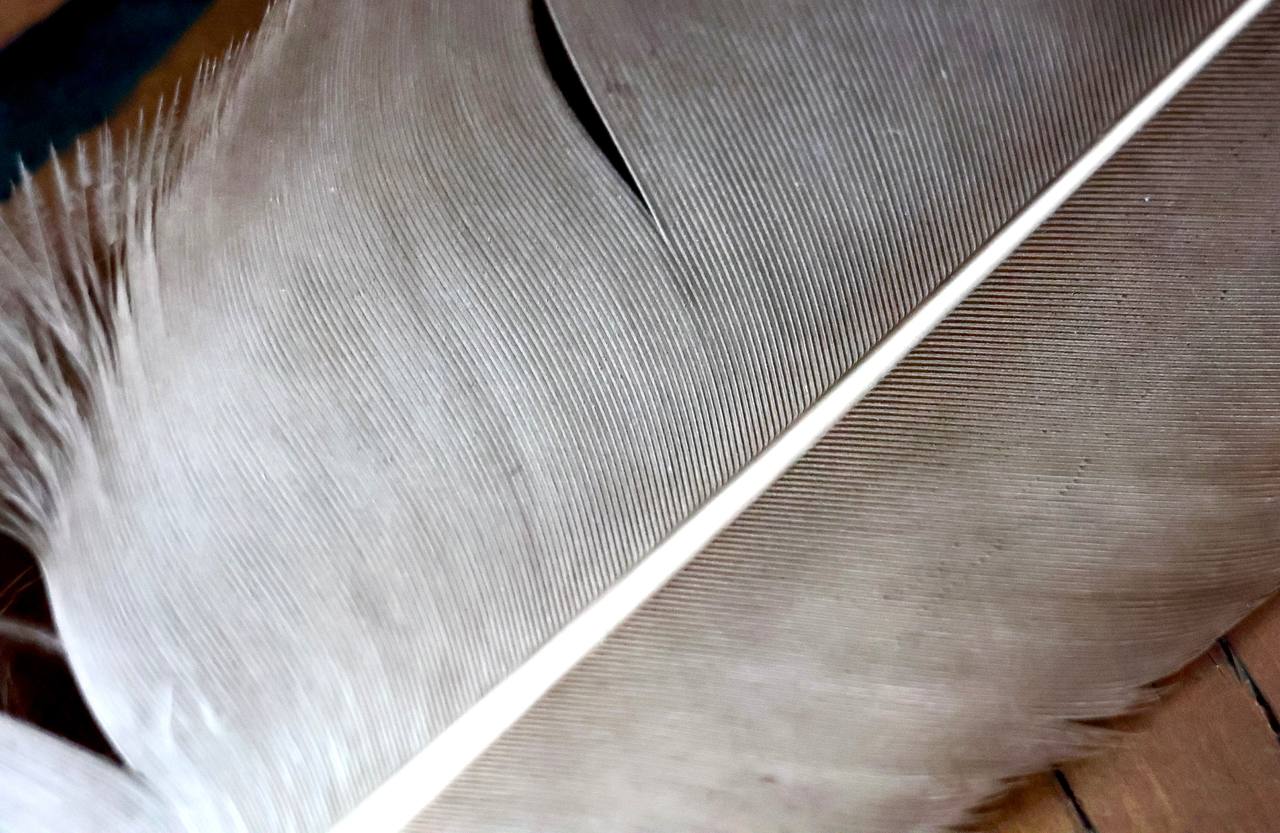
A quote from the book From Atoms to Trees by Sergei Yastrebov. Highly recommended.
Know what this resembles?
Spoiler
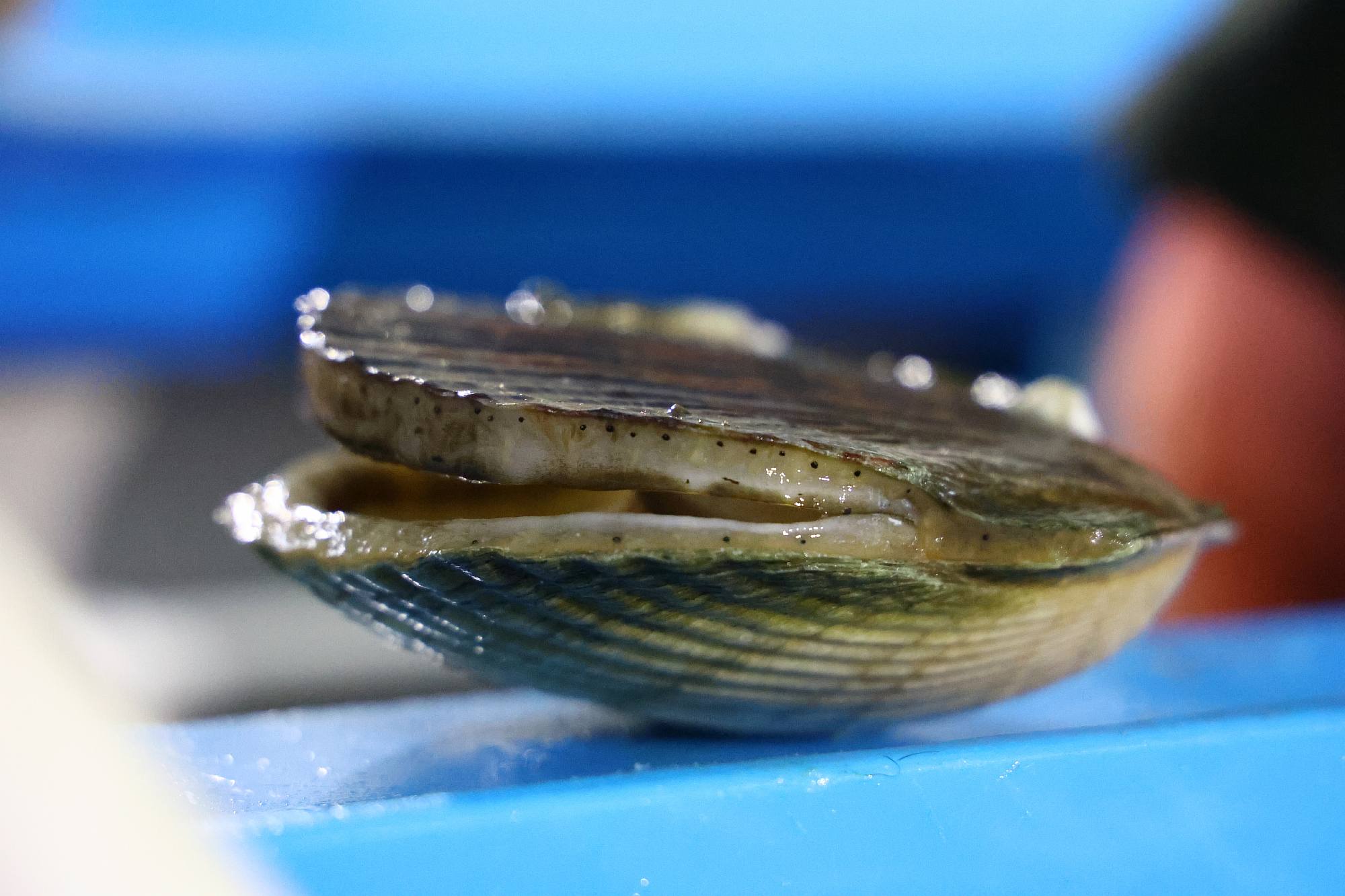
But while with ATP synthase there are simpler machines that can be reassembled into this through coevolution, fusion, or direct injections of foreign code (horizontal gene transfer), in the case of the flagellum no simpler forms were found. More precisely, the Type III secretion system was found, which is mechanically similar, but there's currently a debate whether it appeared after the flagellum or served as spare parts for it. In short, the flagellum is exactly what creationists are clinging to with all their might right now.
The Argus Wing
So there's this creature:
Male argus with a long wing, photograph by Francesco Veronesi from Wikimedia Commons
This bird goes against natural selection because it grew wings (in the photo they look like a tail) that are useless for individual survival.
The principle is this:
- The bigger this wing, the more noticeable the pheasant.
- The bigger the wing, the slower it takes off.
- So the bigger the wing, the more often it gets eaten.
- And the more often it gets eaten, the smaller its wing should be.
- If it's still alive, by classical natural selection we should see optimally aerodynamic wings.
But here's where sexual selection matters. The argus uses this ornament to compete for a mate. The more it shows off — what an enormous wing and how brilliantly it survives with it — the greater the chances it's genuinely strong and healthy. Females choose the most promising one (meaning strong and healthy, because pheasants don't have bank accounts) and thereby reinforce the genes for an enormous wing. Size matters.
So what we're seeing now is a kind of optimum — the boundary between macho pheasants who are desperately managing to persevere and survive, but if you add a couple more centimeters, they statistically get eaten before they reproduce.
Don't underestimate sexual selection. Nor other factors like genetic drift, evolutionary bottlenecks (when only hundreds of individuals of a species remain, like the Voronezh beavers — progenitors of all European beavers), and so on.
Where Are the Intermediate Forms?
Another common question about classical evolution — where is the entire multitude of smoothly transitioning animals in the paleontological record? Why do we see discrete steps rather than smooth transitions?
This, too, is fairly explainable:
- First, it's not like we have infinite resolution in our fossil finds. We often find literally single specimens of something we can play with like a construction set.
- Second, there's the concept of rapid changes, where for most of their time, species exist in equilibrium — meaning they change insignificantly. But when conditions shift (for example, environmental change), fairly rapid shifts occur on a paleontological timescale. Since the log is saved at a low sampling rate, we see it as a step-like transition.
The classic example of rapid evolution is bacterial adaptation to antibiotics. Granted, we're the ones applying the pressure, but I recently wrote about that. And there, by the way, pay attention to horizontal gene transfer — it resolves another batch of questions about the molecular side of evolutionary processes.
The Fittest Survives
Another thing people sometimes forget. "Survival of the strongest" is a mistranslation. It's fittest, meaning the most adapted.
This means a creature can become more complex, improve, and generally become more interesting from an engineering standpoint — and then get optimized down to something simpler. The modern crocodile, for example, is a simplification of a more complex ancestor that had warm blood (separation of venous and arterial blood flow) and other features. Because it was precisely the CRmini with long battery life that turned out better than the CRpro with loads of features but very energy-hungry muscles. I roughly estimated that the modern crocodile consumes about 0.5 kWh per day. The big one probably consumed around 4–6 kilowatt-hours, so let's honor its memory.
What survives and endures is whatever fits the environment best across the totality of factors. Evolution has no purpose — it's a reaction to changing external circumstances, an accumulation of small changes, mutation randomness — but through it all, several filtering mechanisms ensure the selection of the most adapted to current circumstances. Accordingly, circumstances then change partly under the influence of those who adapted to them.
What's Next
There's a whole lot more we've learned since Darwin — for example, about epigenetics; multilevel selection has been proposed (where RNA plays the role instead of reptiloids); that very horizontal gene transfer; that very punctuated development; and so on.
You can compare this to how physics is taught in school and beyond:
- Preservation of a beneficial trait — that's like Aristotelian physics, where bodies move only under the application of force, and experiments are postponed. Not taught.
- Darwin's theory — like Newtonian physics: convenient for explaining to a schoolchild, generally applicable, but not very precise by modern standards.
- And this whole mix with the synthetic theory of evolution and beyond — those are the analogs of general relativity and what came after. Enjoy.
Right now I feel somewhat obligated to outline these things, because my text about "You're Writing Animals Wrong" suddenly started making the rounds on the Russian internet again. This time — as an argument against intelligent design in light of the recent flame war.
More Texts
I've written quite a bit about animals, and here are those texts:
- Octopus, a candidate from the Fourier series.
- Beavers, wild terraformers who reshape the planet into their own.
- Wildebeest and crocodiles, a decision-making system.
- Snake, a cute warm creature in a spacesuit.
- Mammoth Ivanych, born in Russia. A very good example of mammoth evolution with intermediate forms due to a changing environment.
- Saigas, antelopes in gas masks.
- A not-very-smart finch whose range matters critically.
- Dog and shaback (airport sniffing special equipment).
- Wisents (cows with devil faces weighing nearly a ton).
- Mating turtles.
- Mangrove forest.
- A transfer hub for birds.
- And silkworm farming.
Books
I highly recommend the already mentioned From Atoms to Trees by Sergei Yastrebov, The Sum of Biotechnology by Panchin, Dawkins at minimum The Selfish Gene and everything you can get your hands on by Sapolsky. And if you recommend something in the comments — that would be awesome. Thanks in advance!
UPDATE:
DVIsa recommends:
- The Phenomenon of Science: A Cybernetic Approach to Evolution — V.F. Turchin
- The Active Connected World — Yu.V. Chaikovsky (he's not a biologist but a historian of science — which allows for a different perspective on the history of developing ideas)
- Selected Works on Paleoecology — V.V. Zherikhin (who said individual species evolve? No, the biota evolves as a whole!)
alche: Evgeny Kunin, The Logic of Chance: The Nature and Origin of Biological Evolution. A very useful book.
victor-homyakov: Alexander Markov, The Birth of Complexity: Evolutionary Biology Today — Unexpected Discoveries and New Questions.
Wizard_of_light: Mikhail Nikitin, The Origin of Life: From Nebula to Cell.
mrdredd11: The Mating Mind by Geoffrey Miller.
aio350: The Clap of One Palm by Nikolai Kukushkin.